
ctl_ctloutput-leak
 bazad/ctl_ctloutput-leak
CVE-2017-13868: Information leak of uninitialized kernel heap data in XNU.
binary-exploitationexploitationinformation-gathering+2
27
bazad/ctl_ctloutput-leakCVE-2017-13868: Information leak of uninitialized kernel heap data in XNU.
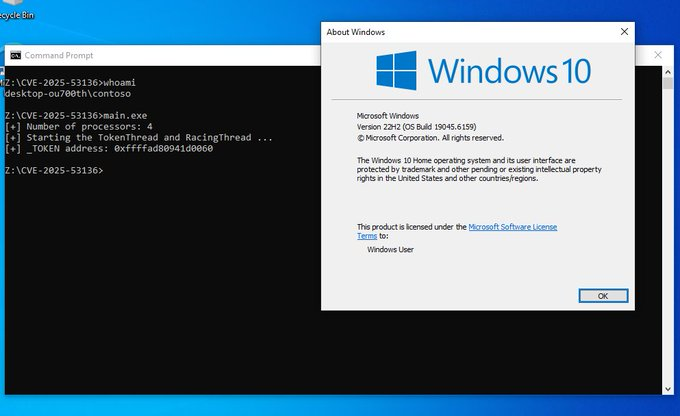 nu1lptr0/cve-2025-53136
Kernel Information Disclosure
 feliam/cve-2014-4378
Exploit analysis for CVE-2014-4378: information disclosure in Apple CoreGraphics via crafted PDF, enabling memory layout leak and bypass of ASLR,…
 freeide/cve-2021-31955-poc
Proof-of-concept exploit for CVE-2021-31955, a Windows kernel information disclosure vulnerability. Demonstrates exploitation on 64-bit systems to…
 hyunjungg/cve-2023-21688
Exploit for CVE-2023-21688 combining a side-channel information leak with a use-after-free (UAF) chain for kernel privilege escalation.
 dothanthitiendiettiende/cve-2019-6207
Exploit for CVE-2019-6207: kernel heap information leak in getdirentriesattr on macOS <=10.14.4 and iOS <12.2, triggerable from sandbox.
 datntsec/cve-2020-1206
Technical analysis of CVE-2020-1206 (SMBleed) kernel information disclosure vulnerability in Windows SMBv3, including unauthenticated memory leak…
 abdurahmon3236/cve-2024-44947
Proof-of-concept exploit for Linux kernel FUSE information leak (CVE-2024-44947), demonstrating beyond-EOF memory disclosure via mmap and including…
 sashs/ropper
Display information about files in different file formats and find gadgets to build rop chains for different architectures (x86/x86_64, ARM/ARM64,…
 pablomk7/enlbufferpwn
Information and PoC about the ENLBufferPwn vulnerability
 xuechiyaobai/cve-2019-9810-poc
Array.prototype.slice wrong alias information.
 hacksysteam/cve-2021-45067
Exploit for Adobe Reader DC out-of-bounds read vulnerability (CVE-2021-45067) that leaks sensitive information from the sandboxed process via…
 randorisec/cve-2022-1972-infoleak-poc
Proof-of-concept exploit for CVE-2022-1972, a kernel information leak in the Netfilter subsystem. Demonstrates unprivileged user namespace…
 sandumjacob/cve-2023-2033-analysis
A collection of resources and information about CVE-2023-2033
 hackspeak/cve-2026-14669
Proof-of-concept exploit for CVE-2026-14669, a PostgreSQL to_char() timezone abbreviation heap buffer overflow enabling RCE through information leak…
 ngtuonghung/cve-2022-4543-entrybleed
C-based proof-of-concept exploit for CVE-2022-4543 (EntryBleed), a Linux kernel vulnerability enabling information disclosure and potential privilege…
 prabhashaka/exploitation-cve-2020-8835
Exploit code for CVE-2020-8835, a Linux kernel information disclosure vulnerability, demonstrating the flaw and its exploitation.
 otofoto/cve-2010-5230
Multiple untrusted search path vulnerabilities in MicroStation 7.1 allow local users to gain privileges via a Trojan horse (1) mptools.dll, (2)…