 omar2535/graphqler
☸The first ever dependency-aware GraphQL API testing tool!


The only dependency-aware GraphQL API testing tool!



GraphQLer is a cutting-edge tool designed to dynamically test GraphQL APIs with a focus on adaptability. It offers a range of sophisticated features that streamline the testing process and ensure robust analysis of GraphQL APIs. GraphQLer proficiently manages created objects and resources, effectively identifies dependencies on objects, queries, and mutations, and dynamically rectifies errors within queries based on the API's restrictions. GraphQLer has been used to find many bugs in production-grade GraphQL APIs!
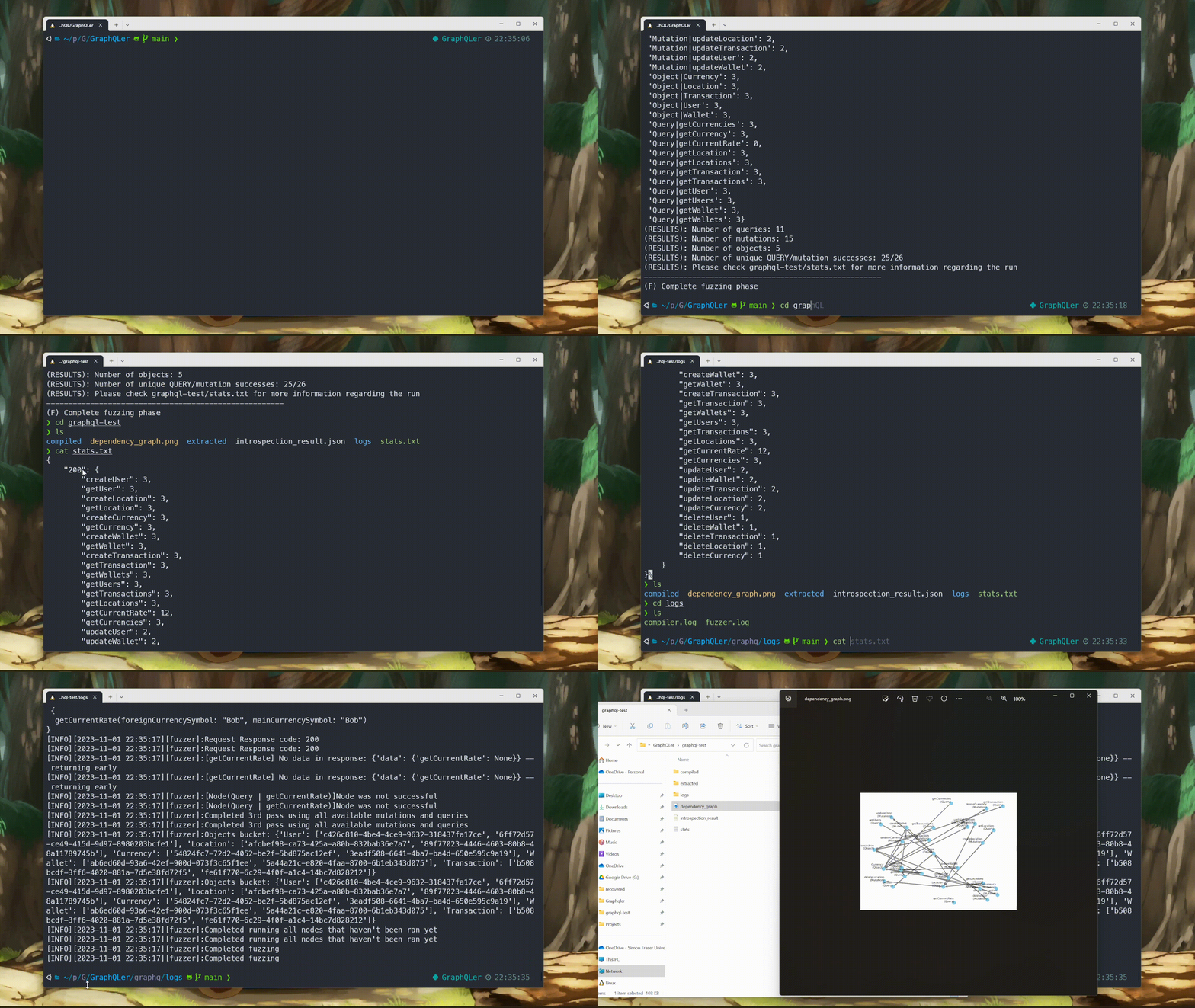
To begin using GraphQLer, check out the installation guide.
❯ python3 main.py --help
usage: main.py [-h] [--compile] [--fuzz] [--run] --path PATH [--auth AUTH] --url URL

options:
  -h, --help   show this help message and exit
  --compile    runs on compile mode
  --fuzz       runs on fuzzing mode
  --run        run both the compiler and fuzzer (equivalent of running --compile then running --fuzz)
  --path PATH  directory location for saved files and files to be used from
  --auth AUTH  authentication token Example: 'Bearer arandompat-abcdefgh'
  --url URL    remote host URL
Below will be the steps on how you can use this program to test your GraphQL API. The usage is split into 2 phases, compilation and fuzzing.
A third mode is also included for ease of use, called run mode. this mode compiles both the compilation and fuzzing mode into one single command.
(.env) python main.py --compile --url <URL> --path <SAVE_PATH>
After compiling, you can view the compiled results in the <SAVE_PATH>/compiled. Additionally, a graph will have been generated called dependency_graph.png for inspection. Any UNKNOWNS in the compiled .yaml files can be manually marked; however, if not marked the fuzzer will still run them but just without using a dependency chain.
(.env) python main.py --fuzz --url <URL> --path <SAVE_PATH>
While fuzzing, statistics related to the GraphQL API and any ongoing request counts are logged in the console. Any request return codes are written to <SAVE_PATH>/stats.txt. All logs during fuzzing are kept in <SAVE_PATH>/logs/fuzzer.log. The log file will tell you exactly which requests are sent to which endpoints, and what the response was. This can be used for further result analysis.
Runs both the Compile mode and Fuzz mode
(.env) python main.py --run --url <URL> --path <SAVE_PATH>
There are also varaibles that can be modified in the constants.py file. These correspond to specific features implemented in GraphQLer, and can be tuned to your liking.
| Variable Name | Variable Description | Variable Type | Default |
|---|---|---|---|
| MAX_LEVENSHTEIN_THRESHOLD | The levenshtein distance between objects and object IDs | Integer | 20 |
| MAX_OBJECT_CYCLES | Max number of times the same object should be materialized in the same query/mutation | Integer | 3 |
| MAX_OUTUPT_SELECTOR_DEPTH | Max depth the query/mutation's output should be expanded (such as the case of infinitely recursive selectors) | Integer | 3 |
| USE_OBJECTS_BUCKET | Whether or not to store object IDs for future use | Boolean | True |
| USE_DEPENDENCY_GRAPH | Whether or not to use the dependency-aware feature | Boolean | True |
| MAX_FUZZING_ITERATIONS | Maximum number of fuzzing payloads to run on a node | Integer | 5 |
| MAX_TIME | The maximum time to run | Integer | 3600 |
