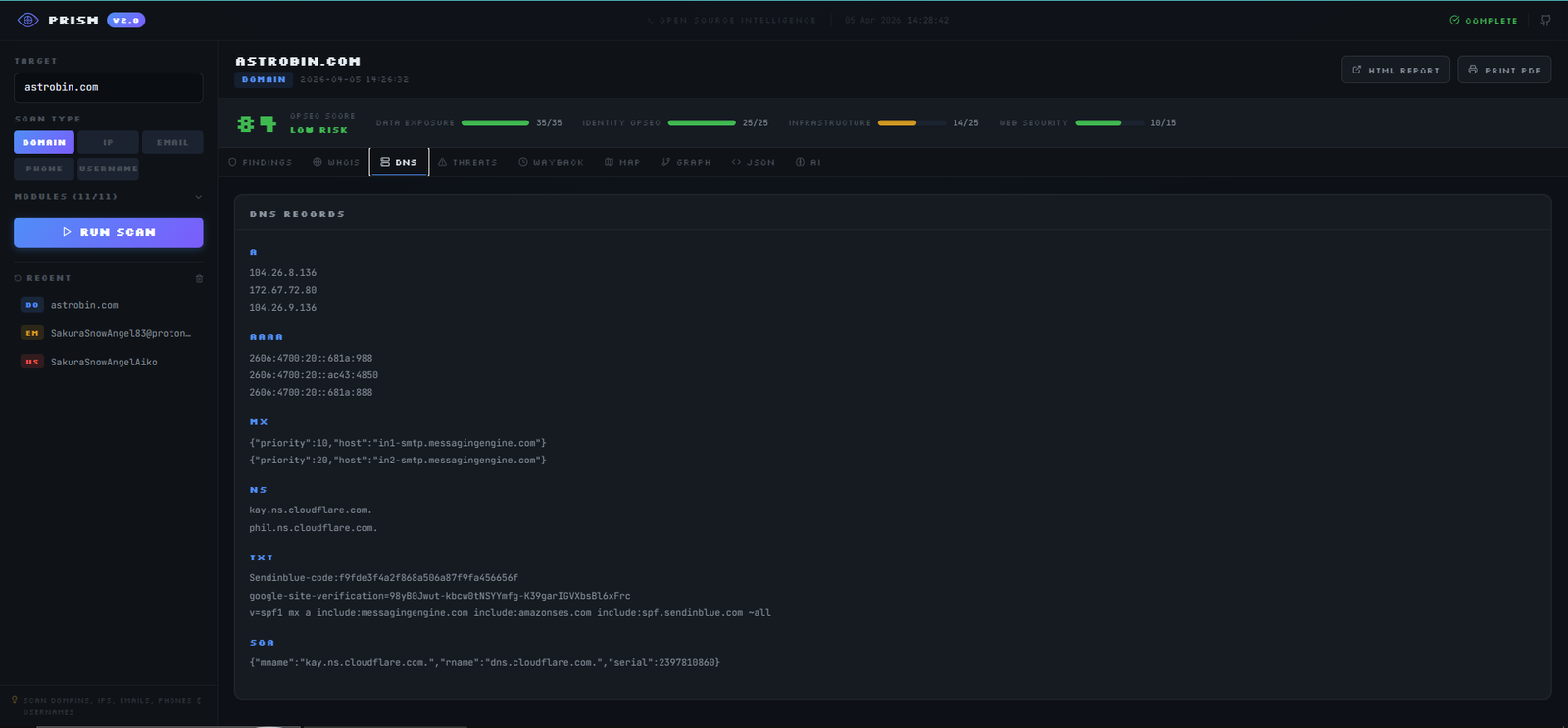


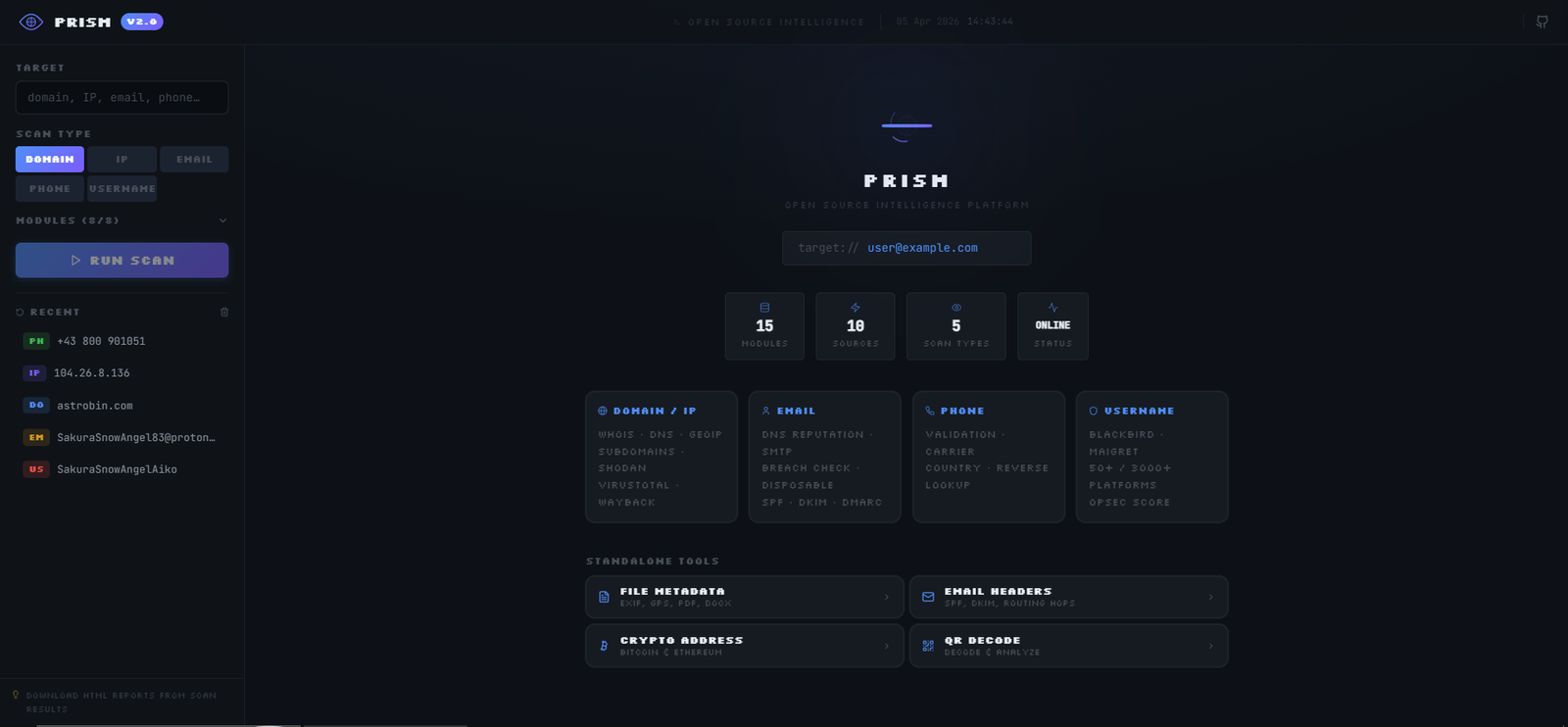
Self-hosted OSINT platform. Point it at a domain, IP, email, phone or username and 26 modules run in parallel: WHOIS, DNS, threat intel, breaches, username search. One dashboard, an exposure score, an entity graph, HTML and PDF reports.
Self-hosted OSINT platform with 26 modules, OPSEC scoring, AI summary, and a real-time web dashboard.
Scan a domain, IP, email, phone or username and get WHOIS, DNS, threat intel, breach data, username search, dark-web mirrors, OPSEC score, entity graphs, and HTML/PDF reports in seconds.
Live Demo · Docker Quick Start · Configuration · Architecture · Security · Changelog · FAQ




AI analysis on the live demo can be slow. The demo server sits in a region every hosted LLM provider blocks, so its AI calls are routed out through a proxy before they reach a model. It works, it is just slower than a normal instance, so give the summary a minute. A self-hosted instance with your own provider responds at full speed. See the FAQ.
Also from me: Claude Security Skills, eight security skills for Claude Code that also run in CI. It runs in CI as a GitHub Action,
uses: NovaCode37/claude-security-skills@v1, that puts secret-scanning and Python SAST findings on the exact line of your pull request; 1.4.0 addsgo.modsupport and catches HTTP calls without a timeout. Standard library only, nothing to install.
Why PRISM? • Overview • How it compares • Use cases • Features • Screenshots • Quick Start • Configuration • API • Project Structure • Running Tests • CI/CD • Roadmap • Star History • Legal Notice • Support the project • Contributing • Credits • License
python cli.py scan example.com --json, manage scheduled re-scans with python cli.py watchlist add example.com --interval 6, and see which modules -m accepts and which are missing an API key with python cli.py modulesX-API-Key / Bearer), no query-string secrets, strict CORS, per-principal scan isolationdocker run ghcr.io/novacode37/prism-platform with nothing to build (amd64 and arm64)modules/PRISM queries 20-odd external sources and puts what comes back in one place. Targets can be a domain, an IP, an email, a phone number or a username. Results land in a dashboard as they arrive, with a relationship graph, a GeoIP map, an exposure score and HTML or PDF export.
Stack:
flowchart LR
    U[User / Browser] -->|HTTPS + X-API-Key| FE[Next.js 15 Dashboard]
    FE -->|REST + WebSocket| API[FastAPI Backend]
    API --> SCH[Scan Orchestrator<br/>asyncio + queues]
    SCH --> MOD[26 OSINT Modules]
    MOD --> EXT[(External APIs<br/>Shodan / VT / Censys<br/>crt.sh / Wayback / etc.)]
    SCH --> CACHE[(Module Cache<br/>TTL JSON)]
    SCH --> STORE[(Scan Storage<br/>per-principal)]
    SCH --> WH[Webhook Dispatcher<br/>HMAC + SSRF guard]
    API --> AI[AI Summary / Chat<br/>OpenRouter / Groq]
    API --> RPT[Report Generator<br/>HTML + xhtml2pdf]
SpiderFoot, theHarvester, Recon-ng and Maltego all cover ground PRISM does, and several of them cover it better. theHarvester and Recon-ng are CLI tools and comfortable to script around. SpiderFoot has far more modules. Maltego's graph work is a different league.
What PRISM does that those generally do not: results stream into a browser while the scan runs, everything is one container with no keys required to get started, and the scan ends with a report you can hand to someone who is not an analyst. If you want depth and already live in a terminal, SpiderFoot or Recon-ng is probably the better tool. If you want to point something at a domain and read the answer, this is built for that.

