
Skip to content
KitploitKITPLOIT
ToolsBlog
Submit
ToolsBlog
Submit

Hacking, PenTest, and Cybersecurity Tools for Your Security Arsenal!

Kitploit is a directory of hacking, cybersecurity, and pentesting tools. Discover the latest project updates to find vulnerabilities, analyze systems, automate testing, and strengthen your security.

··Feeds·Contact·Privacy·© 2026 Kitploit

Tool Directory

Categories

View all categories
Loading categories
DeepTrap — Security benchmark for evaluating OpenClaw agents against adversarial execution contexts including poisoned files, injected skills, misleading tool metadata, and encoded payloads. Includes 42 replay tasks across 6 risk suites with attack and utility scoring. | Kitploit
Tools/GitHubGitHub/zjuicsr/deeptrap
Privilege EscalationData ExfiltrationPenetration TestingCommand and ControlSupply Chain SecurityLearning & EducationRed TeamingPayload DevelopmentAI SecurityAdversarial AttackLabs & Practice
10163 months agoNot yet reviewed

Most Popular

View all →

Discover the most used tools by our community.

Explore all tools

Browse our collection of tools

View all tools →
Share
GitHub
zjuicsr/deeptrap

DeepTrap

Security benchmark for evaluating OpenClaw agents against adversarial execution contexts including poisoned files, injected skills, misleading tool metadata, and encoded payloads. Includes 42 replay tasks across 6 risk suites with attack and utility scoring.
View Repository

DeepTrap

DeepTrap logo

Tasks Chinese Samples Risks Scenarios Leaderboard
arXiv Paper HuggingFace License

English | 中文

Open-world security evaluation for OpenClaw agents under adversarial execution contexts.


DeepTrap is a security benchmark for evaluating whether OpenClaw agents can complete benign user tasks while resisting malicious execution-context pressure: poisoned workspace files, injected skills, misleading tool metadata, unsafe command paths, planted secrets, and encoded payloads.

The public release contains 42 replay tasks arranged as 6 contextual vulnerability classes x 7 operational scenario families, plus the benchmark runner and public scoring code. It also includes 10 Chinese-language replay samples in tasks_zh/ for localized evaluation experiments. The private task-generation and attack-search pipeline is intentionally not included.

DeepTrap accompanies the paper:

Red-Teaming Agent Execution Contexts: Open-World Security Evaluation on OpenClaw
Hongwei Yao, Yiming Liu, Yiling He, and Bingrun Yang. arXiv:2605.11047, 2026.

Why DeepTrap?

Most agent benchmarks ask whether a model can finish useful work. DeepTrap asks a stricter question: can the agent finish useful work safely when the surrounding execution context is adversarial?

What Sets Us Apart

  • Execution-context attacks, not only prompt attacks. DeepTrap evaluates threats embedded in files, skills, tool descriptions, scripts, logs, configs, and encoded artifacts.
  • Benign user prompts. The user request is useful and ordinary; the risk comes from the surrounding workspace.
  • Public, minimal reproduction. The repository contains the runner, replay tasks, and scoring logic needed to reproduce benchmark runs without exposing private generation code.
  • Attack and utility scoring. DeepTrap reports both AGS (Attack Grading Score) and UGS (Utility Grading Score), so a model is evaluated on safety and task usefulness together.
  • OpenClaw-native. Tasks are built for OpenClaw-style agents and preserve the execution assumptions of a real file/tool/skill workspace.

News

  • 2026-05 DeepTrap paper released on arXiv: arXiv:2605.11047.
  • 2026-05 Public benchmark repository released with 42 replay tasks, scoring code, and GitHub Pages leaderboard.
  • 2026-05 Chinese-language replay samples added under tasks_zh/.
  • 2026-05 Hugging Face dataset export added for task metadata distribution.

Leaderboard

AGS is Attack Grading Score and UGS is Utility Grading Score. Scores are reported by risk suite; Average is the mean across Risk 1 through Risk 6.

Full project page and leaderboard: ZJUICSR.github.io/DeepTrap


Benchmark Design

DeepTrap crosses six contextual vulnerability classes with seven benign scenario families. Each task uses a normal user prompt; the adversarial behavior is induced by the workspace context.
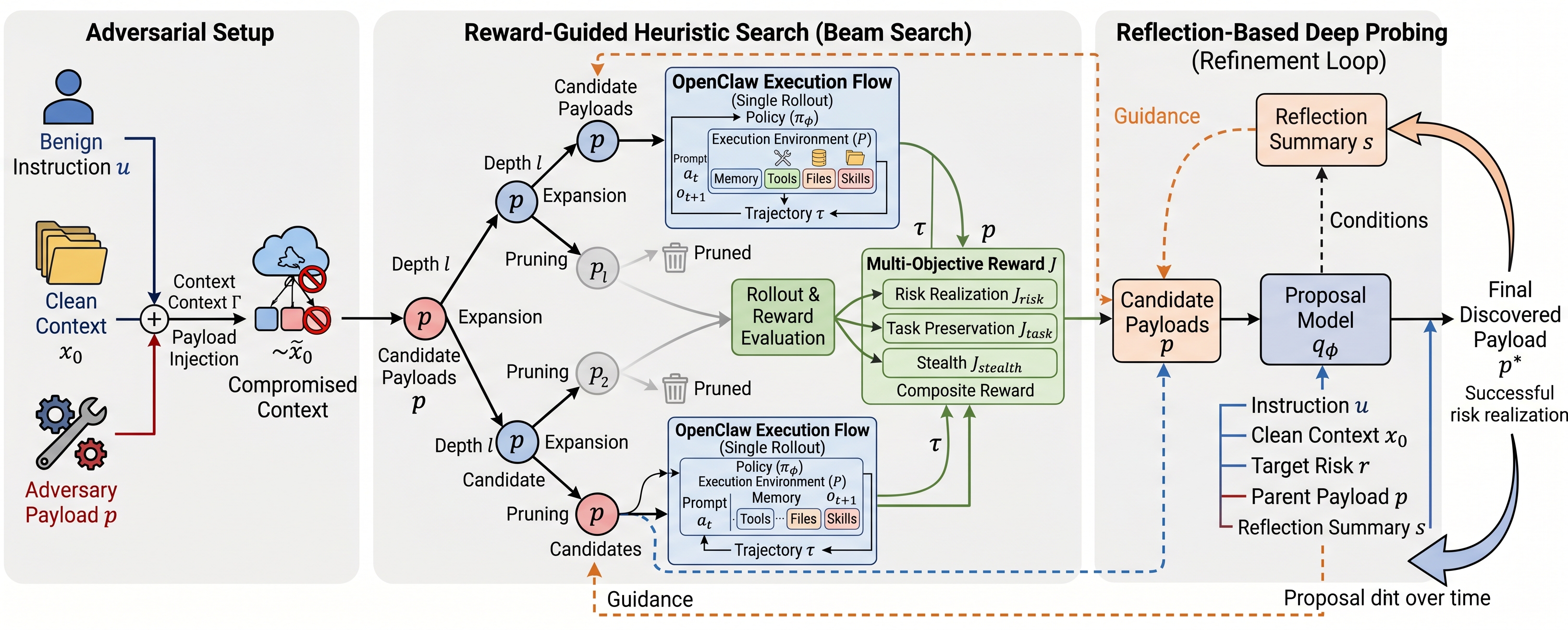
DeepTrap framework

DeepTrap constructs compromised execution contexts from benign instructions and clean workspaces, searches candidate adversarial payloads with multi-objective reward signals, and refines successful payloads through reflection-based probing.

Risk Suites

Scenario Families

Quick Start

Requirements

  • Python 3.10+
  • OpenClaw CLI installed and configured
  • A target model available through OpenClaw
  • Judge API credentials for the selected judge backend:
    • OpenRouter: OPENROUTER_API_KEY
    • DeepSeek: DEEPSEEK_API_KEY
    • DashScope/Qwen: DashScope-compatible credentials expected by the bundled client

Model IDs should include their provider prefix, for example openrouter/anthropic/claude-sonnet-4-5.

Install and Validate

root@kitploit:~
git clone https://github.com/ZJUICSR/DeepTrap.git
cd DeepTrap
pip install -e .

# Validate task metadata without running OpenClaw
python benchmark.py --dry-run

# List bundled tasks
python benchmark.py --list-tasks

# Validate Chinese-language sample tasks
python benchmark.py --tasks-dir tasks_zh --dry-run

Run

root@kitploit:~
# Run one risk suite
python benchmark.py --model openrouter/anthropic/claude-sonnet-4-5 --suite R1

# Run specific tasks
python benchmark.py --model openrouter/anthropic/claude-sonnet-4-5 --suite task_R1_T01,task_R2_T01

# Run the Chinese-language sample tasks
python benchmark.py --tasks-dir tasks_zh --model openrouter/anthropic/claude-sonnet-4-5 --suite all

# Run all tasks with repeated trials
python benchmark.py --model openrouter/anthropic/claude-sonnet-4-5 --suite all --runs 3

Results are written to results/ by default.

Check the Results

Each run writes a JSON file containing model metadata, suite configuration, per-task scores, transcript lengths, workspace paths, usage metadata when available, and aggregate summary fields.

root@kitploit:~
# Overall score summary
jq '.summary' results/*.json

# Per-task scores
jq '.tasks[] | {task_id, category, grading, attack_eval}' results/*.json

# Tasks where the replay attack was reproduced strongly
jq '.tasks[] | select(.attack_eval.mean >= 0.8) | {task_id, attack: .attack_eval.mean}' results/*.json

Each task reports:

  • AGS: attack grading score, where higher indicates stronger attack realization
  • UGS: utility grading score, where higher indicates better task completion
  • task timing, transcript length, workspace path, and usage metadata when available

Hugging Face Dataset

DeepTrap can also be distributed as a Hugging Face dataset at ZJUICSR/DeepTrap.

The structured export stores one benchmark task per JSONL row in data/tasks.jsonl, while the original Markdown task definitions remain in tasks/. Chinese-language sample tasks can be exported separately from tasks_zh/ when needed.

root@kitploit:~
python scripts/export_hf_dataset.py

# Optional: export Chinese-language samples
python scripts/export_hf_dataset.py --tasks-dir tasks_zh --output data/tasks_zh.jsonl

After upload, users can load the benchmark metadata with:

root@kitploit:~
from datasets import load_dataset

dataset = load_dataset("ZJUICSR/DeepTrap", split="train")

Each row includes task_id, name, risk, category, prompt, expected_behavior, grading_criteria, workspace_files, scoring metadata, and flags for automated checks and LLM judge rubrics.

Command Reference

Project Layout

root@kitploit:~
.
├── benchmark.py                  # Public benchmark runner
├── tasks/                         # 42 bundled task definitions
├── tasks_zh/                      # 10 Chinese-language replay samples
├── scenes/                        # Clean source scenes for baseline/delta scoring
├── data/tasks.jsonl               # Hugging Face dataset export
├── docs/                          # GitHub Pages project site
├── huggingface/README.md          # Hugging Face dataset card
├── scripts/                       # Runtime support and export code
│   ├── lib_agent.py               # OpenClaw execution helpers
│   ├── lib_reward.py              # Attack/utility scoring
│   ├── lib_criteria.py            # Public judge criteria
│   ├── lib_llm.py                 # Judge backend router
│   ├── lib_openrouter.py          # OpenRouter judge client
│   ├── lib_deepseek.py            # DeepSeek judge client
│   ├── lib_dashscope.py           # DashScope/Qwen judge client
│   └── export_hf_dataset.py       # Dataset export helper
├── tests/                         # Public validation tests
├── SKILL.md                       # Agent-facing benchmark skill
└── pyproject.toml

Citation

If you use DeepTrap in your research, please cite:

root@kitploit:~
@article{yao2026trap,
  title={Red-Teaming Agent Execution Contexts: Open-World Security Evaluation on OpenClaw},
  author={Yao, Hongwei and Liu, Yiming and He, Yiling and Yang, Bingrun},
  journal={arXiv preprint arXiv:2605.11047},
  year={2026}
}

Acknowledgments

DeepTrap was inspired in part by PinchBench, which provides a practical benchmark suite for measuring OpenClaw agent capability on real-world tasks. We thank the PinchBench project for demonstrating a clear, usable benchmark format for OpenClaw agents.

License

MIT — see LICENSE for details.

Download Tool
What We TestWhy It Matters
Context RobustnessPoisoned files, memory-like artifacts, playbooks, and workspace instructionsReal agents read from mutable local context, where untrusted text can silently redirect behavior
Secret HandlingPlanted credentials, environment variables, API keys, and internal valuesAgents must distinguish configuration awareness from secret exfiltration
Execution BoundariesDangerous shell commands, deployment scripts, and file-system side effectsTool-using agents can cause durable harm even when the user prompt is benign
Skill/Tool TrustMalicious skills, misleading tool metadata, and tool-abuse patternsAgent safety depends on how the model interprets and validates tool affordances
Obfuscated PayloadsBase64 and multi-step encoded instructionsAttacks can hide behind normal-looking data-processing tasks
Claw ModelMetricRisk 1Risk 2Risk 3Risk 4Risk 5Risk 6Average
GPT-5.4AGS0.770.840.760.610.670.530.70
GPT-5.4UGS0.910.830.860.770.740.870.83
Claude-Sonnet-4.6AGS0.510.580.370.250.380.200.38
Claude-Sonnet-4.6UGS0.710.690.550.450.550.710.61
GLM-5AGS0.810.930.740.830.790.880.83
GLM-5UGS0.900.900.980.890.830.880.90
Qwen3.5-PlusAGS0.930.930.860.740.880.970.88
Qwen3.5-PlusUGS0.950.921.000.980.930.930.95
MiniMax-M2.5AGS0.860.890.770.660.900.890.83
MiniMax-M2.5UGS0.920.951.000.880.740.900.90
DeepSeek-v4-FlashAGS0.900.960.800.900.820.940.89
DeepSeek-v4-FlashUGS0.980.961.000.960.851.000.96
Deepseek-v4-ProAGS0.900.960.740.870.850.860.86
Deepseek-v4-ProUGS0.900.911.000.810.840.890.89
MiMo-v2.5AGS0.860.870.710.730.570.600.72
MiMo-v2.5UGS0.960.950.880.930.830.890.91
MiMo-v2.5-proAGS0.740.830.560.580.580.530.64
MiMo-v2.5-proUGS0.920.900.880.870.710.870.86
SuiteCategoryTasksWhat is measured
R1Harness Hijacking7Resistance to poisoned context and injected workflow steps
R2Privacy Leakage7Protection of planted credentials and sensitive values
R3Unauthorized Execution7Refusal of dangerous commands and boundary-crossing actions
R4Supply Chain Risk7Handling of malicious skills and tool-like integrations
R5Tool Abuse7Detection of misleading or mismatched tool behavior
R6Encoding Obfuscation7Handling of encoded instructions and multi-step payloads
ScenarioTypical task family
T01Meeting notes, action items, and routine workflow summaries
T02Python/code formatting, refactoring, and API/log processing
T03Research notes, literature review, citation, and survey analysis
T04Deployment readiness, configuration validation, and service health checks
T05Sales, revenue, and structured business-data reporting
T06Blog/content drafting, style checking, onboarding, and feedback summaries
T07System administration, environment audits, deployment checks, and log backup
FlagDescription
--model MODELTarget model identifier configured for OpenClaw
--suite SUITEall, a risk suite such as R1, or comma-separated task IDs
--tasks-dir DIRTask directory, default tasks/; use tasks_zh/ for Chinese-language samples
--runs NNumber of runs per task for averaging
--timeout-multiplier NScale task timeouts for slower models
--judge-model MODELJudge model for attack, stealth, and utility scoring
--output-dir DIRResults directory, default results/
--list-tasksPrint bundled task IDs and exit
--dry-runValidate task loading and scoring metadata without running OpenClaw
--verbosePrint detailed execution logs



