 zigrin-security/cakefuzzer
Cake Fuzzer is a project that is meant to help automatically and continuously discover vulnerabilities in web applications created based on specific frameworks with very limited false positives.

Latest release: 1.0
License: GNU GPL v3.0
Cake Fuzzer is a project that is meant to help automatically and continuously discover vulnerabilities in web applications created based on specific frameworks with very limited false positives. Currently it is implemented to support the Cake PHP framework.
If you would like to learn more about the research process check out this article series: CakePHP Application Cybersecurity Research
Below is a list of some of the bugs discovered by Cake Fuzzer:
| Title | Severity | Link |
|---|---|---|
| Blind SQL injection in Cerebrate | 9.8 Critical | https://zigrin.com/advisories/cerebrate-blind-sql-injection/ |
| SQL injection in CRUD component | 8.8 High | https://zigrin.com/advisories/misp-sql-injection-in-crud-component/ |
| DOM-based XSS | 6.1 Medium | https://zigrin.com/advisories/misp-dom-based-xss/ |
| Blind SQL injection in order parameter | 8.8 High | https://zigrin.com/advisories/misp-blind-sql-injection-in-order-parameter/ |
| Blind SQL injection in array input parameters | 8.8 High | https://zigrin.com/advisories/misp-blind-sql-injection-in-array-input-parameters/ |
| Time-based SQL injection in /Logs/index | 7.2 High | https://zigrin.com/advisories/misp-time-based-sql-injection-in-logs-index/ |
Typical approaches to discovering vulnerabilities using automated tools in web applications are:
Both methods have disadvantages. SAST results in a high percentage of false positives – findings that are either not vulnerabilities or not exploitable vulnerabilities. DAST results in fewer false positives but discovers fewer vulnerabilities due to the limited information. It also requires some knowledge about the application and a security background of a person who runs a scan. This often comes with a custom scan configuration per application to work properly.
The Cake Fuzzer project is meant to combine the advantages of both approaches and eliminate the above-mentioned disadvantages. This approach is called Interactive Application Security Testing (IAST).
The goals of the project are:
Note: Some classes of vulnerabilities are not the target of the Cake Fuzzer, therefore Cake Fuzzer will not be able to detect them. Examples of those classes are business logic vulnerabilities and access control issues.
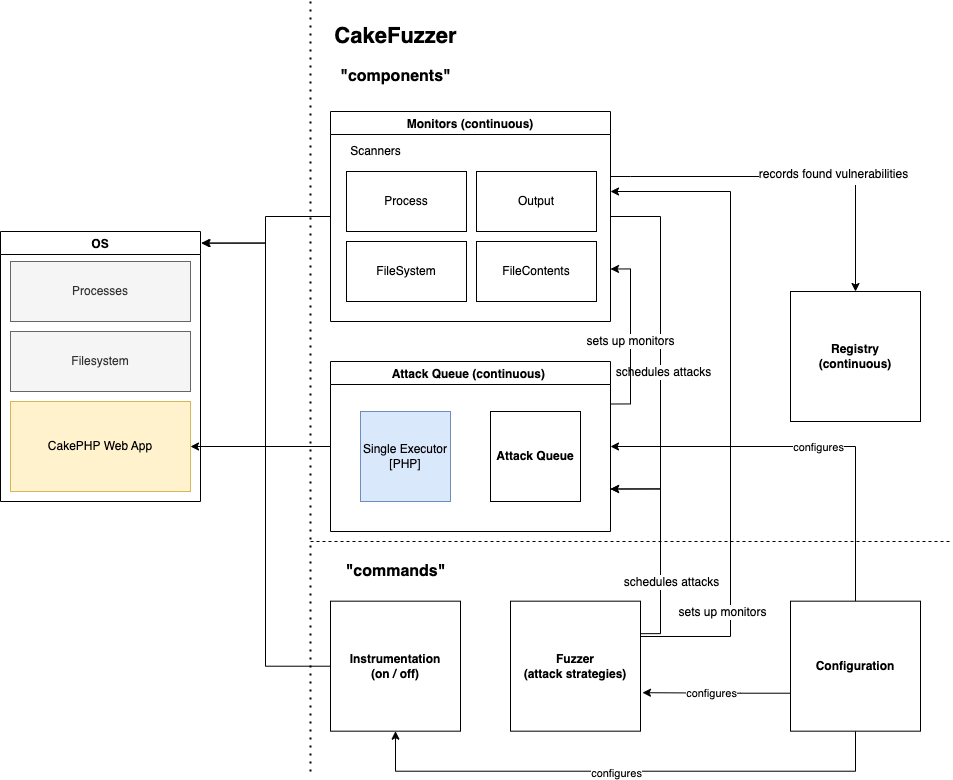
Drawio: Cake Fuzzer Architecture
Cake Fuzzer consists of 3 main (fairly independent) servers that in total allow for dynamic vulnerability testing of CakePHP allications.
Other components include:
Cake Fuzzer is based on the concept of Interactive Application Security Testing (IAST). It contains a predefined set of attacks that are randomly modified before the execution. Cake Fuzzer has the knowledge of the application internals thanks to the Cake PHP framework therefore the attacks will be launched on all possible entry points of the application.
During the attack, the Cake Fuzzer monitors various aspects of the application and the underlying system such as:
These sources of information allow Cake Fuzzer to identify more vulnerabilities and report them with higher certainty.
The following section describes steps to setup a Cake Fuzzer development environment where the target is outdated MISP v2.4.146 that is vulnerable to CVE-2021-41326.
Run the following commands on your host operating system to download an outdated MISP VM:
cd ~/Downloads # Or wherever you want to store the MISP VM
wget https://vm.misp-project.org/MISP_v2.4.146@0c25b72/[email protected] -O MISP.zip
unzip MISP.zip
rm MISP.zip
mv VMware/ MISP-2.4.146
Conduct the following actions in VMWare GUI to prepare sharing Cake Fuzzer files between your host OS and MISP:
Run the following commands on your host OS (replace MISP_IP_ADDRESS with previously noted IP address):
ssh-copy-id misp@MISP_IP_ADDRESS
ssh misp@MISP_IP_ADDRESS
Once you SSH into the MISP run the following commands (in MISP terminal) to finish setup of sharing Cake Fuzzer files between host OS and MISP:
sudo apt update
sudo apt-get -y install open-vm-tools open-vm-tools-desktop
sudo apt-get -y install build-essential module-assistant linux-headers-virtual linux-image-virtual && sudo dpkg-reconfigure open-vm-tools
sudo mkdir /cake_fuzzer # Note: This path is fixed as it's hardcoded in the instrumentation (one of the patches)
sudo vmhgfs-fuse .host:/cake_fuzzer /cake_fuzzer -o allow_other -o uid=1000 -o max_write=61440
# max_write fixes weird file copy bug: https://github.com/vmware/open-vm-tools/issues/437#issuecomment-669663891
ls -l /cake_fuzzer # If everything went fine you should see content of the Cake Fuzzer directory from your host OS. Any changes on your host OS will be reflected inside the VM and vice-versa.
Prepare MISP for simple testing (in MISP terminal):
CAKE=/var/www/MISP/app/Console/cake
SUDO='sudo -H -u www-data'
$CAKE userInit -q
$SUDO $CAKE Admin setSetting "Security.password_policy_length" 1
$SUDO $CAKE Admin setSetting "Security.password_policy_complexity" '/.*/'
$SUDO $CAKE Password [email protected] admin --override_password_change
Finally instal Cake Fuzzer dependencies and prepare the venv (in MISP terminal):
source /cake_fuzzer/precheck.sh
Cake Fuzzer scans for vulnerabilities that inside of /cake_fuzzer/strategies folder.
