Skip to content
KitploitKITPLOIT
ToolsBlog
Submit
ToolsBlog
Submit

Hacking, PenTest, and Cybersecurity Tools for Your Security Arsenal!

Kitploit is a directory of hacking, cybersecurity, and pentesting tools. Discover the latest project updates to find vulnerabilities, analyze systems, automate testing, and strengthen your security.

··Feeds·Contact·Privacy·© 2026 Kitploit

Tool Directory

Categories

View all categories
Loading categories
cobaltstrike4.5_cdf-1 — cobaltstrike4.5版本破/解、去除checksum8特征、bypass BeaconEye、修复错误路径泄漏stage、增加totp双因子验证、修复CVE-2022-39197等 | Kitploit
Tools/GitHubGitHub/zeoday/cobaltstrike4.5_cdf-1
Penetration Testing FrameworksExploit FrameworksVulnerability AnalysisIDS/IPS EvasionReverse EngineeringCryptographyCommand and ControlBinary AnalysisAuthenticationRed TeamingPayload Development
13 years agoNot yet reviewed

Most Popular

View all →

Discover the most used tools by our community.

Explore all tools

Browse our collection of tools

View all tools →
Share
GitHub
zeoday/cobaltstrike4.5_cdf-1

cobaltstrike4.5_cdf-1

cobaltstrike4.5版本破/解、去除checksum8特征、bypass BeaconEye、修复错误路径泄漏stage、增加totp双因子验证、修复CVE-2022-39197等

View Repository

cobaltstrike4.5_cdf

Crack cobaltstrike4.5, remove checksum8 feature, bypass BeaconEye, fix stage leakage via wrong path, add TOTP two-factor authentication, add encrypted username display, fix foreign spawn bug in 4.5, rename client configuration file, etc.

cobalt strike4.5 crack

cobaltstrike4.5 crack

[TOC]

Disclaimer / Agreement

This tool and article content are for security research only. Users assume all legal and related responsibilities arising from the use of this tool and article content! The author assumes no legal responsibility! If you engage in any illegal activities while using this tool or article content, you shall bear the corresponding consequences yourself. We will not assume any legal or joint liability. Otherwise, please do not install or use this tool. Your use of this tool or any other express or implied acceptance of this agreement shall be deemed as your having read and agreed to be bound by this agreement. When using this tool for security research, you should ensure that the behavior complies with laws and regulations and that sufficient authorization has been obtained. Do not use it against unauthorized targets.

Yes, I'm back, continuing the original cobaltstrike4.4_cdf: https://github.com/lovechoudoufu/about_cobaltstrike4.4_cdf This time it's version 4.5. The previous 4.4 was deleted by GitHub, and it's estimated that this project will also be deleted soon.

It is recommended to join the Telegram group. Subsequent updates and deleted projects can be downloaded from the group:
image-20220802163532221

Before use, please carefully verify the corresponding version's jar file hash.

CS Crack

Versions before 4.5

Certificate authentication process (using 4.3 as an example): slightly modified in version 4.5.

Official decryption keys for each version:

root@kitploit:~
4.0 1be5be52c6255c33558e8a1cb667cb06
4.1 80e32a742060b884419ba0c171c9aa76
4.2 b20d487addd4713418f2d5a3ae02a7a0
4.3 3a4425490f389aeec312bdd758ad2b99
4.4 5e98194a01c6b48fa582a6a9fcbb92d6

cobaltstrike.auth authentication key file, RSA encrypted. Decrypted content:

4.3

root@kitploit:~
-54, -2, -64, -45,	// file header
0, 77,	// subsequent length 
1, -55, -61, 127, 	// certificate time limit 29999999 (perpetual)
0, 0, 0, 1, 	// watermark
43, 	// version
16, 20, 20, 20, 20, 20, 20, 20, 20, 20, 20, 20, 20, 20, 20, 20, 20, 
16, 20, 20, 20, 20, 20, 20, 20, 20, 20, 20, 20, 20, 20, 20, 20, 20, 
16, 20, 20, 20, 20, 20, 20, 20, 20, 20, 20, 20, 20, 20, 20, 20, 20, 
16, 58, 68, 37, 73, 15, 56, -102, -18, -61, 18, -67, -41, 88, -83, 43, -103

With each version update, the corresponding length increases by 17, and the key increases by 17 bytes.

In aggressor/Aggressor.class, License.checkLicenseGUI(new Authorization()); starts the license authentication:
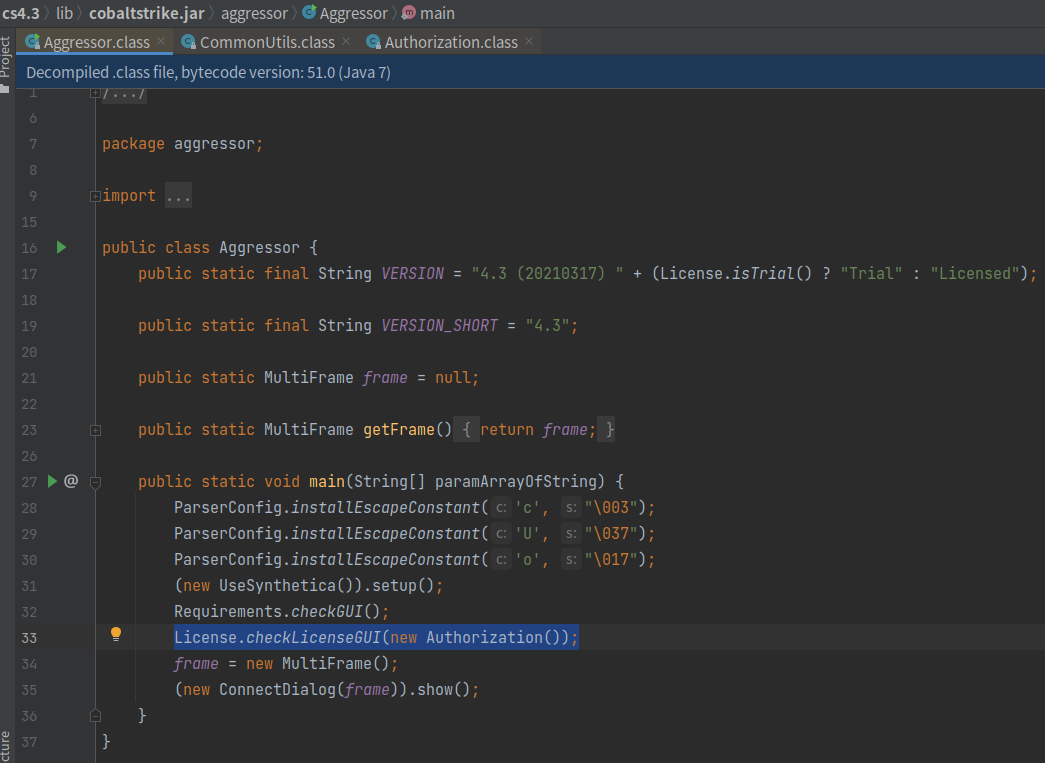
image-20211101142121856

License.checkLicenseGUI uses isValid, isPerpetual, isExpired, isAlmostExpired to determine if the license is valid or expired:
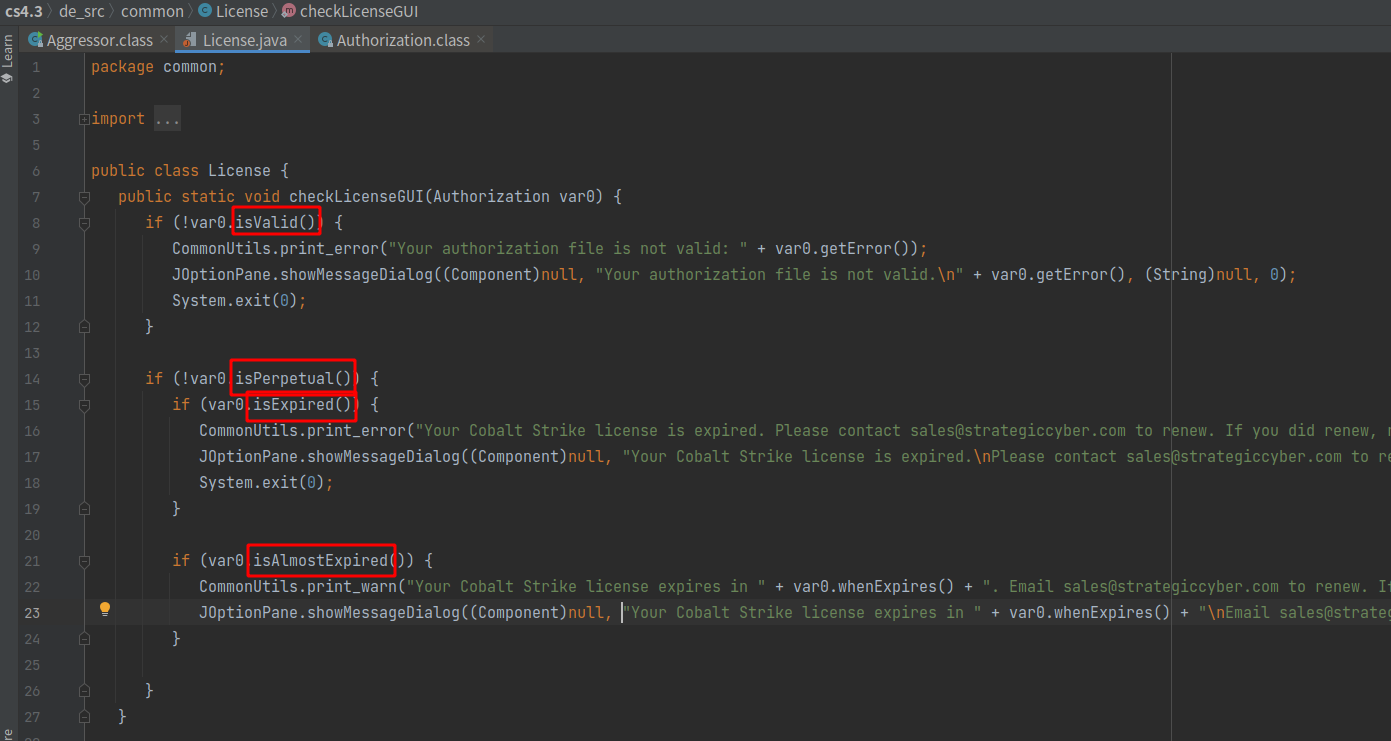
image-20211101142738431

The Authorization class handles the cobaltstrike.auth file, reads the file content, and calls AuthCrypto().decrypt to process it:
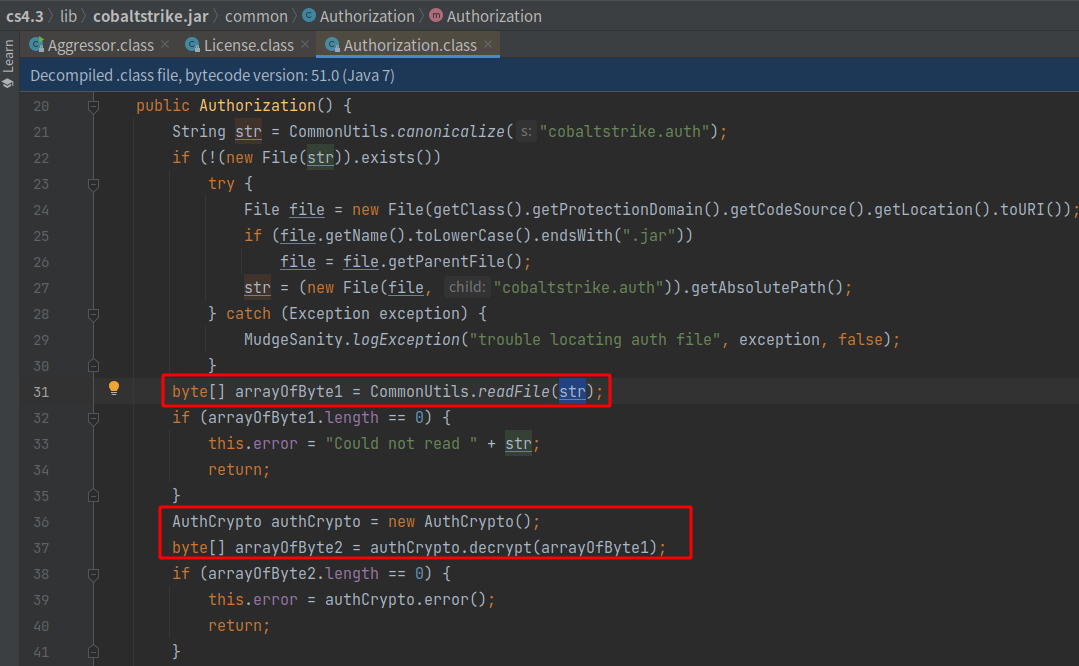
image-20211101143829398

In the AuthCrypto() constructor, load() is called, which performs an MD5 check on resources/authkey.pub and then retrieves the RSA public key:
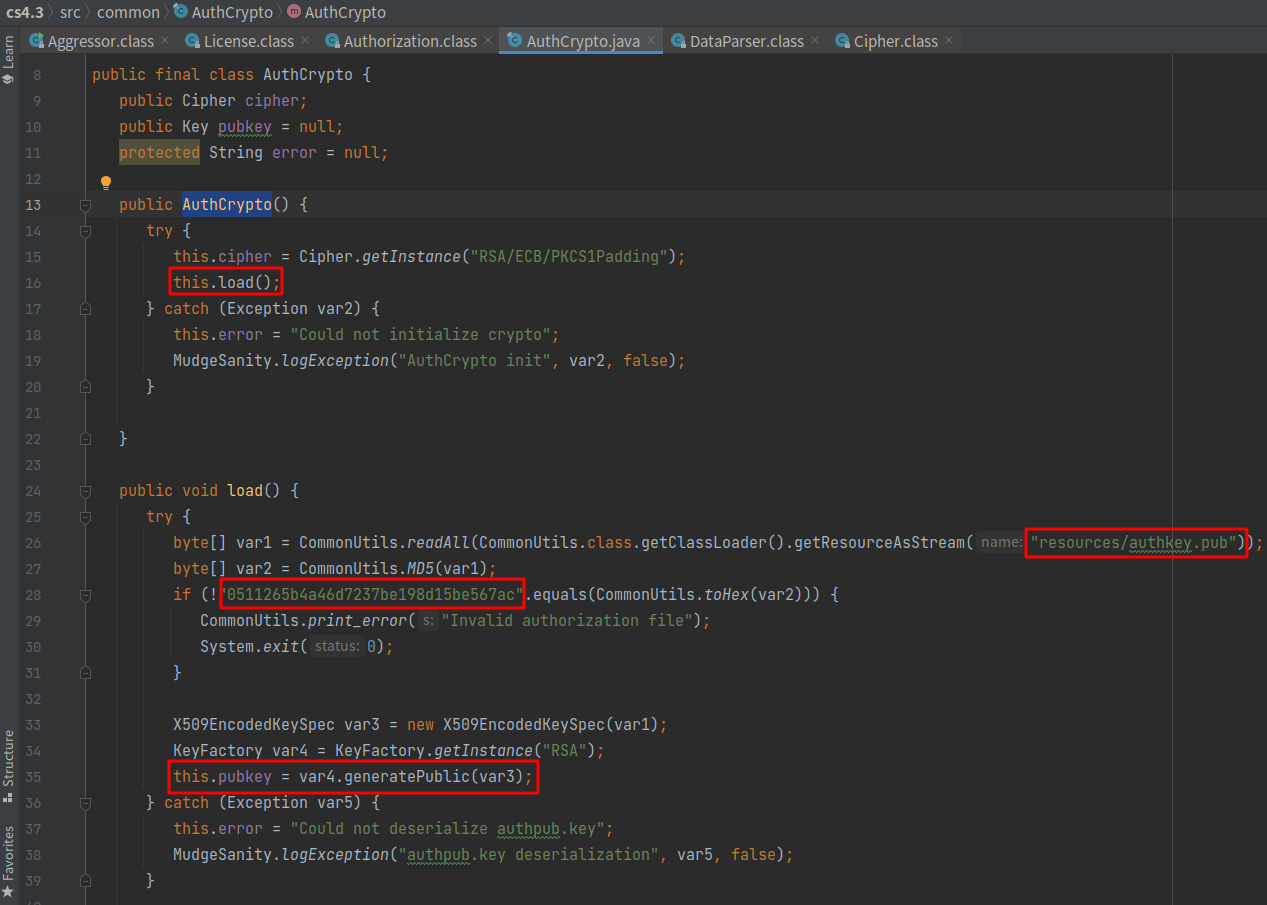
image-20211101144809625

In decrypt(), _decrypt is called to RSA-decrypt the content of the cobaltstrike.auth file using the public key, assigns the result to array var2, then converts it using DataParser to var3. readInt() retrieves the first four bytes of var3 for file header verification (-889274181 for 3.x; -889274157 for 4.x). Then readShort() gets two bytes as the length, assigned to var5, and var6 = var3.readBytes(var5) retrieves that length of content and returns it:
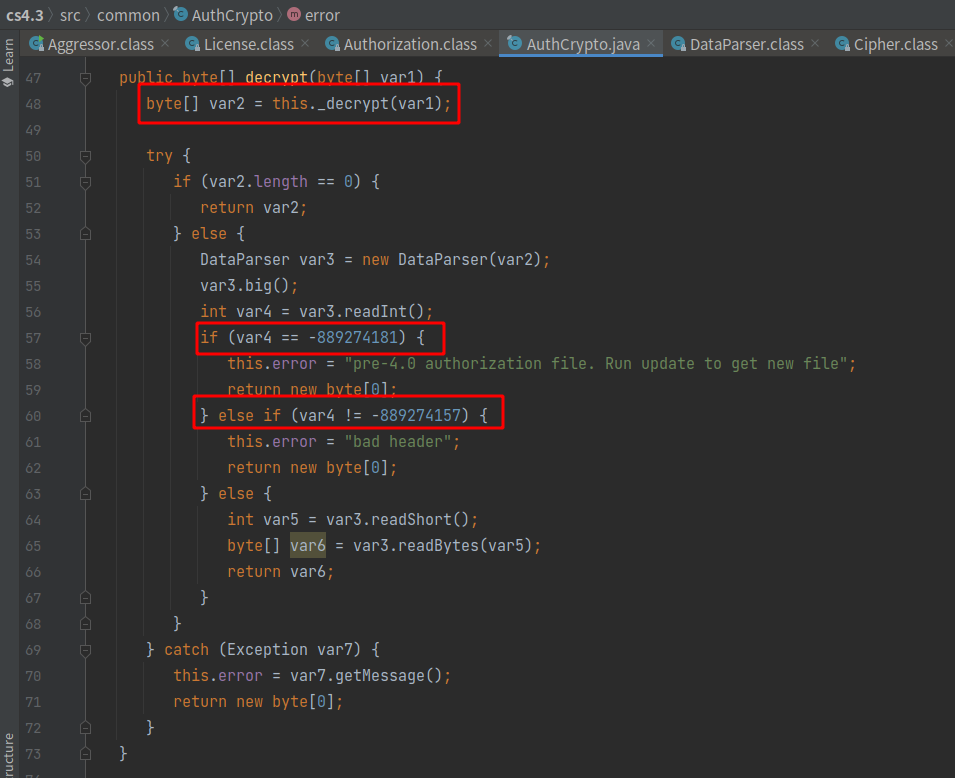
image-20211101145153818

In the Authorization class, the obtained arrayOfByte2 is the content after removing the first six bytes. It continues processing arrayOfByte2: first retrieves four bytes assigned to i, then four bytes assigned to watermark, then one byte assigned to b1. It checks if b1 < 43, if i == 29999999. In common/ListenerConfig, when watermark is 0, an antivirus detection watermark is added:
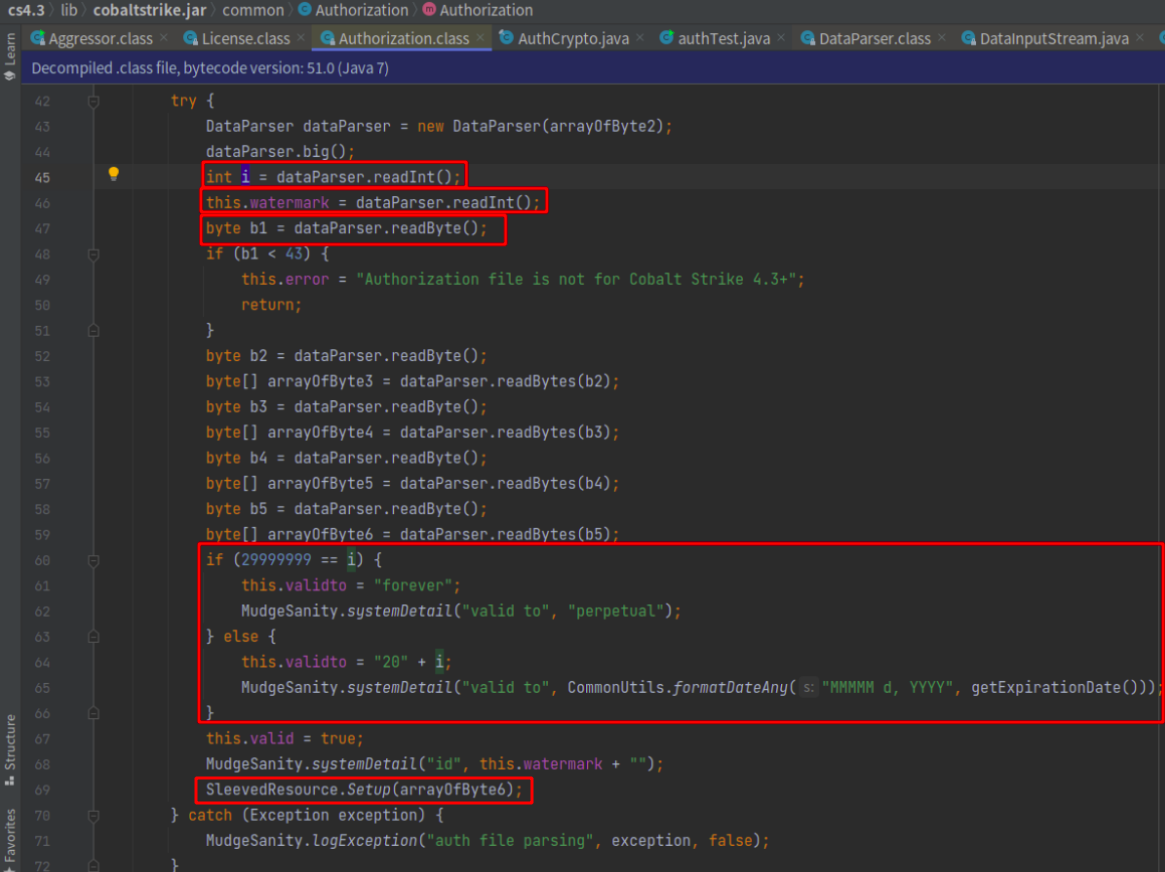
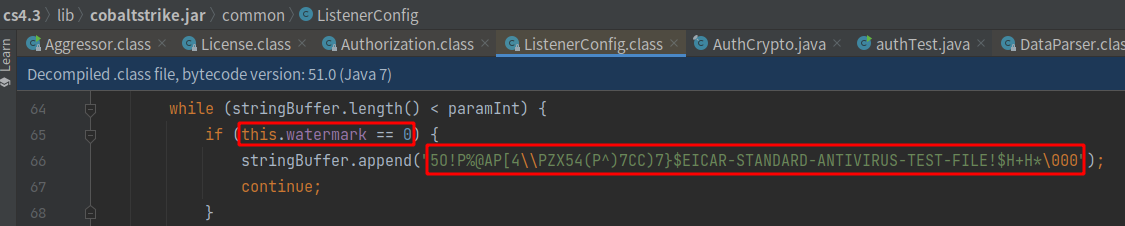
image-20211101152338045

image-20211101152000407

After removing the first six bytes, then removing the nine bytes for i, watermark, b1, the remaining content is the keys from 4.0 to 4.3, structured as: 16, 20, 20, 20, 20, 20, 20, 20, 20, 20, 20, 20, 20, 20, 20, 20, 20:

root@kitploit:~
            byte b2 = dataParser.readByte();	// get 1 byte, i.e., 16
            byte[] arrayOfByte3 = dataParser.readBytes(b2);		// get 16 bytes, which is the key for 4.0
            byte b3 = dataParser.readByte();	// get 1 byte, i.e., 16
            byte[] arrayOfByte4 = dataParser.readBytes(b3);		// get 16 bytes, which is the key for 4.1
            byte b4 = dataParser.readByte();	// get 1 byte, i.e., 16
            byte[] arrayOfByte5 = dataParser.readBytes(b4);		// get 16 bytes, which is the key for 4.2
            byte b5 = dataParser.readByte();	// get 1 byte, i.e., 16
            byte[] arrayOfByte6 = dataParser.readBytes(b5);		// get 16 bytes, which is the key for 4.3, assigned to arrayOfByte6

In the Authorization class, SleevedResource.Setup is called to process arrayOfByte6. In SleevedResource, the key is set as the decryption key for AES and HmacSHA256. In _readResource, this.data.decrypt(arrayOfByte1); is called for decryption, and the decrypted content is the dll files in /sleeve/:
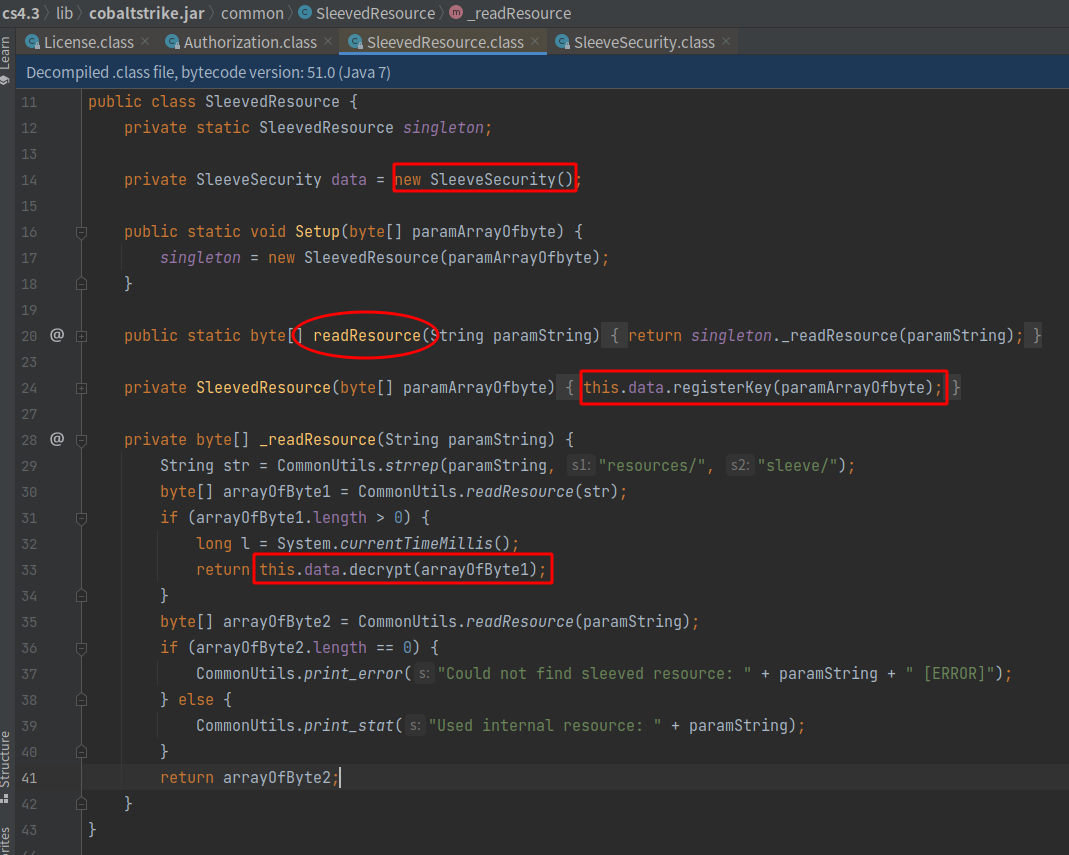
image-20211101153935202

In SleeveSecurity, the key for AES and HmacSHA256 decryption is set. It uses the passed value to compute a 256-bit digest, then takes bytes 0-16 as the AES key and bytes 16-32 as the HmacSHA256 key:
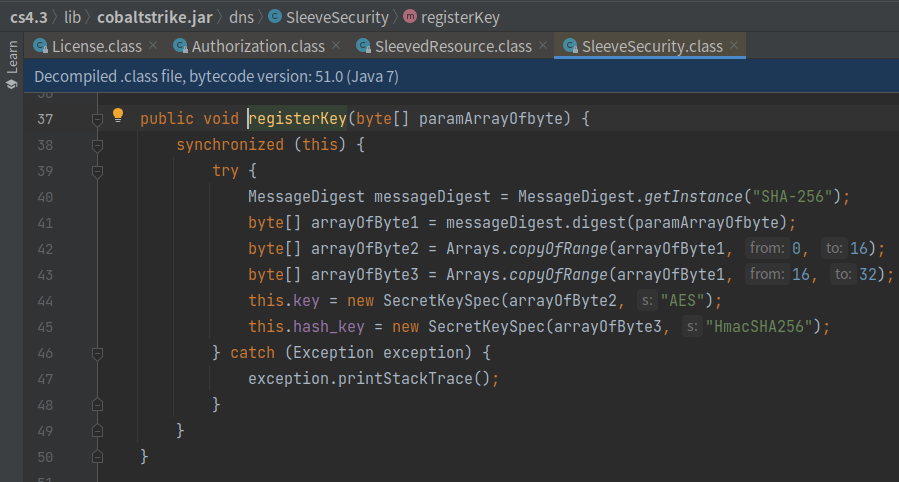
image-20211101154127243

If the corresponding key is not obtained, the dll in the sleeve folder cannot be decrypted, and when connecting to the server, the error message "[Sleeve] Bad HMAC" will appear:
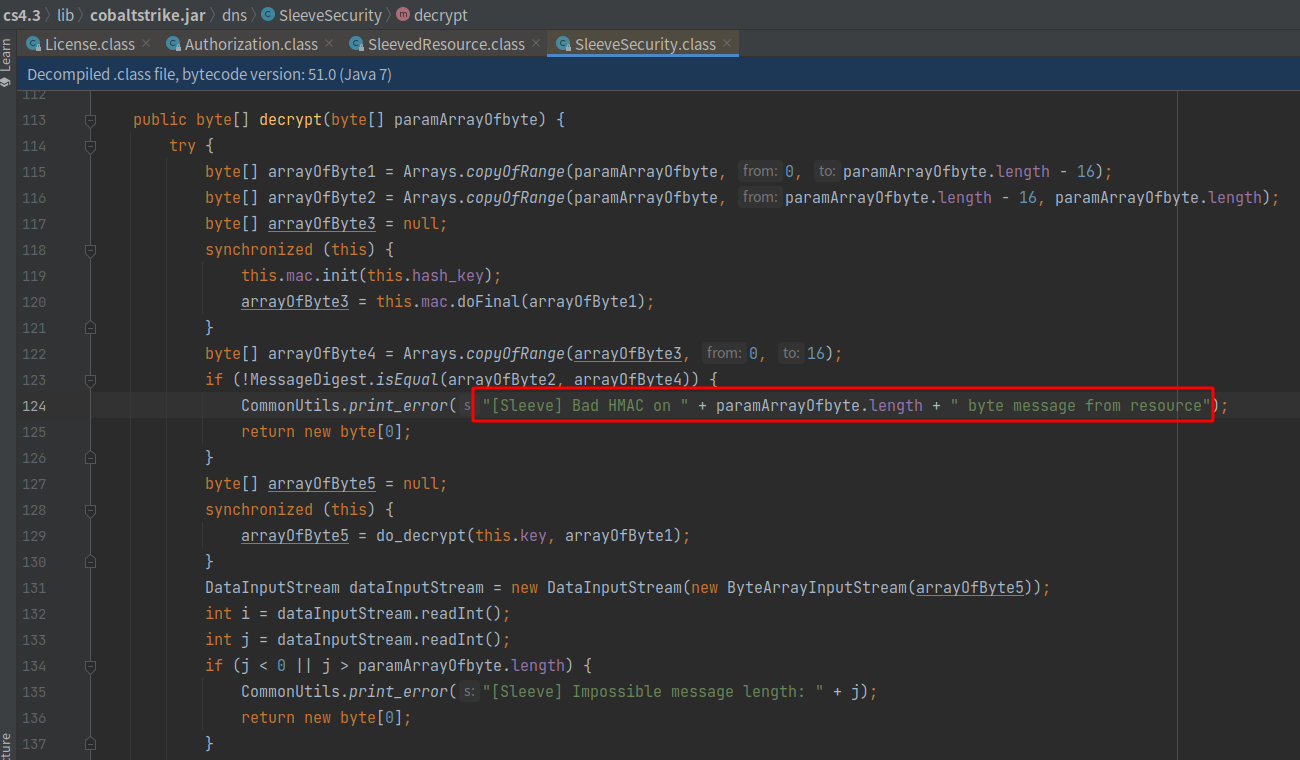
image-20211101160942103

For the HMAC decryption part, refer to: Cobaltstrike 4 crack: I issue a license to myself

Therefore, the key to a successful crack is the corresponding CS version key.

New Validation in Version 4.5

According to the official description, version 4.5 adds license security, which is indeed the case:
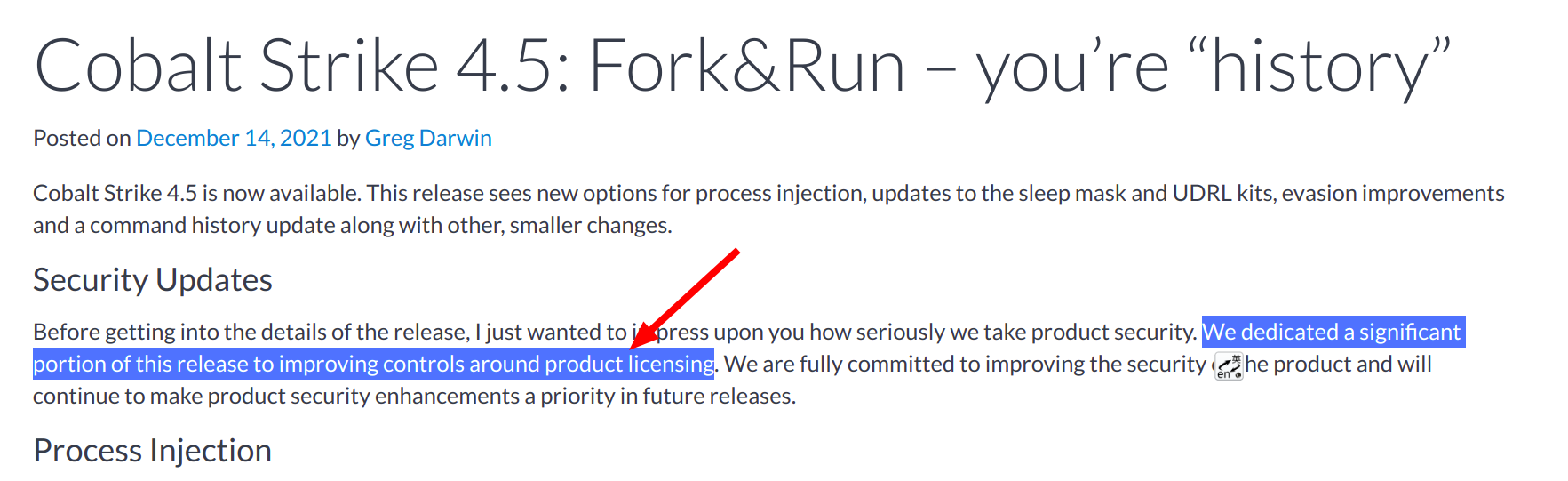
image-20220802145353409

So we need to decrypt the leaked auth file to see what's added:

image-20220802154920364

Behind the key position in 4.5, there is an extra string. This extra part is the newly added watermarkHash for this version:

image-20220802155137639

The watermarkHash is related to beacon generation and the dll in the sleeve folder. Without it or if it's incorrect, the beacon cannot go online. It is speculated that the official can trace back to the source of the leak through this watermarkHash.

image-20220802155317878

Crack Methods

Method 1: Hardcode the key

Comment out other code and hardcode the parameters assigned after RSA decryption in AuthCrypto().decrypt:

image-20220802155654981

root@kitploit:~
         byte[] var4 = {1, -55, -61, 127, 0, 1, -122, -96, 45, 16, 27, -27, -66, 82, -58, 37, 92, 51, 85, -114, -118, 28, -74, 103, -53, 6, 16, -128, -29, 42, 116, 32, 96, -72, -124, 65, -101, -96, -63, 113, -55, -86, 118, 16, -78, 13, 72, 122, -35, -44, 113, 52, 24, -14, -43, -93, -82, 2, -89, -96, 16, 58, 68, 37, 73, 15, 56, -102, -18, -61, 18, -67, -41, 88, -83, 43, -103, 16, 94, -104, 25, 74, 1, -58, -76, -113, -91, -126, -90, -87, -4, -69, -110, -42, 16, -13, -114, -77, -47, -93, 53, -78, 82, -75, -117, -62, -84, -34, -127, -75, 66, 0, 0, 0, 24, 66, 101, 117, 100, 116, 75, 103, 113, 110, 108, 109, 48, 82, 117, 118, 102, 43, 86, 89, 120, 117, 119, 61, 61};

Method 2: Javaagent approach

Javaagent principle: https://www.cnblogs.com/rickiyang/p/11368932.html

Crack tool reference: https://github.com/Twi1ight/CSAgent

The core of the crack still requires the key for the corresponding CS version.

Remove Backdoors

Set the shouldPad method's return value to false in beacon/BeaconData:

image-20211101180447451

New backdoor in 4.4

(Previously analyzed license authentication with 4.3; after switching to 4.4, it was found that the program exits during runtime, indicating a new backdoor.)

Compared to this.shouldPad's exit, a .class check was added in common/Helper. Just comment it out:

image-20211119153406737

A .class check added in common/Starter. Comment it out:

image-20211119153558224

A .class check added in common/Starter2. Comment it out:

image-20211119153636952

A .class check added in beacon/CommandBuilder: (This backdoor is really sneaky — after the client and teamserver continuously connect for 4 hours, commands cannot be executed. I've never connected that long, so I didn't notice it. ggg)

image-20220505104735903

New backdoor in 4.5

Version 4.5 adds a bunch of backdoors targeting javaagent. If you decompile the jar for cracking, you can ignore them; just search for "javaagent" and modify each occurrence:

image-20220802160404976

After removing these, group activities can resume.

CS Remove Checksum8 Feature

The checksum8 feature is not described in detail. It is necessary to modify it to avoid being scanned by nmap and space search engines.

Code Modification

Change the XOR value in BeaconPayload to a new one:

Any decimal number will do; later, change the corresponding hexadecimal value in the dll.

image-20211108114054512

DLL Modification

Use CrackSleeve to decrypt the dll: https://github.com/ca3tie1/CrackSleeve/

  1. Place cobaltstrike.jar and CrackSleeve.java together
  2. Compile (javac -encoding UTF-8 -classpath cobaltstrike.jar CrackSleeve.java)
  3. Decrypt (java -classpath cobaltstrike.jar;./ CrackSleeve decode) # Execute in Windows command line

Alt+T to search for the keyword: 2Eh

image-20211107222017434

image-20211107222039265

Directly modify the xor value. First, Change byte to find 2Eh and modify it, then Apply patches to input file to save. (Don't forget to save)

image-20211107222223636

DLLs that need modification: beacon.dll, beacon.x64.dll, dnsb.dll, dnsb.x64.dll, pivot.dll, pivot.x64.dll, extc2.dll, extc2.x64.dll (4.5 added several rl100k.dll, which also need modification)

Then use CrackSleeve to encrypt the dll. Finally, place the dll from the encode directory into the IDEA project directory and recompile and package.

After testing, although the URI address can still be requested, the content can no longer be decrypted by nmap scripts, thus avoiding recognition by space search engines:

image-20211107233719344

In addition to modifying the XOR value, you can also change the checksum8 algorithm by referring to https://mp.weixin.qq.com/s?__biz=MzA3MDY2NjMxMA==&mid=2247484641&idx=1&sn=014f6c4ad5343e3f5034c33dffa66f26&chksm=9f3815c8a84f9cde1c7493ff29cfc89c0474fec48ede52be618727e7b9a5ab321c4743e1a44c&mpshare=1&scene=23&srcid=1202NA46yt71CvD3BMGKS10c&sharer_sharetime=1606892728447&sharer_shareid=ff83fe2fe7db7fcd8a1fcbc183d841c4#rd However, this method can only use a fixed URI for access and requires a profile to work. Each time the URI is changed, repackaging is needed. Each method has its pros and cons.

CS Remove BeaconEye Feature

The modification idea to remove BeaconEye features comes from link. Using 4.3 and 4.4 as examples, the bytes that need modification are as follows.

Use CrackSleeve to decrypt the dll: https://github.com/ca3tie1/CrackSleeve/

  1. Place cobaltstrike.jar and CrackSleeve.java together
  2. Compile (javac -encoding UTF-8 -classpath cobaltstrike.jar CrackSleeve.java)
  3. Decrypt (java -classpath cobaltstrike.jar;./ CrackSleeve decode) # Execute in Windows command line

4.3 key: 58, 68, 37, 73, 15, 56, -102, -18, -61, 18, -67, -41, 88, -83, 43, -103 4.4 key: 94, -104, 25, 74, 1, -58, -76, -113, -91, -126, -90, -87, -4, -69, -110, -42

Modification for 4.3

32-bit dll

Address: 10009FBB

Change 6A 00 to 6A 09 (change 00 to any value)

image-20211111165257545

64-bit dll

Address: 000000001800186C3

In beacon.x64.dll, the instruction is xor edx, edx. Change to mov edx, esi

image-20211111165321033

Modification for 4.4

32-bit dll

Address: 1000A0B9

Change 6A 00 to 6A 09 (change 00 to any value)

image-20211112104322791

64-bit dll

Address: 000000018001879B

In beacon.x64.dll, the instruction is xor edx, edx. Change to mov edx, esi

image-20211112105408975

Re-encrypt using: java -classpath cobaltstrike.jar;./ CrackSleeve encode

image-20211111173148579

image-20211112124415835

Modification for 4.5

32-bit dll

Address: 1000A65D

image-20220609144218351

64-bit dll

Address: 000000018000CA3F

image-20220609160825342

(4.5 added several rl100k.dll, which also need modification)

CS Fix Stage Leakage via Wrong Path

Source: https://mp.weixin.qq.com/s?__biz=Mzg2NjQ2NzU3Ng==&mid=2247489846&idx=1&sn=181c223cab4bce4e06def94604166348&chksm=ce4b32a1f93cbbb70e63e589d0da6323a8d2d4539c8aa0ef57d4005976dda6d73caeddebcac3&mpshare=1&scene=1&srcid=0308x6zXAxyDR8lv27V2O9yn&sharer_sharetime=1647358883801&sharer_shareid=15e69d4f532774f3e596a31efa4ef72b#rd

image-20220330111308258

The method is to add a / check on the URI. If it doesn't start with /, respond with 404:

Modification for 4.4

image-20220330111413985

Modification for 4.3

image-20220330125957143

Add Encrypted Username Display

To prevent leaking the TOTP password or the login name in the Event Log, the name field is displayed with MD5 salted. After modification:

image-20220330112745362

Add TOTP Verification

Added TOTP two-factor authentication to enhance login security and prevent brute force cracking of passwords.

On the teamserver side, a TOTP QR code link is added to the teamserver output:

image-20220407112543322

(Delete nohup.out after copying the QR code. Each time teamserver is started, a new QR code is generated, so you need to scan it again each restart.)

Open the link in a browser (requires VPN) and scan the QR code with Google Authenticator or a TOTP verification app. Alternatively, copy the secret after secret%3D and configure it in the app:

image-20220407112054716

On the connect side, host, port, and password remain the same. In the user field, the last six digits are the TOTP dynamic number for connection:

image-20220407111813265

If the TOTP dynamic number is missing or incorrect, a prompt appears:

image-20220407113709140

Note: Sometimes you may not have your phone. You can use a browser TOTP plugin or write a simple TOTP script in Python.

Fix CS4.5 Foreign Spawn Bug

When using windows/foreign/reverse_http(s) for spawn, the following error occurs:

image-20220827183854784

In this version, related Custom getScalar operations were added in ScListener, but the foreign case was not considered, causing an error when var1.customDLL and customFileName are empty:

image-20220827184042529

The temporary fix is to check if the payload is foreign and directly return the shellcode. If there are other bugs, please submit issues:

image-20220827190844595

After the fix, it works normally:

image-20220827190954960

CS Client Configuration File Name Modification

To prevent MySQL honeypots from reading the configuration, the CS client configuration file name is no longer default and generates an 11-character file name (11 characters from the MD5 of the MAC address).

image-20220827191056012

Download Tool