
WPair is a defensive security research tool that demonstrates the CVE-2025-36911 (eg WhisperPair) vulnerability in Google's Fast Pair protocol. This vulnerability affects millions of Bluetooth audio devices worldwide, allowing unauthorized pairing and potential microphone access without user consent.
CVE-2025-36911 (eg WhisperPair) Vulnerability Scanner & Research Tool




Features • Installation • Usage • How It Works • Vulnerability • Credits
This application is an independent implementation created by @ZalexDev in his own capacity. The original KU Leuven researchers discovered and disclosed the vulnerability but have not released any code and are not affiliated with this project. Their inclusion in credits is solely to acknowledge their research contribution.
WPair is a defensive security research tool that demonstrates the CVE-2025-36911 vulnerability in Google's Fast Pair protocol. This vulnerability affects millions of Bluetooth audio devices worldwide, allowing unauthorized pairing and potential microphone access without user consent.
Purpose: Help security researchers, device manufacturers, and end-users identify vulnerable devices that need firmware updates.
| Feature | Description |
|---|---|
| BLE Scanner | Discovers Fast Pair devices broadcasting the 0xFE2C service UUID |
| Vulnerability Tester | Non-invasive check if device is patched against CVE-2025-36911 |
| Exploit Demonstration | Full proof-of-concept for authorized security testing |
| HFP Audio Access | Demonstrates microphone access post-exploitation |
| Live Listening | Real-time audio streaming to phone speaker |
| Recording | Save captured audio as M4A files |
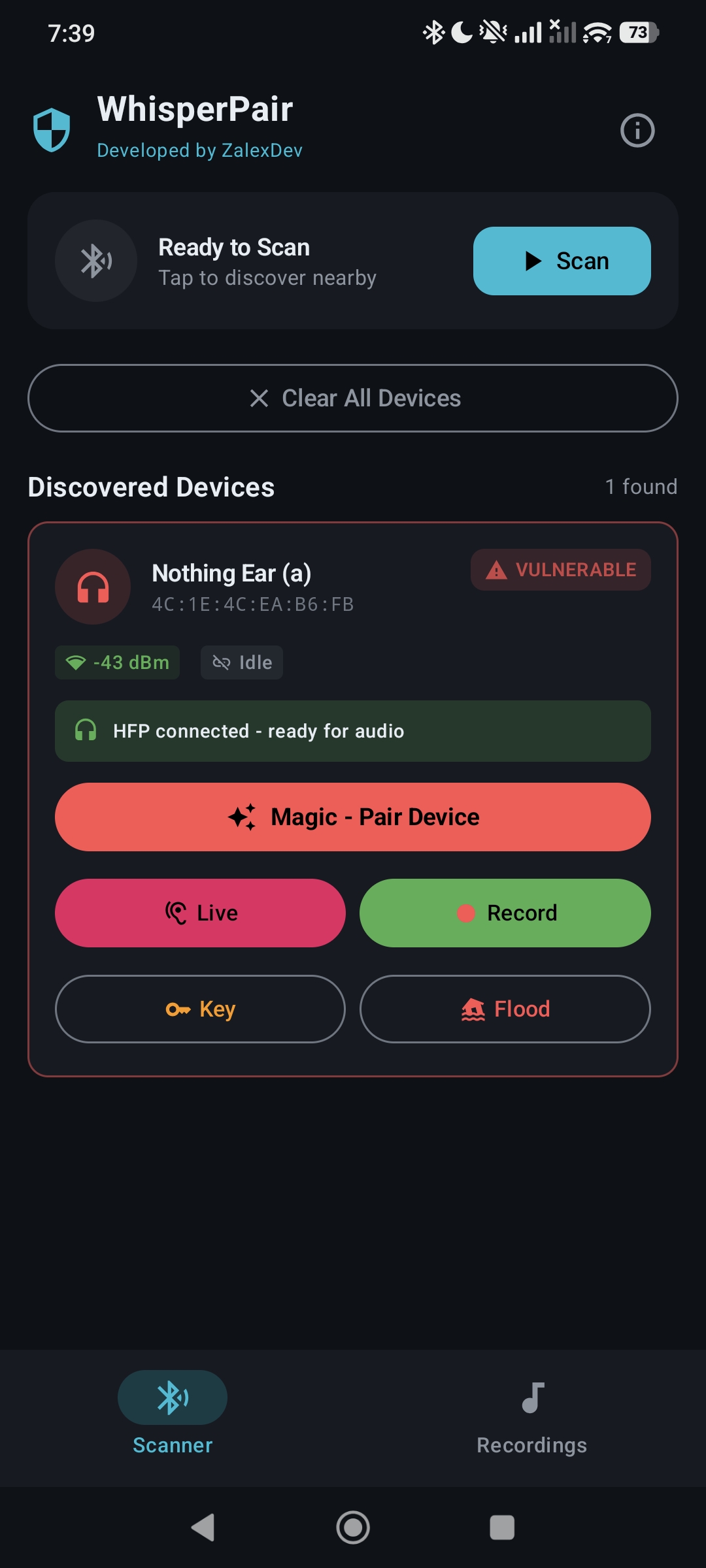
This tool deliberately does not include FMDN provisioning functionality. While the vulnerability chain technically allows enrolling compromised devices into Google's Find Hub Network for persistent location tracking, I've chosen not to implement this capability. Converting someone's headphones into a covert tracking beacon crosses a clear ethical line from security research into stalkerware territory. The Account Key write and audio access demonstrations are sufficient to prove the vulnerability's severity.
WPair-vX.X.X.apkgit clone https://github.com/zalexdev/whisper-pair-app.git
cd whisper-pair-app
./gradlew assembleDebug
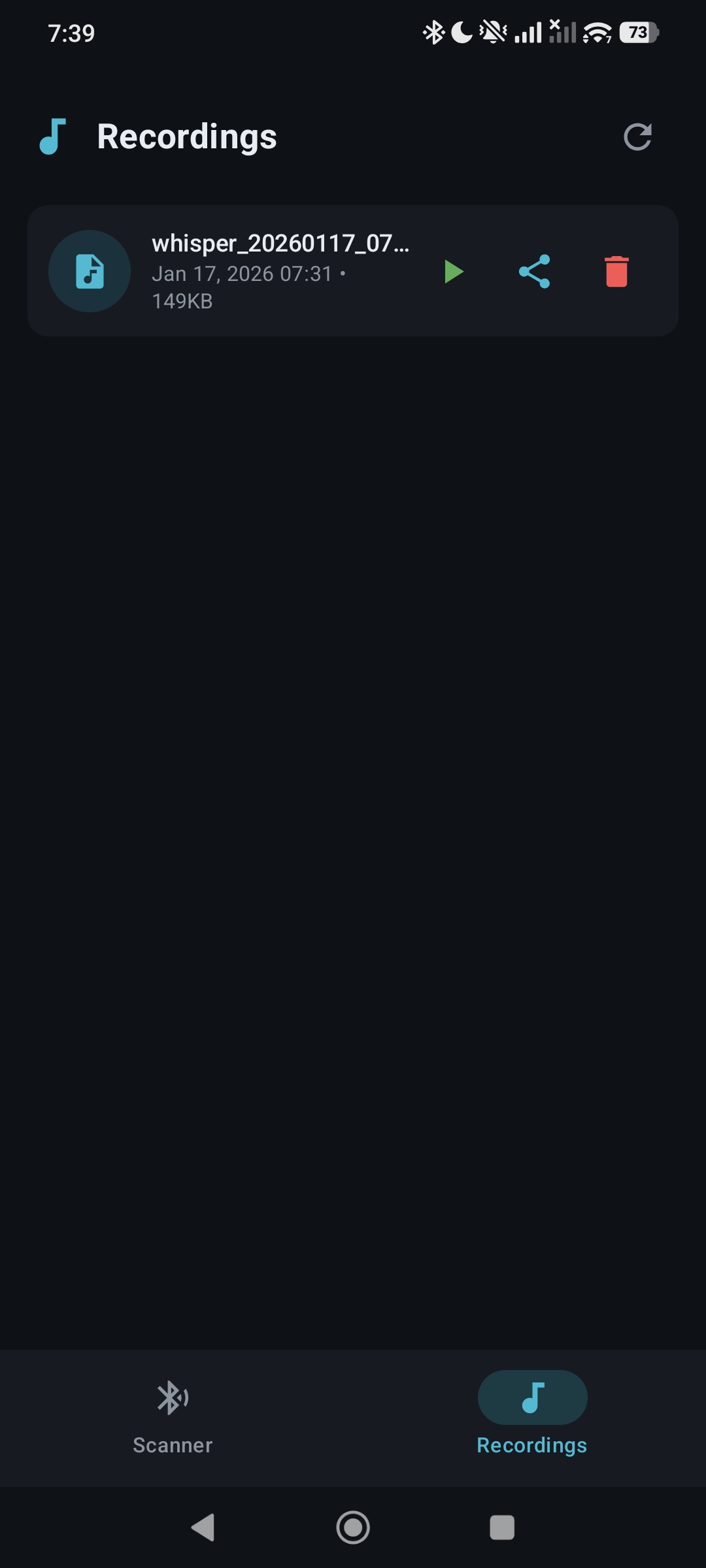
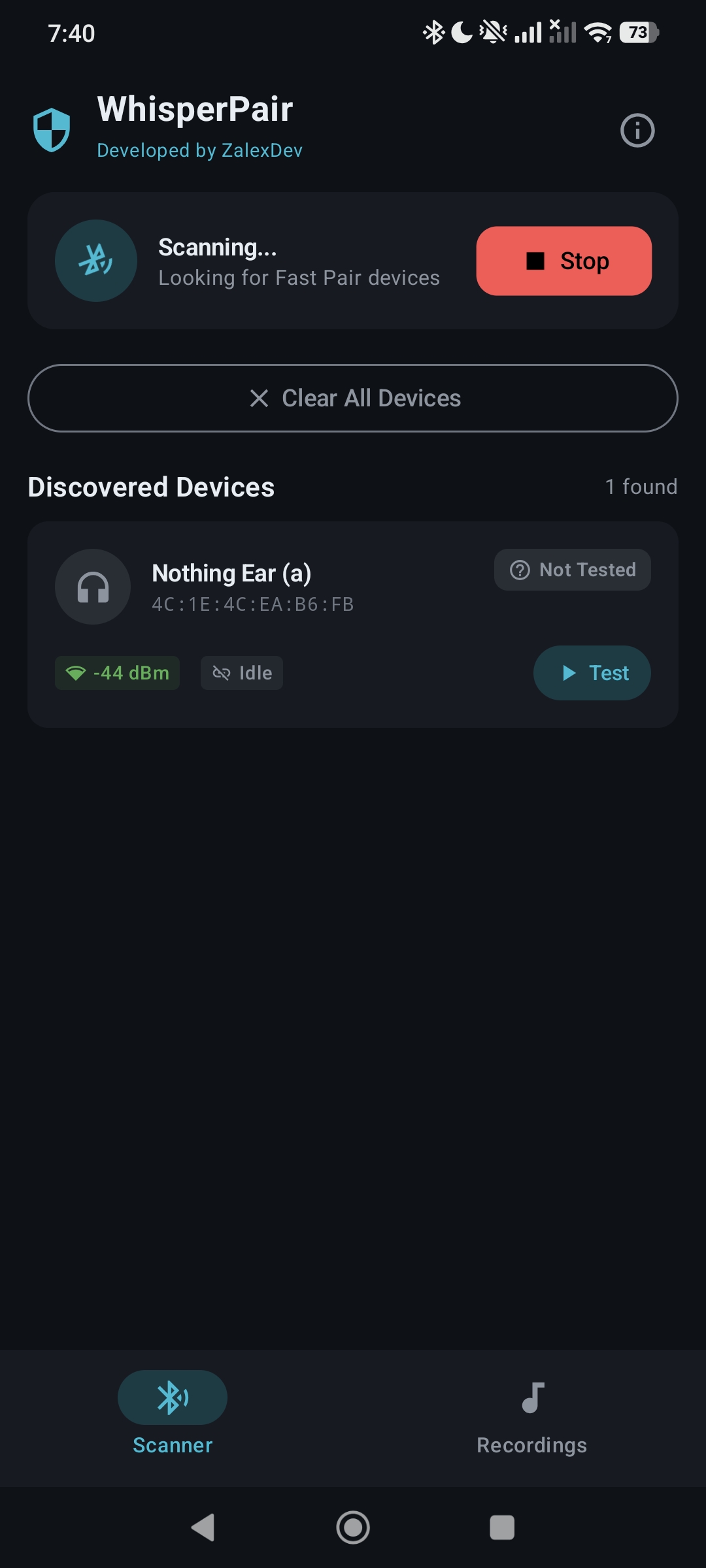
Tap Scan to discover nearby Fast Pair devices. Devices in pairing mode will show a "Pairing" badge.
For devices not in pairing mode, tap Test to check if they're vulnerable. This is non-invasive and doesn't pair with the device.
| Status | Meaning |
|---|---|
VULNERABLE | Device is affected by CVE-2025-36911 |
Patched | Device has been updated with security fix |
Error | Test inconclusive (device may be already paired) |
For vulnerable devices, tap Magic to demonstrate the full exploit chain:
After successful pairing:
sequenceDiagram
    participant App as WPair
    participant Target as Vulnerable Device
    participant BT as Android Bluetooth

    App->>Target: BLE Scan (0xFE2C service)
    Target-->>App: Fast Pair Advertisement

    Note over App: Vulnerability Test
    App->>Target: GATT Connect
    App->>Target: Read Model ID
    App->>Target: Write Key-Based Pairing (no signature)
    Target-->>App: Response (Vulnerable if accepted)

    Note over App: Exploitation
    App->>Target: Key-Based Pairing Request
    Target-->>App: Encrypted Response + BR/EDR Address
    App->>BT: createBond(BR/EDR Address)
    BT->>Target: Bluetooth Classic Pairing
    Target-->>BT: Pairing Complete

    Note over App: Audio Access
    App->>BT: Connect HFP Profile
    BT->>Target: HFP Connection
    App->>BT: Start SCO Audio
    Target-->>App: Microphone Stream
flowchart LR
    A[Scan] --> B{Fast Pair<br>Device?}
    B -->|Yes| C[Test Vulnerability]
    B -->|No| A
    C --> D{Vulnerable?}
    D -->|Yes| E[Exploit]
    D -->|No| F[Patched ✓]
    E --> G[Pair Device]
    G --> H[Connect HFP]
    H --> I[Access Microphone]
Severity: High CVSS Score: 8.1 Affected: Google Fast Pair Protocol implementations
The Fast Pair protocol uses Key-Based Pairing to authenticate pairing requests. The vulnerability exists because:
Major affected manufacturers include:
WhisperPair/
├── app/src/main/java/com/zalexdev/whisperpair/
│   ├── MainActivity.kt          # UI and navigation
│   ├── Scanner.kt                # BLE Fast Pair scanner
│   ├── FastPairDevice.kt         # Device data model
│   ├── VulnerabilityTester.kt    # Non-invasive vuln check
│   ├── FastPairExploit.kt        # PoC exploit implementation
│   └── BluetoothAudioManager.kt  # HFP audio handling
├── app/src/main/res/
│   └── ...                       # UI resources
└── README.md

