 yulisec/cve-2025-7771
Full exploit chain for CVE-2025-7771 in ThrottleStop.sys, abusing unvalidated physical memory R/W IOCTLs to escalate from administrator to SYSTEM on Windows.

Full proof-of-concept for the TechPowerUp ThrottleStop.sys driver (CVE-2025-7771).
A signed, still-loadable kernel driver exposes unvalidated physical memory read and
write through two IOCTLs. This repo turns that primitive into a working
administrator-to-SYSTEM local privilege escalation and documents a device-naming quirk
that breaks most path- and filename-based detections.
A PoC for the same IOCTLs already existed (see Credits). This is an independent, full exploit chain rather than a primitive demonstration.
| Field | Value |
|---|---|
| SHA256 | 16F83F056177C4EC24C7E99D01CA9D9D6713BD0497EEEDB777A3FFEFA99C97F0 |
| SHA1 | 82ED942A52CDCF120A8919730E00BA37619661A3 |
| MD5 | 6BC8E3505D9F51368DDF323ACB6ABC49 |
| Version | 3.0.0.0 ("Low-Level Driver", 2004-2020) |
| Signer | TechPowerUp LLC, DigiCert EV Code Signing |
| Cert thumbprint | 524EDA9C819321C66E22C7BABEB23DAEAFFB2182 |
| Cert validity | 2019-08-10 to 2022-06-15 |
The certificate expired in 2022, but the signature carries a trusted countersignature timestamp, so Windows still loads it. Revocation only helps if its date precedes the signing time, which is rarely the case for old drivers like this.
The version resource has no CompanyName, OriginalFilename or InternalName, so the
file cannot be attributed to a vendor from its own metadata.
Two IOCTLs read and write physical memory with no bounds or address validation:
| IOCTL | Operation |
|---|---|
0x80006498 | Physical read |
0x8000649C | Physical write |
Both are METHOD_BUFFERED, so there is no user-pointer dereference; the defect is the
missing validation of the caller-supplied physical address, not an unchecked pointer.
Worth flagging: the write handler 0x8000649C is declared FILE_READ_ACCESS. A handle
opened read-only can still issue physical writes, so the declared access mask does not
match what the handler actually does.
Opening the device needs administrator rights, so this is not a privilege boundary crossing on its own. What it gives an attacker who is already admin is arbitrary kernel read/write from user mode, which defeats the protections that are supposed to hold above admin: HVCI code integrity, PPL, and EDR/AV self-protection. Classic bring-your-own- vulnerable-driver.
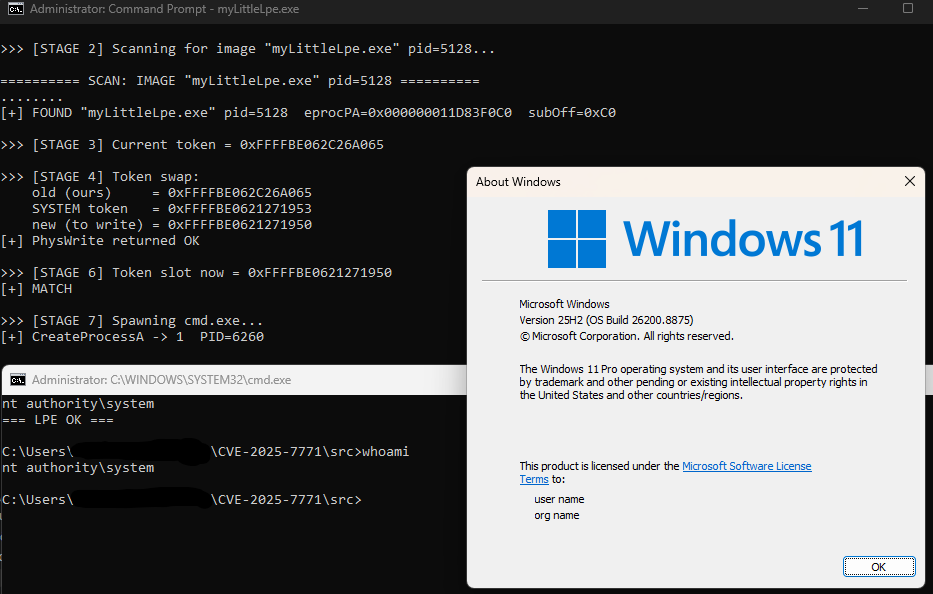
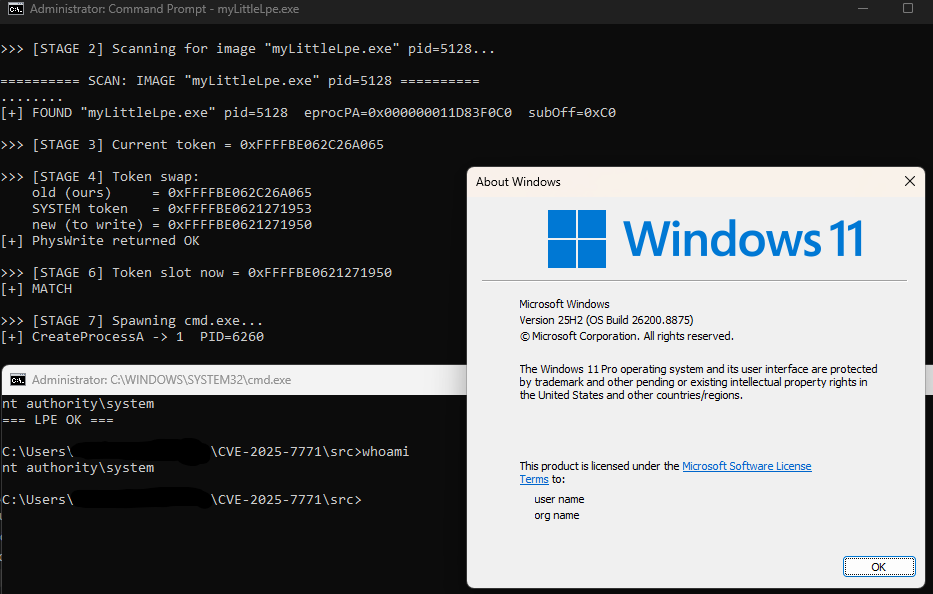
As a concrete demonstration, the PoC uses the R/W primitive to steal the SYSTEM token and spawn a SYSTEM shell.
CVSS 4.0: AV:L/AC:H/AT:N/PR:H/UI:N/VC:H/VI:H/VA:H/SC:H/SI:H/SA:H (8.7, High).
Everything runs from user mode against the driver's physical R/W IOCTLs. There is no page-table walking and no CR3 involved; both processes are located by scanning physical memory directly:
ImageFileName is
System and UniqueProcessId is 4. The scan is bounded to the populated RAM ranges
read from the firmware's HARDWARE\RESOURCEMAP\...\Physical Memory registry key,
not a guessed window, so MMIO holes are never touched and nothing above installed RAM
is missed.Token field (EPROC_TOKEN) from the located
EPROCESS.Token slot. The token
is an _EX_FAST_REF, so the low reference-count bits are masked by default (--mask
selects the behaviour).cmd.exe; whoami returns NT AUTHORITY\SYSTEM.Offsets (EPROC_TOKEN, EPROC_PID, EPROC_IMG_NAME, etc.) are for a specific build and
must be confirmed against dt nt!_EPROCESS on the target Windows version.
The executable name matters. Step 3 locates our own process by matching its
ImageFileName in physical memory, and that field is capped at 15 characters with the
scan matching the first 8. Keep the compiled name short and distinctive; if you rename
the binary, stay within that limit or the self-scan will not find the process.
The driver does not use a fixed device name. It derives the device object name from the
service name it is registered under; the filename on disk is irrelevant. Registering
the binary under service TRIXX produces \\.\TRIXX no matter what the file is called on
disk.
So any detection keyed on \Device\ThrottleStop or ThrottleStop.sys is trivially
bypassed. Detection has to be based on the file hash or the signing certificate:
SHA256:     16F83F056177C4EC24C7E99D01CA9D9D6713BD0497EEEDB777A3FFEFA99C97F0
Thumbprint: 524EDA9C819321C66E22C7BABEB23DAEAFFB2182
Subject:    CN=TechPowerUp LLC, O=TechPowerUp LLC, L=Spokane, S=Washington, C=US
The DEVICE_NAMES list in the source is just a probe for known product installs. Pass a
device name as an argument to target a service you registered yourself.
| CVE | Driver |
|---|---|
| CVE-2019-7245 | GPU-Z.sys |
| CVE-2025-5324 | GPU-Z.sys |
| CVE-2025-7771 | ThrottleStop.sys (this repo) |
The binary is not shipped here. Verify any copy against the SHA256 above. The sample is catalogued in LOLDrivers.
cl /nologo /EHsc /W4 /O2 src\ThrottleStop.cpp /Fe:myLittleLpe.exe /link advapi32.lib
Lab use only. Run inside an isolated VM with a snapshot to roll back to.
sc.exe create <name> type= kernel binPath= C:\path\to\ThrottleStop.sys
sc.exe start <name>

myLittleLpe.exe

sc.exe stop <name>
sc.exe delete <name>
The binary takes no arguments. It prints the physical memory map, scans for the SYSTEM
and local EPROCESS, swaps the token, and spawns cmd.exe running as
NT AUTHORITY\SYSTEM.
Other public work on the same driver, for comparison:
Published for defensive research and detection engineering. The vulnerability is already public as CVE-2025-7771. Everything here was tested on systems owned by the author. Do not run this against systems you do not own or are not authorised to test.
