 xoreaxeaxeax/mmiotic
Latency x-ray for undocumented hardware

# mmiotic An exploratory tool for MMIO timing — time any physical address, and dissect the hardware off the latency. 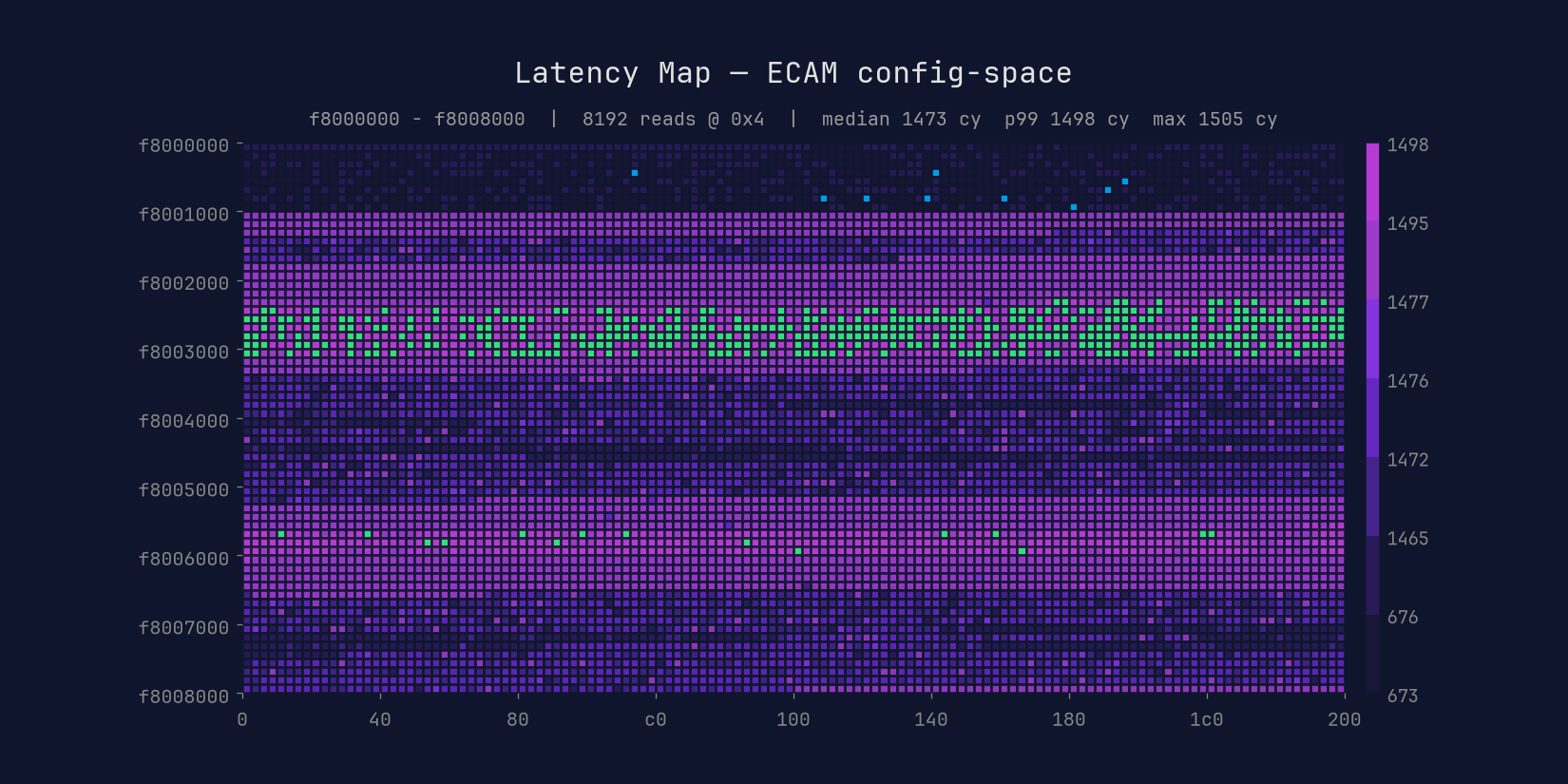 Unexpectedly useful for hardware reverse-engineering, hypervisor fingerprinting, side-channelling device activity, register characterization, calibrating malicious triggers, and crafting obscenely long machine instructions. ## Examples ### Reverse engineering memory ranges The first megabyte of physical memory is an easy example to start with, even if its structure is already well-known. 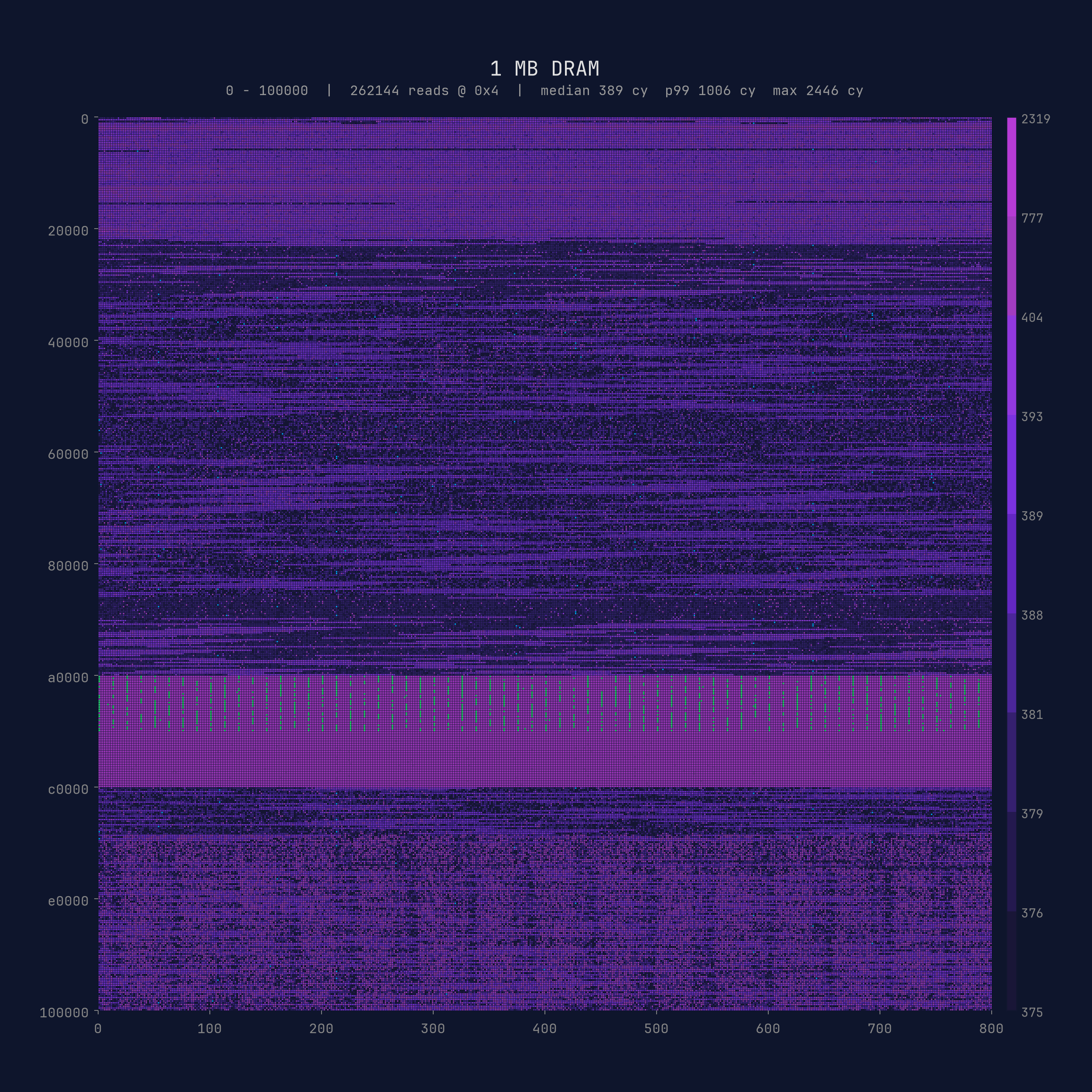 The latency boundaries let us carve up the address space, without relying on reported layouts. 1. Start with a simple latency scan: `sudo ./mmiotic --start-address 0x0 --end-address 0x100000 --stride 4 --count 20 --quiet-mmap` 2. Latency lands on the classic boundaries — DRAM to `0x9FFFF` at ~380 cy, then the 128 KB video hole, which splits in two at `0xB0000`. The change in variance at `0x20000` may indicate a different page walk for the null page. 3. `A0000`–`AFFFF`: slow and jittery (996 cy, stdev 327), routed to the powered-but-idle Radeon. `B0000`–`BFFFF`: fast and rigid (780 cy, stdev 3.2, reads `ffffffff`), claimed by nobody. Similar-looking data, but a 100x variance gap. 4. `C0000`–`FFFFF`: `/proc/iomem` says "System ROM", but scan shows DRAM latency, not flash speed — the BIOS is shadowed into DRAM. ### Undocumented mailbox registers Scan a root-complex config space (`00:00.0`, 4 KB) for latency outliers against a flat ~675-cycle floor: 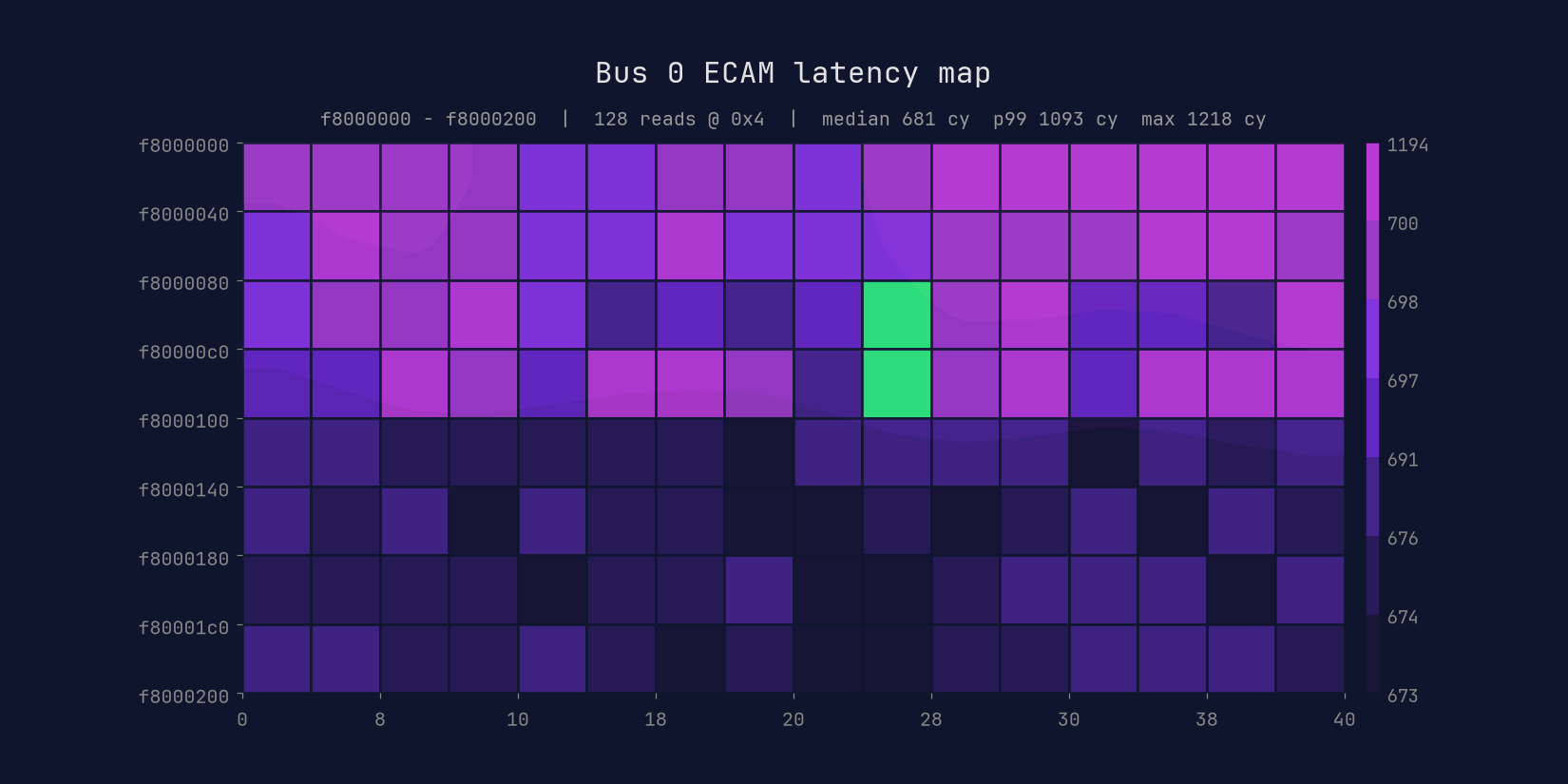 The mailbox latency is significantly higher than the surrounding data, and the duplicated spikes and equivalent variances let us match functionally similar registers. 1. Scan the root-complex config space: `sudo ./mmiotic --start-address 0xf8000000 --end-address 0xf8001000 --stride 4 --count 200` 2. Two dwords are the outliers: offset `0xe4` (1218 cy, value `80e3110b`) and `0xa4` (1199 cy, value `deadbeef`). `e4` is a documented doorbell; `a4` is undocumented. 3. Near-identical latency, 0x40 apart, both far above the floor — one register family reaching the same off-die target, of which only `e4` is public. 4. The values differ: `deadbeef` reads as an uninitialized/error sentinel — same mailbox, `a4` unimplemented or fed invalid input. ### Interrupt calibration Carefully selected latencies can sometimes be used in unusual exploitation scenarios ([MCHAMMER](https://github.com/xoreaxeaxeax/mchammer), [smiiiiiiiiiiiiiiii](https://github.com/xoreaxeaxeax/smiiiiiiiiiiiiiiii)): 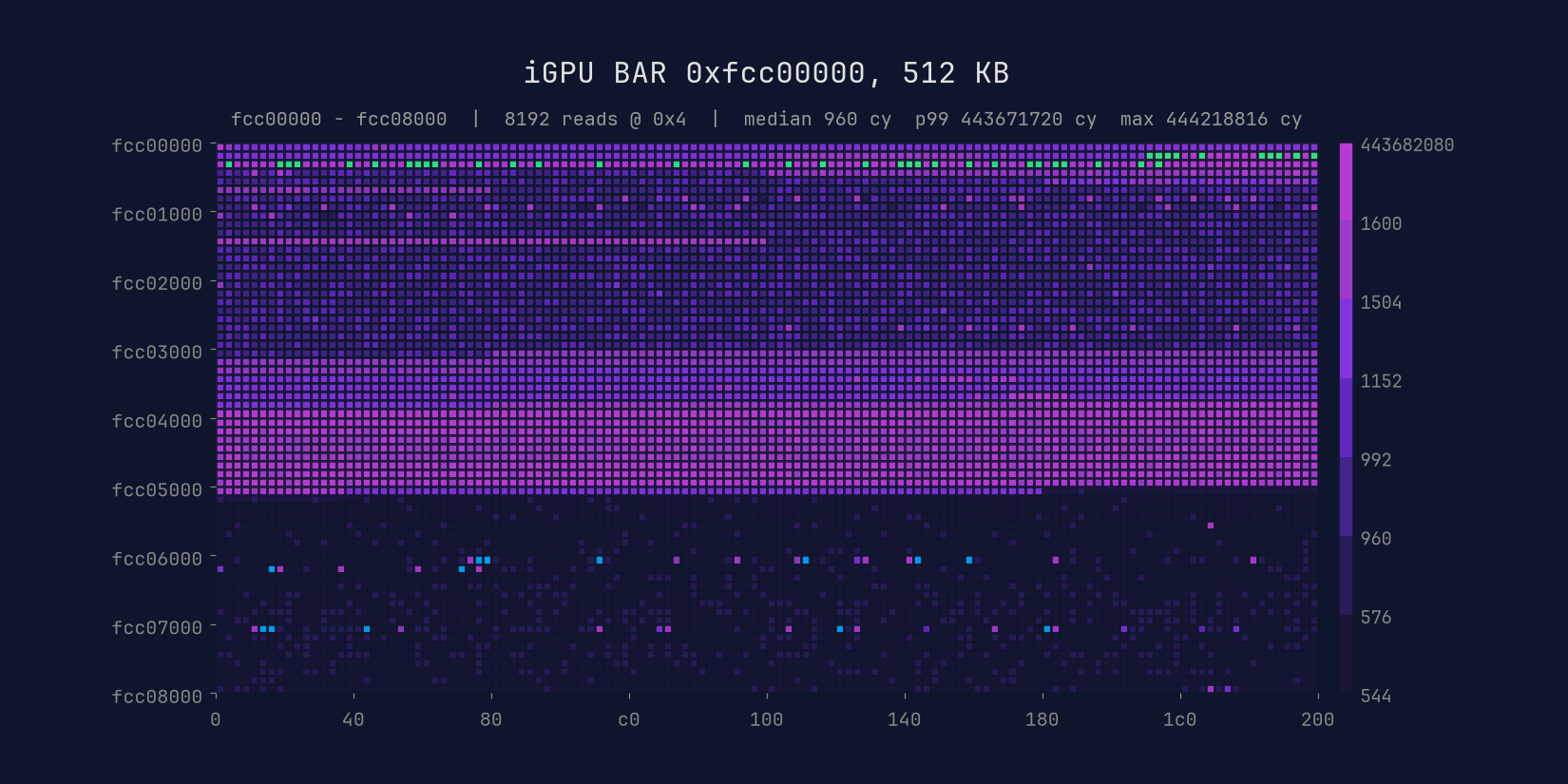 Here an idle, driverless Radeon turns one aligned 4-byte read into a ~100,000-cycle stall. 1. `sudo ./mmiotic --start-address 0x90e00000 --end-address 0x90e00100 --stride 4 --count 50` — sweep the head of the GPU BAR (`0x90e00000`, 256 KB). `0x90e00008` costs 110,152 cy; `0x90e00018`, 16 bytes on, is fast again at 1,523 — per-register, not per-page. 2. `sudo ./mmiotic --start-address 0x90e00000 --end-address 0x90e40000 --stride 4 --count 1 --binary` — `--binary` probes in bit-reversal order, so the full 256 KB aperture is uniformly covered after 1,012 probes, mapping a contiguous 48 KB block where every register is slow. 3. Likely, the latency is due to an SMU round-trip to ungate a clock/power-gated domain — so the latency map extracts the GPU's power layout, no driver or datasheet needed. ### Killer peek Ideally, *reading* a physical address would be a relatively safe operation, but `mmiotic` is especially good at accidentally finding the exceptions: 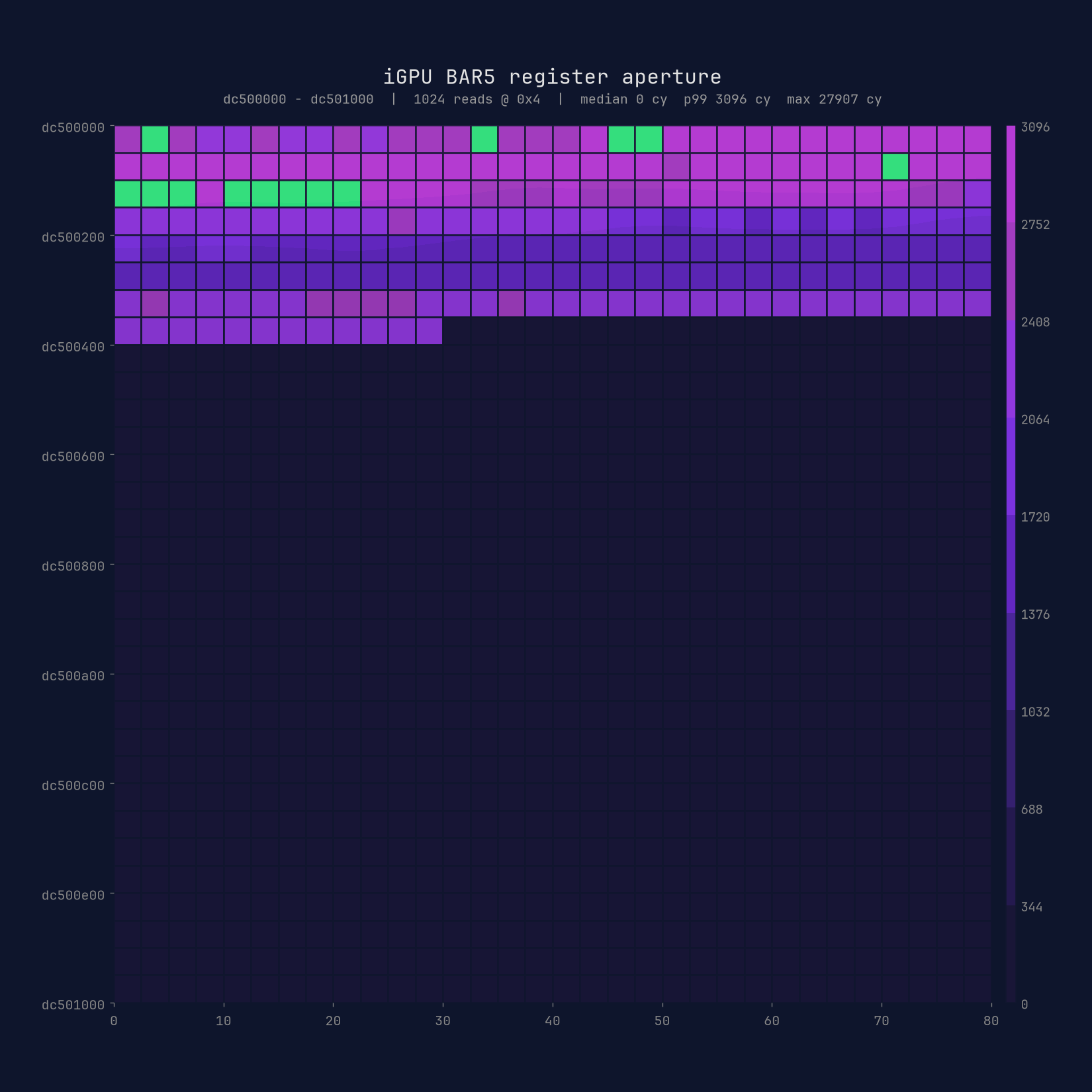 For example, on the above platform, a 1-byte read of `0xdc5003b0` — offset `0x3b0` of an undriven Zen 4 iGPU register BAR (Region 5, `0xdc500000`, 512 KB) — reliably resets the system. 1. `sudo ./mmiotic --address 0xdc5003b0 --size 1 --count 1`. No output; the box reboots. 2. Exactly one dword: `0x3ac` and `0x3b4` on either side read `00000000` at ~3,200 cy and are harmless. 3. A per-dword sweep of `0x3a0`–`0x3fc` finds 7 poison dwords interleaved with 17 safe ones. 4. `sudo busybox devmem 0xdc5003b0 32` and `sudo dd if=/dev/mem bs=1 count=1 skip=$((0xdc5003b0))` take the box down if you'd rather skip the middleman. ## Usage > [!WARNING] > Some platforms will reset when specific address regions are probed by > `mmiotic`. Be careful where you use this. ### Targeting | Option | Names | |--------|-------| | `-b/-d/-f/-r` | PCI `--bus`/`--device`/`--function`/`--register` — decoded against the ECAM base | | `-o, --offset <n>` | offset from the MMIO base (skips B/D/F decode) | | `-A, --address <n>` | one physical address; sets the region base implicitly | | `-a/-z` | `--start-address`/`--end-address` — a physical range; implies `--scan` | The ECAM base and size are auto-detected from ACPI MCFG (`/sys/firmware/acpi/tables/MCFG`). Override with `-M, --mmio-base` / `-Z, --mmio-size`. ### Scanning | Option | Effect | |--------|--------| | `-S, --scan` | walk all addresses in the target region | | `-t, --stride <n>` | step between addresses (default: 4) | | `-n, --limit <n>` | stop after this many addresses | | `--binary` | probe in bit-reversal order — after *k* probes the range has uniform coverage at ~`range/k` granularity (see the warning above) | | `-x, --limited` | limited register range (`0x00`–`0xff` vs `0x000`–`0xfff`) | | `-e, --skip` | skip functions that read `0xffffffff` at offset 0 (absent devices) | | `-I, --iomem` | scan every non–System-RAM top-level region in `/proc/iomem` | | `-R, --ioregion <name>` | scan `/proc/iomem` regions whose label matches `<name>`, any depth | `--find-target`/`--find-longest` turn scanning into search: | Option | Effect | |--------|--------| | `-F, --find-target <s>` | find an address whose access time reaches `s` seconds, then escalate width (unaligned 4b → 8/16/32/64/512b) to push it higher | | `-G, --find-longest` | same search, but exhaust every candidate instead of bailing on the first hit | | `-B, --fallbacks <n>` | candidates carried into the escalation phase (default: 10) | ### Access method | Option | Effect | |--------|--------| | `-s, --size <n>` | bytes per access: 1 / 2 / 4 (default) / 8 / 16 (XMM) / 32 (YMM) / 64 (ZMM) / 512 (`fxrstor`). Sizes > 4 are outside spec but work on tested hardware; AVX widths need AVX / AVX-512F | | `-c, --count <n>` | samples per address (default: 1); the minimum is reported | | `-L, --lock` | time a locked RMW: `lock xadd` (sizes 1/2/4/8) or `lock cmpxchg16b` (size 16). Writes the value back | | `-g, --gather` | time a vectored gather; `--size 16/32/64` picks XMM/YMM/ZMM (AVX-512) | | `-w, --write-read` | capture *write* latency by timing a read that must observe a prior posted write — see below | | `-E, --enter` (`--enter-2`, `--enter-3`) | drive a burst of up to 30 accesses from one `enter $0, $31` — see below | | `-k, --continue` | on an `fxrstor` fault, drop that sample and keep scanning | ### Output / execution | Option | Effect | |--------|--------| | `-C, --min-cycles <n>` | only print results with `min_cycles >= n` | | `-T, --time` | show nanoseconds alongside cycles (detects TSC frequency) | | `-N, --nanosecond` | with `--time`, print raw nanoseconds, no unit scaling | | `-P, --progress` | live scan progress on `stderr` | | `-p, --processor <n>` | pin to logical CPU `n` (default: 0) — reduces timer noise | | `-u, --unbound` | don't pin to a core | | `--lazy-mmap` | map in 2 GB windows on demand; required for regions > 2 GB | | `--quiet-mmap` | suppress "mmap failed" noise from inaccessible regions | ### Result lines ``` b/d/f.o.l: 00:02:00.00.4 address: 00000000f0100000 min: 312 max: 480 stdev: 2.1 dynamic: 0 value: 8086abcd ``` | Field | Meaning | |-------|---------| | `b/d/f.o.l` | bus/device/function, register offset, access size | | `offset` | offset from the MMIO base — replaces `b/d/f.o.l` when the target came from `-o`/`-A`/`-a`+`-z` | | `address` | full 64-bit physical address | | `min`/`max` | fastest and slowest access seen, in cycles | | `stdev` | standard deviation of the sampled cycle counts | | `dynamic` | 1 if the value changed at any point across samples | | `value` | value read — for sizes over 8 bytes, the first 32 bytes as space-separated qwords | | `faults` | appended only if an access faulted | `-T` suffixes the cycle counts with `cy` and inserts a scaled min/max time pair (`-N` prints those as raw nanoseconds): ``` b/d/f.o.l: 00:02:00.00.4 address: 00000000f0100000 min: 312 cy max: 480 cy ( 104 ns/ 160 ns) stdev: 2.1 dynamic: 0 value: 8086abcd ``` ## Setup Build: ``` make ``` Runs as root to get access to `/dev/mem`. If you see: `mmap ... Operation not permitted`, try booting with `iomem=relaxed` to lift `CONFIG_STRICT_DEVMEM`: ``` # /etc/default/grub GRUB_CMDLINE_LINUX="iomem=relaxed nopat" ``` Then `sudo update-grub` and reboot. ## In-the-wild `mmiotic` has been used to advance a variety of internal and external research, sometimes in unexpected ways. Some examples of `mmiotic` applications: * [MCHAMMER](https://github.com/xoreaxeaxeax/mchammer): `mmiotic` calibrates a delayed machine check exception for precision delivery of MC# signals into protected environments. * [smiiiiiiiiiiiiiiii](https://github.com/xoreaxeaxeax/smiiiiiiiiiiiiiiii): `mmiotic` resolves the high-latency instruction for breaking the SMM rendezvous. * [The Assembly Hall of Shame](https://github.com/xoreaxeaxeax/asm-hall-of-shame): `mmiotic` is used extensively for the important problem of performance deoptimization. ## Author `mmiotic` is a research effort from Christopher Domas (@xoreaxeaxeax).
