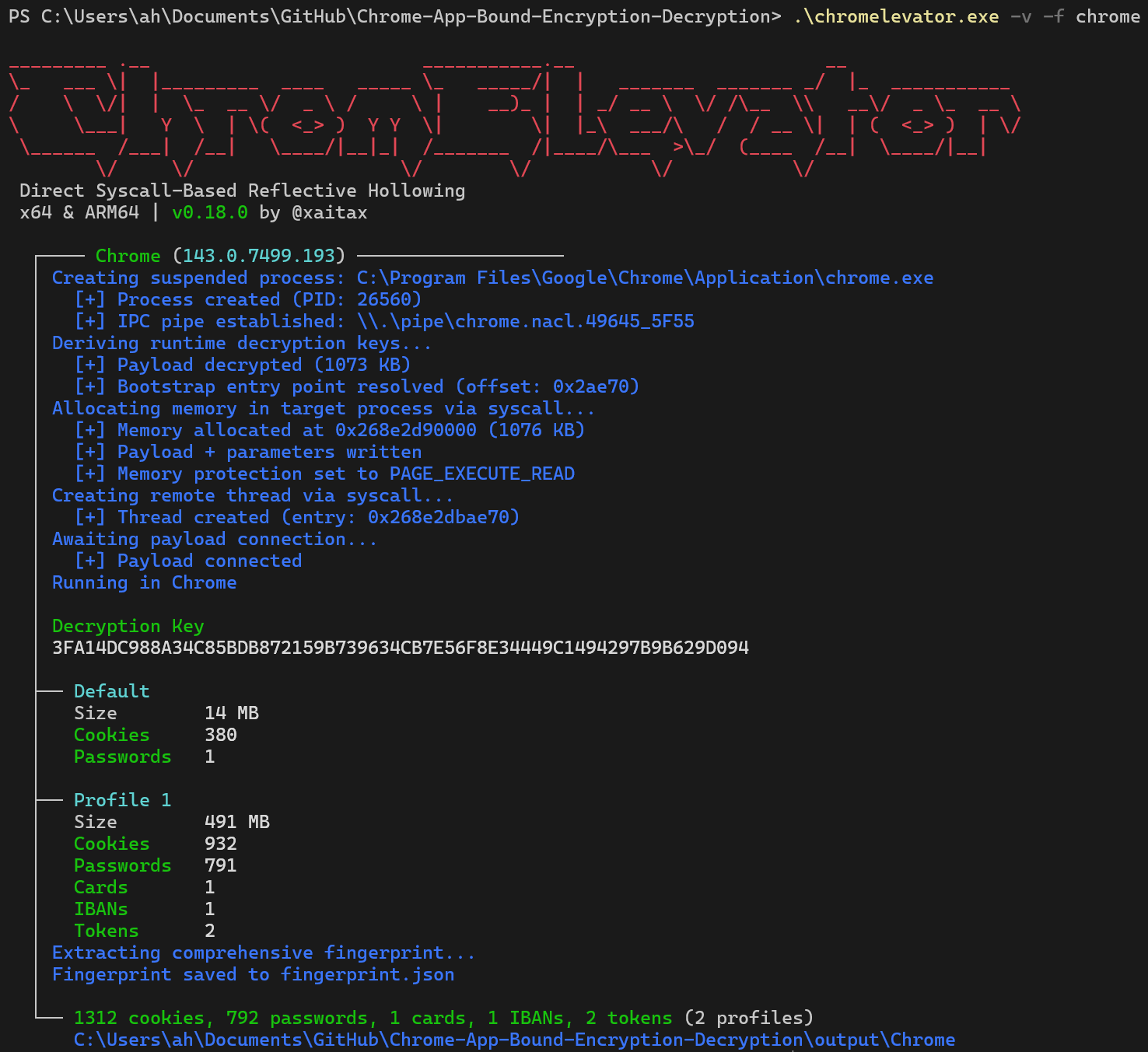

Bypass Chromium's App-Bound Encryption via Direct Syscall-based Reflective Process Hollowing. Extract cookies, passwords, payment methods & tokens from Chrome, Edge, Brave & Avast - fileless, user-mode, no admin required.

Chrome App-Bound Encryption Decryption)




A post-exploitation tool demonstrating a complete, in-memory bypass of Chromium's App-Bound Encryption (ABE). This project utilizes Direct Syscall-based Reflective Process Hollowing to launch a legitimate browser process in a suspended state, stealthily injecting a payload to hijack its identity and security context. This Living-off-the-Land (LOTL) technique subverts the browser's own security model. The fileless approach allows the tool to operate entirely from memory, bypassing user-land API hooks to decrypt and exfiltrate sensitive user data (cookies, passwords, payments) from modern Chromium browsers.
If you find this research valuable, I'd appreciate a coffee:

This tool's effectiveness is rooted in a combination of modern, evasion-focused techniques:
Direct Syscalls for Evasion: Bypasses EDR/AV user-land hooks on standard WinAPI functions by invoking kernel functions directly. The engine dynamically resolves syscall numbers at runtime using Hell's Gate technique with hash-based function matching (no plaintext syscall names in the binary).
Direct Syscall-Based Process Hollowing: A stealthy process creation and injection technique. Instead of injecting into a high-traffic, potentially monitored process, it creates a new, suspended host process. This significantly reduces the chances of detection, as all memory manipulations occur before the process begins normal execution.
Fileless In-Memory Payload: The payload DLL never touches the disk on the target machine. It is embedded as a ChaCha20-encrypted compile-time byte array with compile-time derived keys, decrypted in-memory, and reflectively loaded, minimizing its forensic footprint and bypassing static file-based scanners.
Reflective DLL Injection (RDI): A stealthy process injection method that circumvents LoadLibrary for the main payload, thereby evading detection mechanisms that monitor module loads. The self-contained bootstrap loader maps PE sections, performs relocations, and resolves imports from memory.
Target-Context COM Invocation: The lynchpin for defeating App-Bound Encryption. By executing code within the trusted browser process, we inherit its identity and security context, allowing us to make legitimate-appearing calls to the ABE COM server and satisfy its path-validation security checks.
Nt*/Zw* function names in binary—uses compile-time DJB2 hashes.LoadLibrary calls.--kill flag available for full process termination.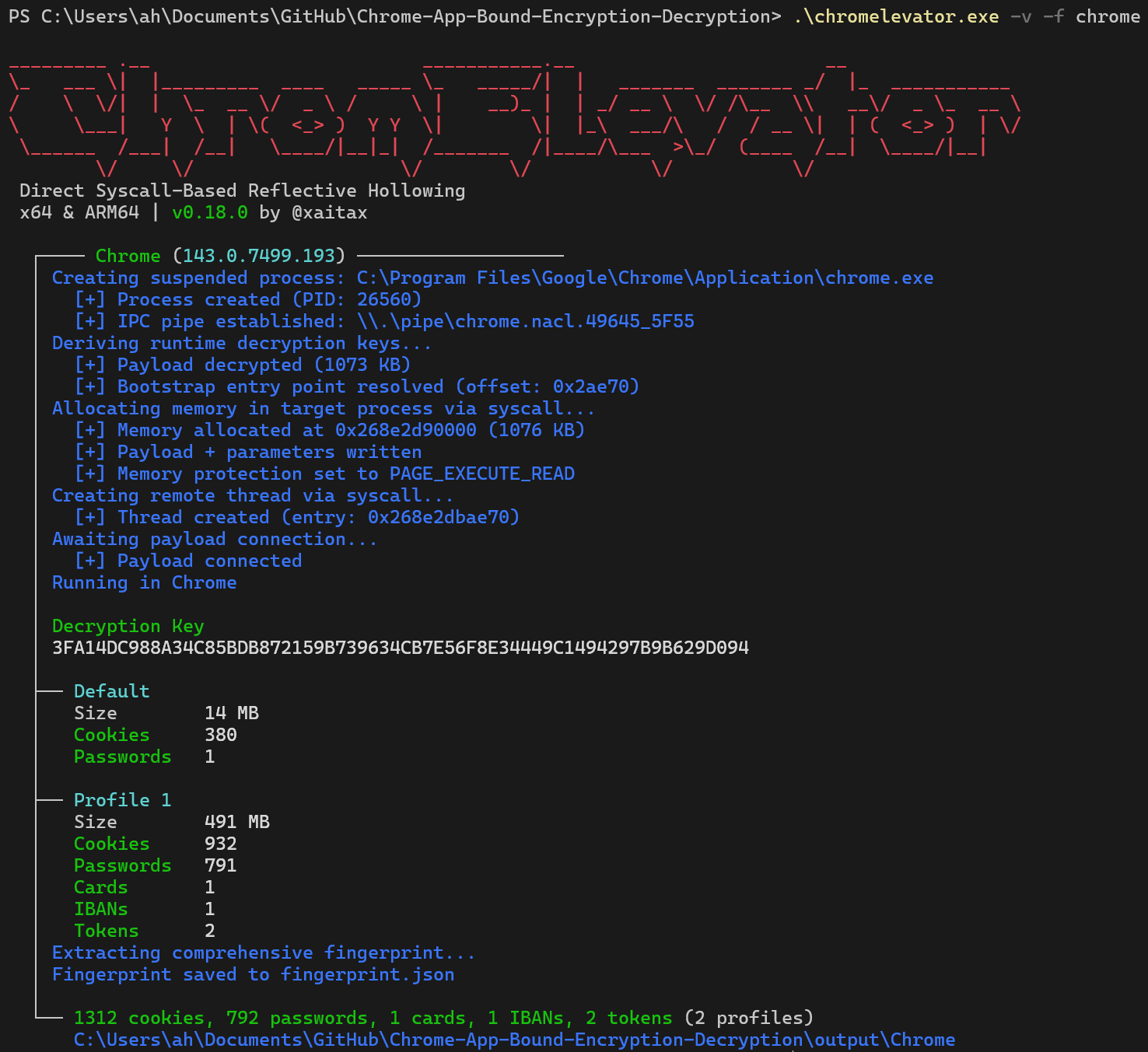
| Browser | Tested Version (x64 & ARM64) |
|---|---|
| Google Chrome | 144.0.7559.133 |
| Google Chrome Beta | 145.0.7632.18 |
| Brave | 1.86.148 (144.1.86.148) |
| Microsoft Edge | 145.0.3800.36 |
| Avast Secure Browser | 143.0.33371.147 |
Note: Chrome/Brave/Edge 144+ use the new
IElevator2COM interface. This tool automatically usesIElevator2when available and falls back toIElevatorfor older versions. Avast Secure Browser uses a customIElevatorChromeinterface with an extended vtable (12 methods, DecryptData at offset 104).
This matrix outlines the extraction capabilities for each supported browser.
| Feature | Google Chrome | Microsoft Edge | Brave | Avast Secure Browser |
|---|---|---|---|---|
| Cookies | ✅ ABE | ✅ ABE | ✅ ABE | ✅ ABE |
| Passwords | ✅ ABE | ✅ ABE | ✅ ABE | ✅ ABE |
| Payment Methods | ✅ ABE | ✅ ABE | ✅ ABE | ✅ ABE |
| IBANs | ✅ ABE | ❌ N/A | ✅ ABE | ✅ ABE |
| Auth Tokens | ❌ N/A | ❌ N/A | ❌ N/A |
The tool's execution is focused on stealth and efficiency, built around a Direct Syscall-based Reflective Hollowing process. This approach ensures that few high-level API calls are made and that the payload operates from within a legitimate, newly created browser process.
chromelevator.exe)