 wxdou/cve-2025-63914
Public disclosure and patch for CVE-2025-63914: Zip bomb vulnerability in Cinnamon/kotaemon.

Public disclosure and patch for CVE-2025-63914: Zip bomb vulnerability in Cinnamon/kotaemon.
Wang Yuanrong
The _may_extract_zip function fails to enforce limits on ZIP decompression, allowing a malicious ZIP bomb to trigger excessive resource consumption and denial of service.
The _may_extract_zip function in the \libs\ktem\ktem\index\file\ui.py file does not check the contents of uploaded ZIP files. Although the contents are extracted into a temporary folder that is cleared before each extraction, successfully uploading a ZIP bomb could still cause the server to consume excessive resources during decompression. Moreover, if no further files are uploaded afterward, the extracted data could occupy disk space and potentially render the system unavailable. Anyone with permission to upload files can carry out this attack.
Use the command to pull and run the latest image:
docker run \
--name kotaemon \
-e GRADIO_SERVER_NAME=0.0.0.0 \
-e GRADIO_SERVER_PORT=7860 \
-v /home/kali/ktem_app_data/:/app/ktem_app_data \
-p 7860:7860 -d \
ghcr.io/cinnamon/kotaemon:0.11.0-full
Create a highly compressible payload consisting of repeated bytes to achieve extreme compression ratios.
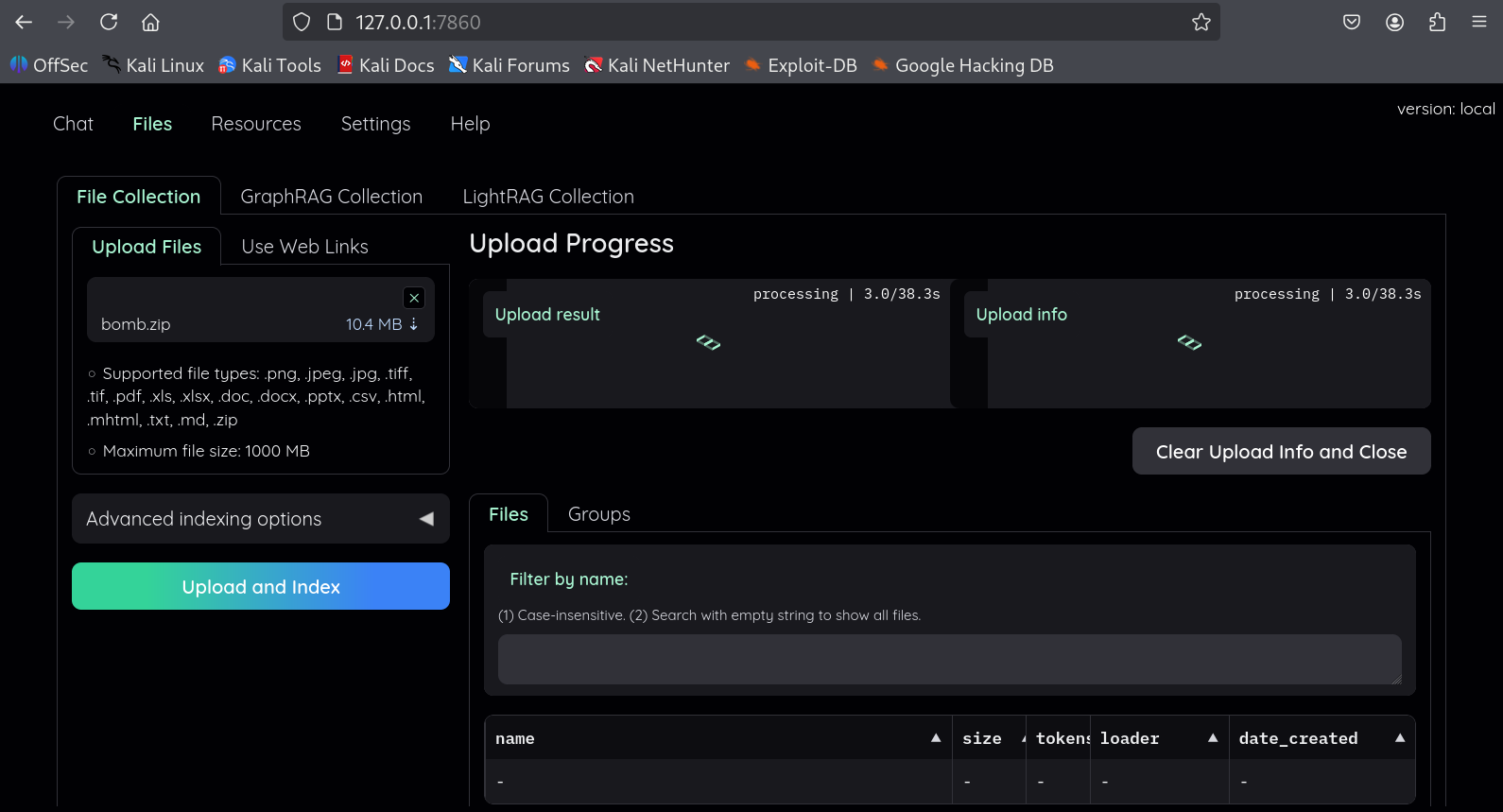
During the process we may notice slowdowns due to resource consumption, and we can check the size of the temporary directory.

This resource usage will remain even when no other files are being uploaded.
An attacker with file-upload privileges can submit a crafted ZIP archive that causes uncontrolled disk, CPU, and memory consumption, leading to service crash or host outage. All instances — including the latest release (0.11.0) — are affected.
A test ZIP bomb and the corresponding patch for version 0.11.0 are provided in this repository.
Patch overview:
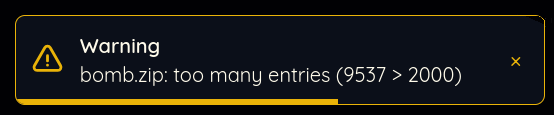
After applying the patch, a warning will pop up when a zip bomb is submitted, and the operation will be rejected: