 webarx-security/wpbullet
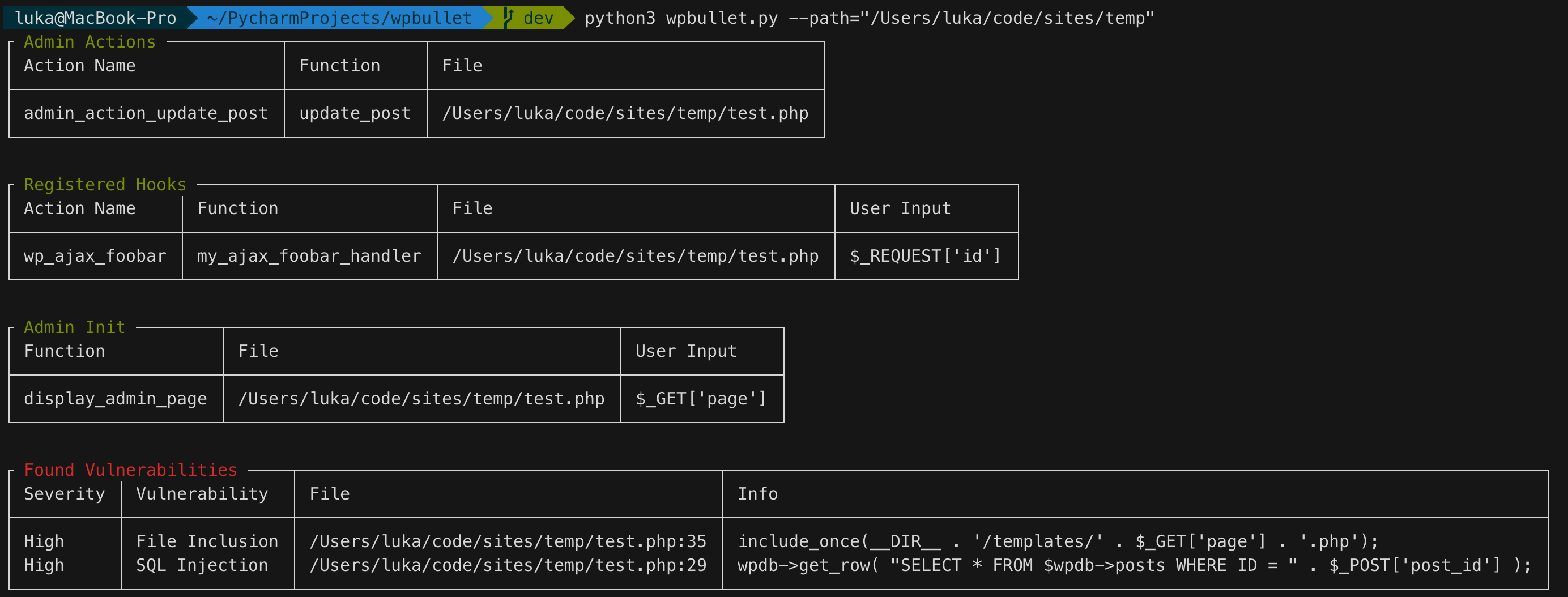
A static code analysis for WordPress (and PHP)

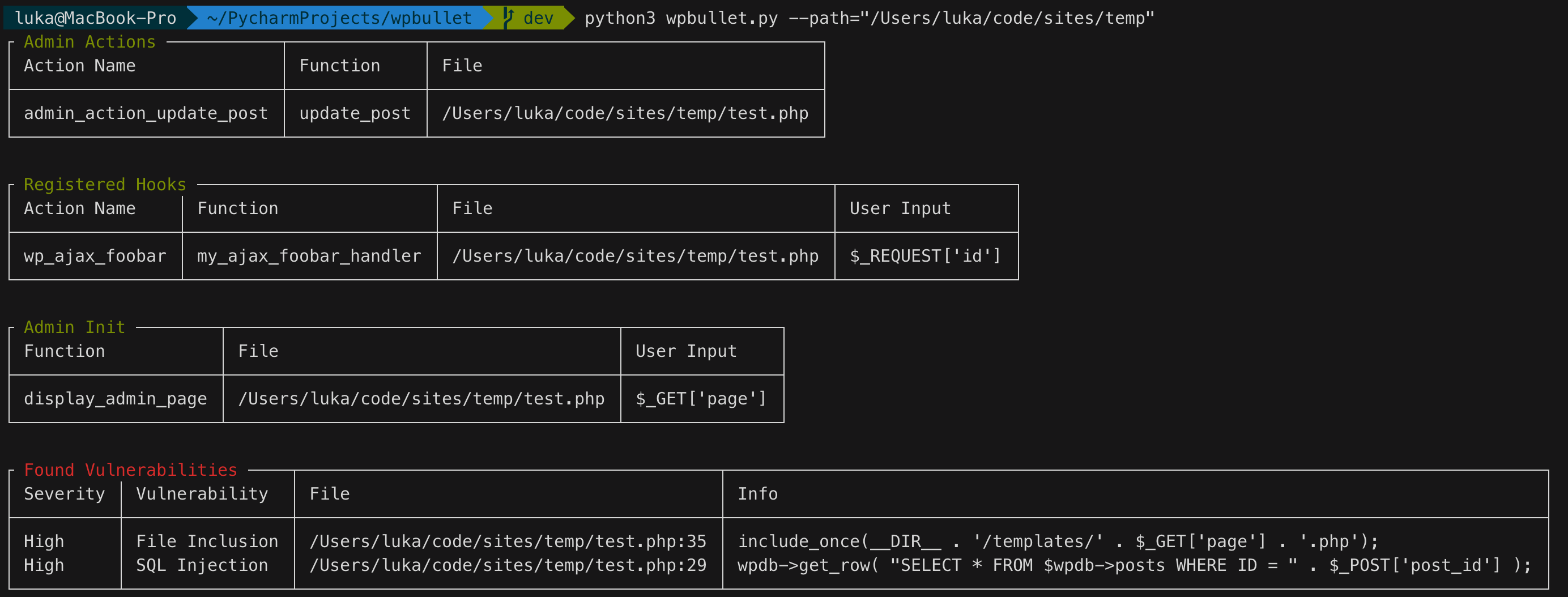


A static code analysis for WordPress Plugins/Themes (and PHP)
Simply clone the repository, install requirements and run the script
$ git clone https://github.com/webarx-security/wpbullet wpbullet$ cd wpbullet$ pip install -r requirements.txt$ python wpbullet.pyAvailable options:
--path (required) System path or download URL
Examples:
--path="/path/to/plugin"
--path="https://wordpress.org/plugins/example-plugin"
--path="https://downloads.wordpress.org/plugin/example-plugin.1.5.zip"

--enabled (optional) Check only for given modules, ex. --enabled="SQLInjection,CrossSiteScripting"
--disabled (optional) Don't check for given modules, ex. --disabled="SQLInjection,CrossSiteScripting"
--cleanup (optional) Automatically remove content of .temp folder after scanning remotely downloaded plugin (boolean)
--report (optional) Saves result inside reports/ directory in JSON format (boolean)

$ python wpbullet.py --path="/var/www/wp-content/plugins/plugin-name"
Creating a module is flexible and allows for override of the BaseClass methods for each module as well as creating their own methods
Each module in Modules directory is implementing properties and methods from core.modules.BaseClass,
thus each module's required parameter is BaseClass
Once created, module needs to be imported in modules/__init__.py. Module and class name must be consistent
in order to module to be loaded.
If you are opening pull request to add new module, please provide unit tests for your module as well.
Modules/ExampleVulnerability.py
from core.modules import BaseClass


class ExampleVulnerability(object):

    # Vulnerability name
    name = "Cross-site Scripting"

    # Vulnerability severity
    severity = "Low-Medium"

    # Functions causing vulnerability
    functions = [
        "print"
        "echo"
    ]

    # Functions/regex that prevent exploitation
    blacklist = [
        "htmlspecialchars",
        "esc_attr"
    ]
Regex pattern is being generated in core.modules.BaseClass.build_pattern and therefore can be overwritten in
each module class.
Modules/ExampleVulnerability.py
import copy


...
# Build dynamic regex pattern to locate vulnerabilities in given content
def build_pattern(self, content, file):
    user_input = copy.deepcopy(self.user_input)

    variables = self.get_input_variables(self, content)

    if variables:
        user_input.extend(variables)

    if self.blacklist:
        blacklist_pattern = r"(?!(\s?)+(.*(" + '|'.join(self.blacklist) + ")))"
    else:
        blacklist_pattern = ""

    self.functions = [self.functions_prefix + x for x in self.functions]

    pattern = r"((" + '|'.join(self.functions) + ")\s{0,}\(?\s{0,1}" + blacklist_pattern + ".*(" + '|'.join(user_input) + ").*)"
    return pattern
Running unit tests: $ python3 -m unittest
