 vulnerscom/zabbix-threat-control
Zabbix vulnerability assessment plugin

Turn the Zabbix you already run into a vulnerability-management console.
ztc reads each host's software inventory through the stock zabbix-agent2
(no extra agent to deploy), audits it against Vulners, and
pushes scored, per-host findings — problems, dashboards and CVSS graphs —
back into Zabbix. One static binary, installed in one command.


UserParameters. Remediation goes through a single whitelisted key + narrow
sudoers — never arbitrary system.run.audit/linux; Windows
registry software via Smart Audit and installed KBs via audit/kb (with
per-CVE CVSS). Smart Audit is independent of the Zabbix version.On your Zabbix server (or any Linux host that can reach Zabbix + Vulners):
curl -fsSL https://raw.githubusercontent.com/vulnersCom/zabbix-threat-control/master/deploy/install.sh | sudo sh
The installer asks for your Vulners API key and Zabbix connection, installs a
systemd service, and offers to create the Zabbix entities (ztc provision --all).
Then link the collection template to the hosts you want scanned — see
docs/guide.md.
Other options (Docker, manual, air-gapped, bootstrap-via-Zabbix):
deploy/README.md.
 hosts: zabbix-agent2  UserParameter
   Linux   → vulners.os / version / arch / packages
   Windows → vulners.os / version / win.software / win.kb
        │   (polled into Zabbix items)
        ▼
   ztc scan ─► collect (Zabbix API) ─► audit (Vulners) ─► aggregate ─► sender ─► Zabbix
                                                                           │
        problems (CVSS severity) · dashboard · graphs · vulners.host tags ◄┘
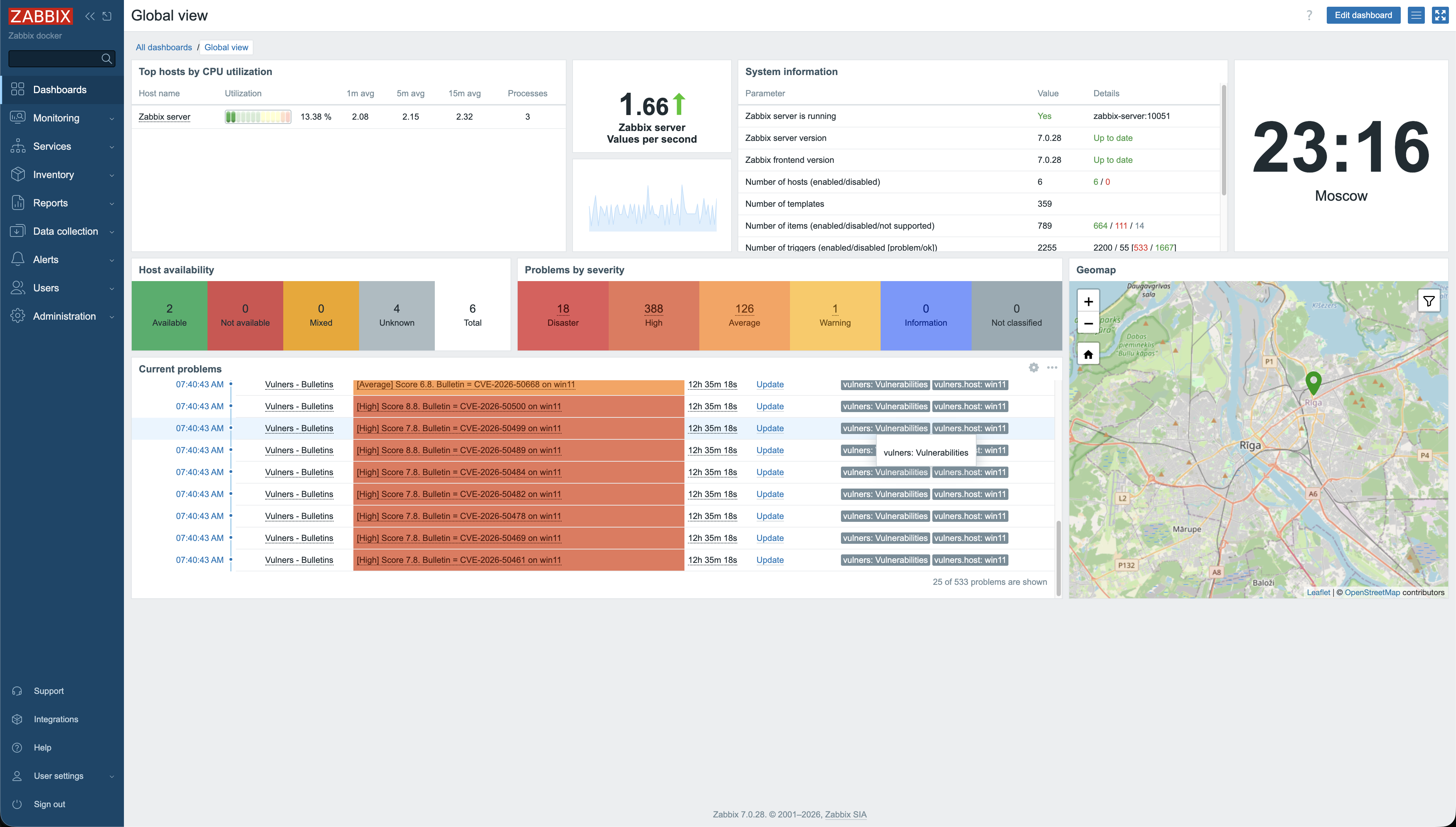
ztc scan --daemon runs the loop on a schedule; ztc provision creates the
Zabbix template, report hosts, triggers and dashboard.
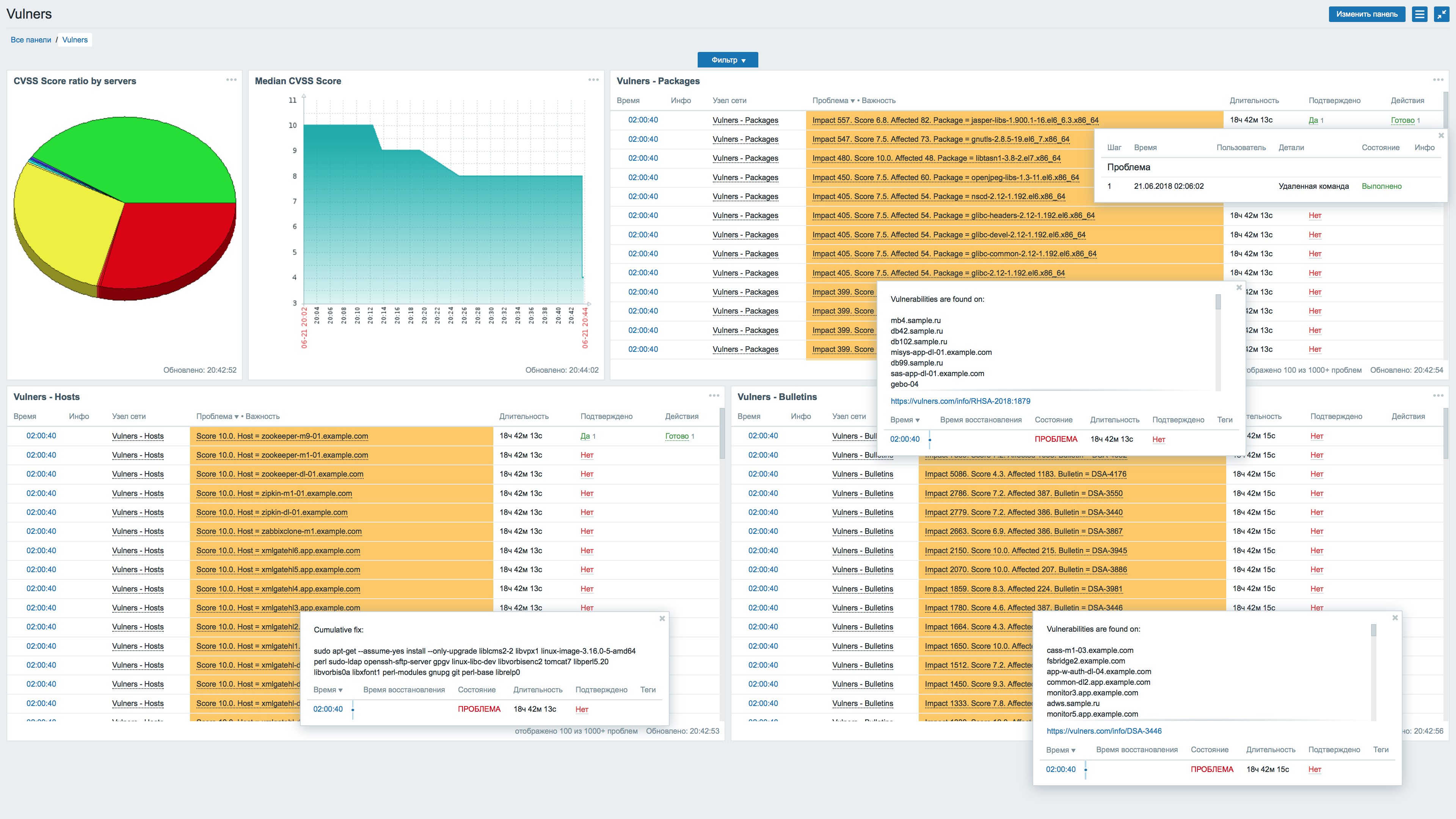
Vulners - Hosts, - Bulletins, - Packages, - Statistics.vulners.host tag. In Monitoring
→ Problems filter Tags: vulners.host Equals <host> to see one host's
vulnerabilities. (One finding = one (vulnerability, host) pair.)Median CVSS trend and score distribution across the fleet:
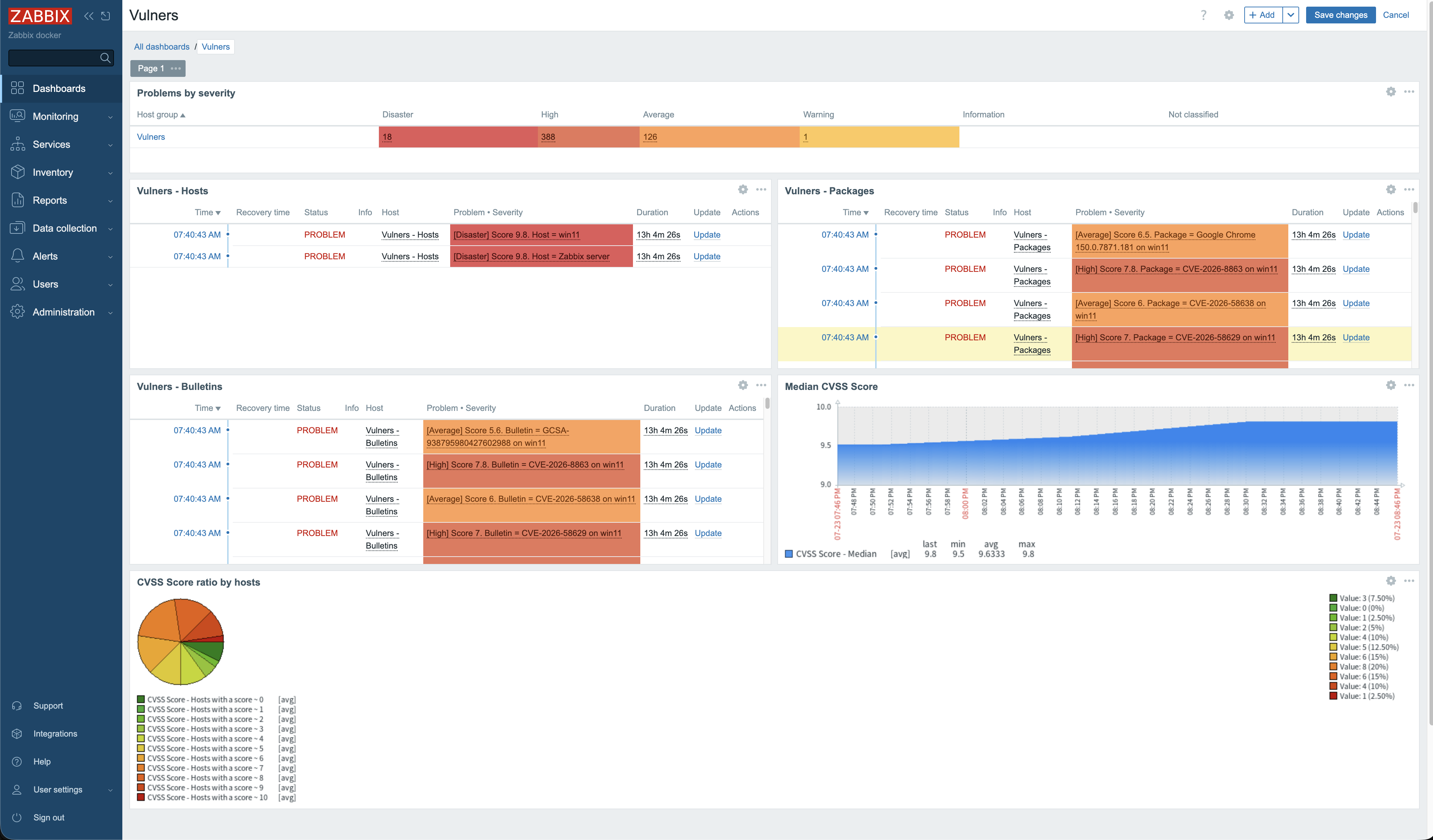
Severity breakdown — real Disaster / High / Average / Warning counts, not one grey "Not classified" bar:
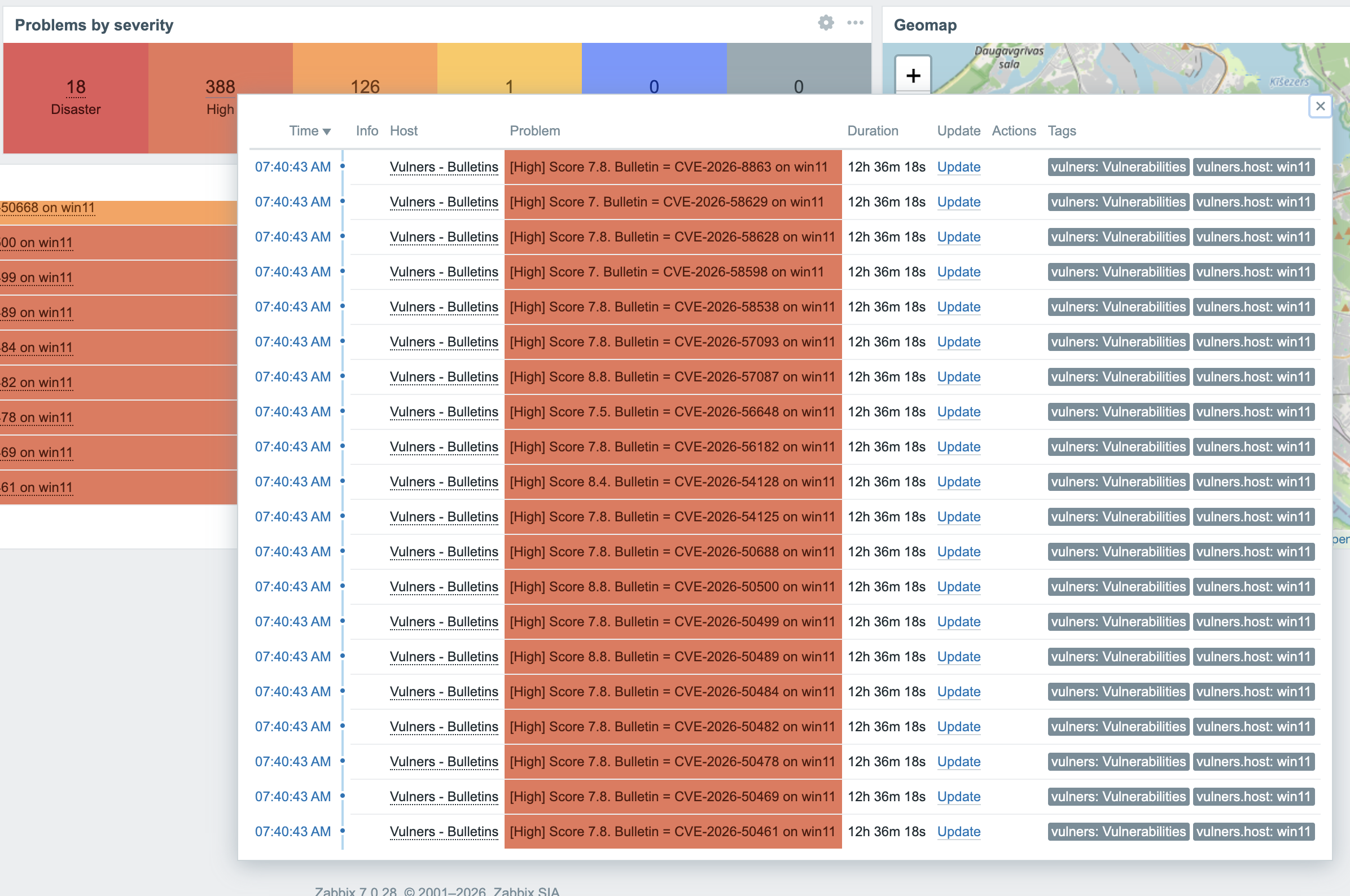
One host's vulnerabilities via the vulners.host tag filter:
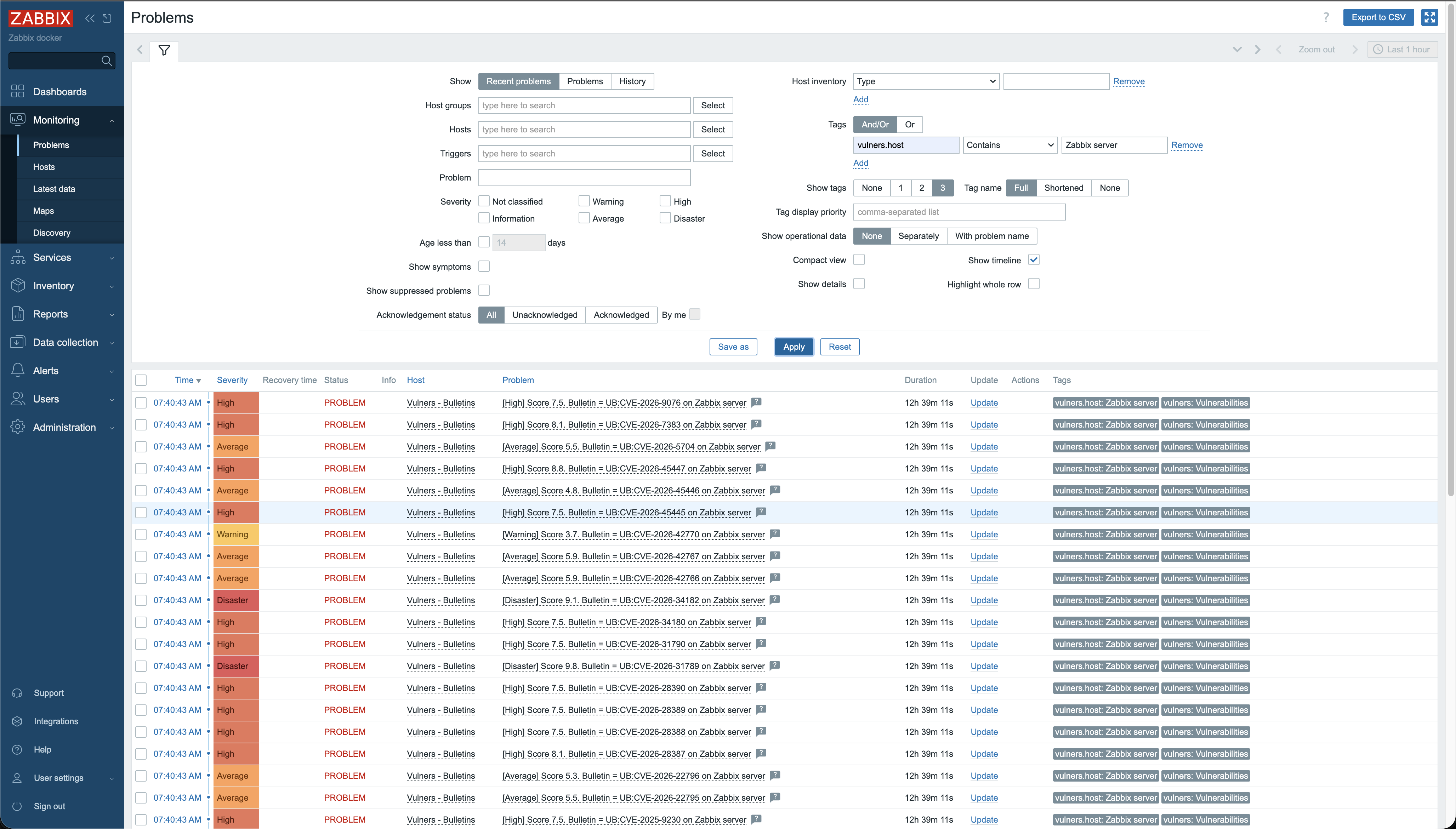
A single finding — scored by CVSS, tagged with its host, linked to vulners.com:

Everything has a default; supply secrets via environment variables (they
override the YAML file). Full example: config.example.yaml.
| Env | Purpose |
|---|---|
VULNERS_API_KEY | Vulners API key (required) |
VULNERS_BASE_URL | self-hosted / proxy Vulners endpoint (optional) |
ZABBIX_URL | Zabbix frontend URL (JSON-RPC API) |
ZABBIX_TOKEN | API token (preferred) … |
ZABBIX_USER / ZABBIX_PASSWORD | … or user + password |
ZABBIX_SERVER_FQDN / ZABBIX_SERVER_PORT | zabbix-sender target |
ZTC_SCHEDULE | daemon scan interval (e.g. 1h) |
ZTC_MIN_CVSS | drop findings below this CVSS before creating objects |
ztc --help lists the full set.
ztc scan --daemon                 # run the scan loop on a schedule
ztc scan --once                   # a single cycle
ztc provision --all               # create/reconcile templates, report hosts, dashboard
ztc fix --host H --package P      # remediate a package (whitelisted, opt-in)
ztc upgrade                       # self-update, then re-run `provision --all`
ztc version --check               # print version and check for updates
ztc fix upgrades a vulnerable package via a whitelisted vulners.fix[<pkg>]
agent key drained by a host-side worker — no arbitrary command execution. It can
run manually or, with scan --daemon --auto-fix, be driven by a trusted user
acknowledging the problem in Zabbix. Rationale:
docs/adr/0001-remediation-mechanism.md.
| Zabbix | 6.0 & 7.0 LTS, 7.4, 8.0 (auto-detected) |
| OS audited | Linux (deb/rpm/apk/…), Windows (software + KB) |
| ztc runs on | Linux amd64 / arm64 |
The original Python implementation remains in this repository's git history
(the commits before the Go rewrite) and in the pre-Go release tags. It shares
the same Zabbix-side names (group, report hosts, dashboard), but collects via
stock agent keys instead of a shipped report.py, splits the template in two,
and drops the fix Action. Step-by-step (config mapping, object cleanup, host
re-instrumentation, remediation switch): docs/MIGRATION.md.
go build ./...     # compile
go test ./...      # unit tests (no network)
go vet ./... && gofmt -l .
make build         # -> bin/ztc
A Docker test stand (Zabbix + agent + ztc) is in
deploy/docker/README.md. CI (build/test/lint) runs
on every push; tagging a v* commit publishes binaries and a GHCR image.
See LICENSE.

