

Skip to content
KitploitKITPLOIT
ToolsBlog
Submit
ToolsBlog
Submit

Hacking, PenTest, and Cybersecurity Tools for Your Security Arsenal!

Kitploit is a directory of hacking, cybersecurity, and pentesting tools. Discover the latest project updates to find vulnerabilities, analyze systems, automate testing, and strengthen your security.

··Feeds·Contact·Privacy·© 2026 Kitploit

Tool Directory

Categories

View all categories
Loading categories
Tools/GitHubGitHub/vinsontang1/vultriage
Static AnalysisVulnerability AnalysisCode AnalysisMachine LearningPapers & ResearchLearning & EducationAI Security
GitHubvinsontang1/vultriage

VulTriage

The code of VulTriage: Triple-Path Context Augmentation for LLM-Based Vulnerability Detection

View Repository
5174 months agoNot yet reviewed

Most Popular

View all →

Discover the most used tools by our community.

Explore all tools

Browse our collection of tools

View all tools →
Share

ChatGPT Image 2026年5月10日 16_51_24

An intelligent vulnerability detection framework based on Large Language Models and static code analysis, supporting multi-dataset evaluation and ablation studies.
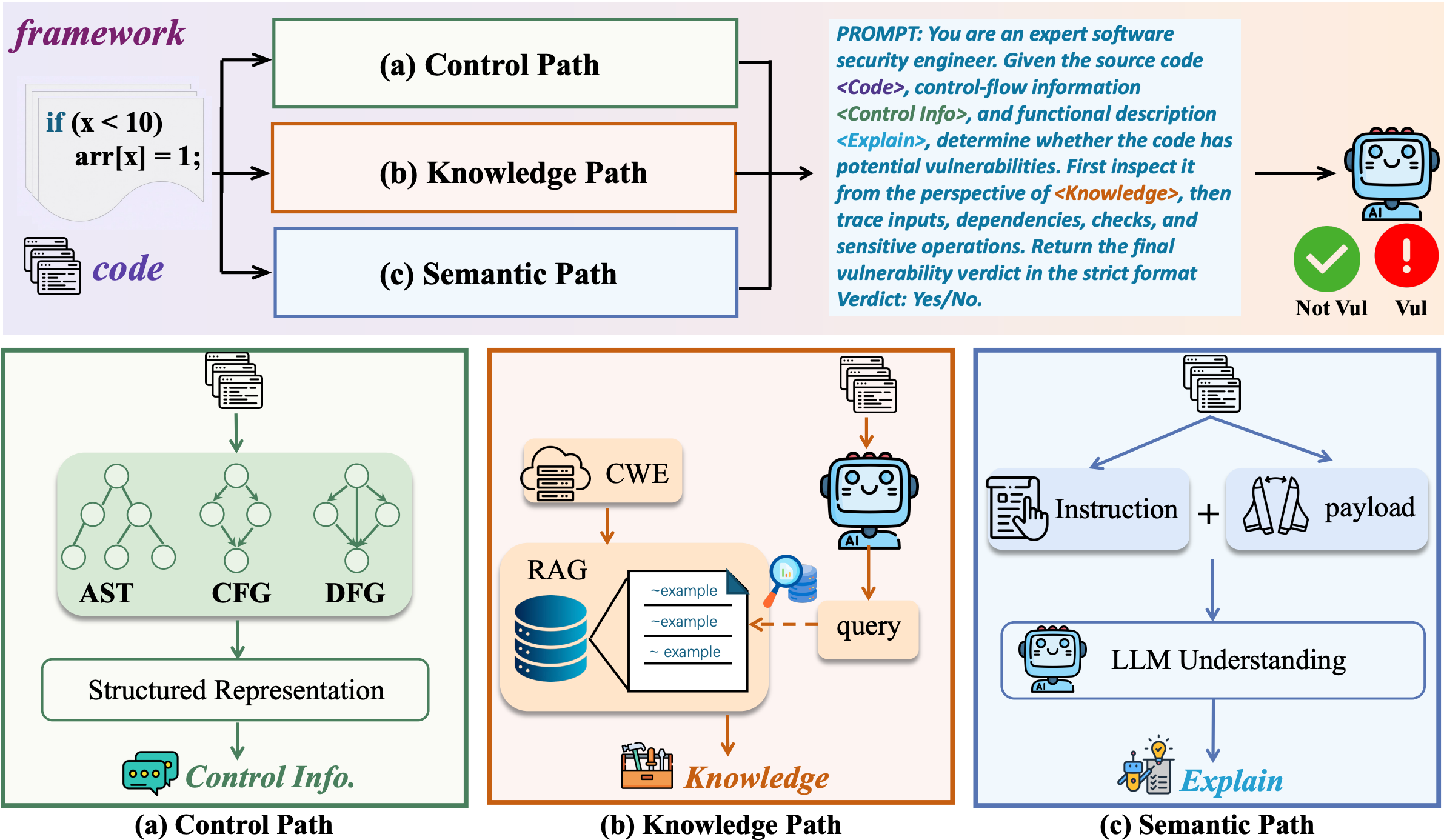
image-20260510164600403

📋 Table of Contents

  • Introduction
  • Key Features
  • System Requirements
  • Quick Start
  • Usage
  • Datasets & Models
  • FAQ

Introduction

This project is an intelligent vulnerability detection framework based on GPT-4o and BGE-M3 models, combining:

  • Static Structure Analysis: Control Flow Graphs (CFG), Data Flow Graphs (DFG), Abstract Syntax Trees (AST)
  • Retrieval-Augmented Generation (RAG): Vulnerability pattern matching based on CWE knowledge base
  • Code Understanding: Semantic analysis using Large Language Models
  • Paired/Single-sample Detection: Support for multiple evaluation modes

Key Features

  • ✅ Support for PrimeVul and Kotlin datasets
  • ✅ Integrated CWE vulnerability knowledge base retrieval
  • ✅ Configurable ablation studies
  • ✅ Real-time metrics tracking
  • ✅ Flexible hyperparameter experiment support
  • System Requirements

    • Python >= 3.9
    • CUDA (optional, for GPU acceleration)

    Quick Start

    1. Install Dependencies

    root@kitploit:~
    pip install -r requirements.txt
    

    2. Prepare Resources

    Download BGE-M3 Model

    The model will be downloaded automatically, or you can download it manually:

    root@kitploit:~
    git clone https://huggingface.co/BAAI/bge-m3
    # Note: BGE-M3 related dependencies can be installed via FlagEmbedding. For details, refer to: pip install -U FlagEmbedding
    

    Prepare CWE Data

    Ensure that cwec_latest.xml/cwec_v4.19.1.xml and 1435.csv/1435_filtered_columns.csv (CWE index data) files exist in the project root directory.

    Note: This project uses CWE Top 25 Most Dangerous Software Weaknesses. Related files are already included in the project root directory.

    Prepare Datasets

    Place the following files in the project root directory:

    • primevul_test_paired.jsonl (PrimeVul dataset)
    • LLM4Vul-main/LLM4Vul-main/data/kotlin_data.csv (Kotlin dataset)

    3. Configure API Key

    Modify the OpenAI API configuration in main.py or hyperparam_exp.py:

    root@kitploit:~
    client = OpenAI(
        api_key="YOUR_API_KEY",
        base_url="https://api.poixe.com/v1"
    )
    

    Note: The current URL https://api.poixe.com/v1 failed to parse. It may be an unsupported webpage type or a broken link. Please verify the link validity or switch to another API provider.

    4. Run Vulnerability Detection

    Basic Mode (Full Functionality)

    root@kitploit:~
    python main.py --wotask all --jsonl_file primevul_test_paired.jsonl
    

    Ablation Study Mode

    root@kitploit:~
    # Without control flow information
    python main.py --wotask wo_ctrl_info_pth --jsonl_file primevul_test_paired.jsonl
    # Without RAG knowledge
    python main.py --wotask wo_rag_pth --jsonl_file primevul_test_paired.jsonl
    # Without code understanding
    python main.py --wotask wo_exp_pth --jsonl_file primevul_test_paired.jsonl
    # Without any auxiliary information
    python main.py --wotask nan --jsonl_file primevul_test_paired.jsonl
    

    Hyperparameter Experiments

    root@kitploit:~
    # Pairwise evaluation mode
    python hyperparam_exp.py --mode pairwise --input_file primevul_test_paired.jsonl --detail_level C --info_comb all --desc_level concise --max_vuln 2
    # Single-sample evaluation mode
    python hyperparam_exp.py --mode single --input_file LLM4Vul-main/LLM4Vul-main/data/kotlin_data.csv
    

    5. View Results

    Detection results are saved in real-time to metrics_log.txt and final evaluation summaries are output to the terminal:

    • Evaluation metrics include accuracy, recall, false positive rate, etc.
    • Ablation study results compare performance differences across different modes to analyze the contribution of each module.

    Usage

    Main Scripts Overview

    ScriptPurpose
    main.pyMain vulnerability detection script with ablation study support
    hyperparam_exp.pyHyperparameter experiments and multi-mode evaluation
    retrieval.pyCWE knowledge base retrieval module (hybrid retrieval based on BGE-M3 model)
    metrics_tracker.pyReal-time metrics tracker with log saving and visualization support

    Parameter Description

    main.py Parameters

    ParameterDefaultDescription
    --wotaskallAblation mode: all (full functionality), wo_ctrl_info_pth (no static structure info), wo_rag_pth (no RAG knowledge), wo_exp_pth (no code understanding), nan (no auxiliary information)
    --jsonl_fileprimevul_test_paired.jsonlJSONL dataset path
    --metrics_filemetrics_log.txtMetrics output file

    hyperparam_exp.py Parameters

    ParameterDefaultDescription
    --modepairwiseEvaluation mode: pairwise or single
    --input_fileRequiredInput file path (JSONL or CSV format)
    --detail_levelCCode analysis detail level: C (complete), B (standard), A (brief)
    --info_comballInformation combination: all, no_ast, no_cfg, no_dfg
    --desc_levelconciseDescription level: concise, normal, detailed
    --max_vuln2Maximum number of vulnerabilities: 2 or 4

    Datasets & Models

    📊 Datasets

    1. PrimeVul Dataset

    • Citation: Yangruibo Ding, Yanjun Fu, Omniyyah Ibrahim, Chawin Sitawarin, Xinyun Chen, Basel Alomair, David Wagner, Baishakhi Ray, and Yizheng Chen. 2025. Vulnerability detection with code language models: How far are we? ISSTA 2025 (2025).
    • Purpose: Paired vulnerability detection benchmark
    • Format: JSONL (contains func and target fields)
    • Source: ISSTA 2025 Conference (ISSTA Official Website). Please refer to the original paper for dataset access permissions.

    2. Kotlin Dataset

    • Citation: Triet Huynh Minh Le, M Ali Babar, and Tung Hoang Thai. 2024. Software vulnerability prediction in low-resource languages: An empirical study of codebert and chatgpt. In Proceedings of the 28th International Conference on Evaluation and Assessment in Software Engineering, 679–685.
    • Purpose: Low-resource language vulnerability prediction research
    • Format: CSV (contains code and label columns)
    • Source: EASE 2024 Conference (EASE 2024 Official Website). Please refer to the original paper for dataset access permissions.

    3. CWE Database

    • Version: CWE v4.19.1
    • Source: MITRE CWE
    • Purpose: Vulnerability pattern knowledge base and retrieval augmentation
    • Note: CWE can be freely used for research, development, and commercial purposes. Copyright attribution to MITRE must be retained.

    🤖 Models

    1. BGE-M3 Embedding Model

    • Developer: BAAI (Beijing Academy of Artificial Intelligence)
    • HuggingFace: BAAI/bge-m3
    • License: MIT License (Note: Current model license page parsing failed. Refer to FlagEmbedding project license which is MIT License)
    • Purpose: Dense and sparse vector hybrid retrieval, supporting multilingual, multi-granularity (max input length 8192 tokens), and multi-functional retrieval
    • Related Project: FlagEmbedding (Open-source repository for BGE series models)

    2. GPT-4o

    • Developer: OpenAI
    • Model Version: gpt-4o-2024-11-20
    • License: Follows OpenAI Terms of Use (effective January 1, 2026)
    • Purpose: Code understanding, vulnerability identification, reasoning and judgment
    • Note: Usage must comply with OpenAI Terms of Service. Illegal or harmful activities and model reverse engineering are prohibited.

    📦 Dependency Libraries

    LibraryVersionLicense
    FlagEmbedding1.4.0MIT
    openai2.26.0Apache 2.0

    FAQ

    Q1: How to change the OpenAI API provider?

    Modify the base_url and api_key in main.py or hyperparam_exp.py.

    Q2: Why are the retrieval results inaccurate?

    1. Check if 1435.csv/1435_filtered_columns.csv is loaded correctly and ensure the CWE index data format is correct;
    2. Confirm that the BGE-M3 model has been downloaded correctly. You can manually download it via git clone https://huggingface.co/BAAI/bge-m3;

    Q3: How to customize evaluation metrics?

    Modify the update_pair_metrics method in metrics_tracker.py to add or adjust metric calculation logic.

    Q4: What if BGE-M3 model download fails?

    Download the model files directly from the HuggingFace website, extract them to the project root directory, or check your network connection and re-execute the git clone https://huggingface.co/BAAI/bge-m3 command.

    Download Tool