
Three unauthenticated vulnerabilities in the Thinkware U3000 dashcam's local WiFi control protocol: arbitrary file write, arbitrary file read, and plaintext WiFi credential disclosure. CVE-2026-101053, CVE-2026-101054, CVE-2026-101055.

Three vulnerabilities in the Thinkware U3000 dashcam's local WiFi control protocol, discovered through reverse engineering the official Android app and confirmed against real hardware. All three require only local network access: no physical access to the device, no prior authentication, and no cooperation from the device owner.
Disclosed to Thinkware on 2026-06-21. The 30-day disclosure window has closed with only a non-technical acknowledgment of receipt.
Dash cams are an unusual category for this kind of exposure. They continuously record a vehicle's movements, and they frequently change hands through rentals, fleet management, and used car sales. Whoever currently has access to the vehicle doesn't necessarily control the network it's configured on. Combined with an arbitrary file write primitive and zero authentication on the control protocol, this goes beyond a privacy concern. It's also a tampering concern: any file on the device, not just video, can be altered or replaced without the owner's knowledge.
This also isn't the first time a vulnerability of this shape has shown up in a Thinkware dash cam. Independent researcher geo-chen previously disclosed several issues in the related F800 Pro model; see geo-chen/Thinkware-Dashcam. Those generally required physical or local filesystem access to exploit. The findings below require neither: network access alone is enough, and the file-write finding is a stronger capability than anything in that prior set.
Note on affected model: all findings below were confirmed against the base Thinkware U3000. Thinkware also sells a separate "U3000 Pro" variant; whether it shares the same protocol implementation has not been tested.
CVE: CVE-2026-101053 (VulDB #410915)
Full writeup:
findings/01-arbitrary-file-write.md
Product: Thinkware U3000 Dashcam
Affected component: TCP control protocol (port 7878 command / port 8787 data), no authentication
Attack vector: Any device on the same local network can write attacker-controlled content to any absolute path on the device's filesystem.
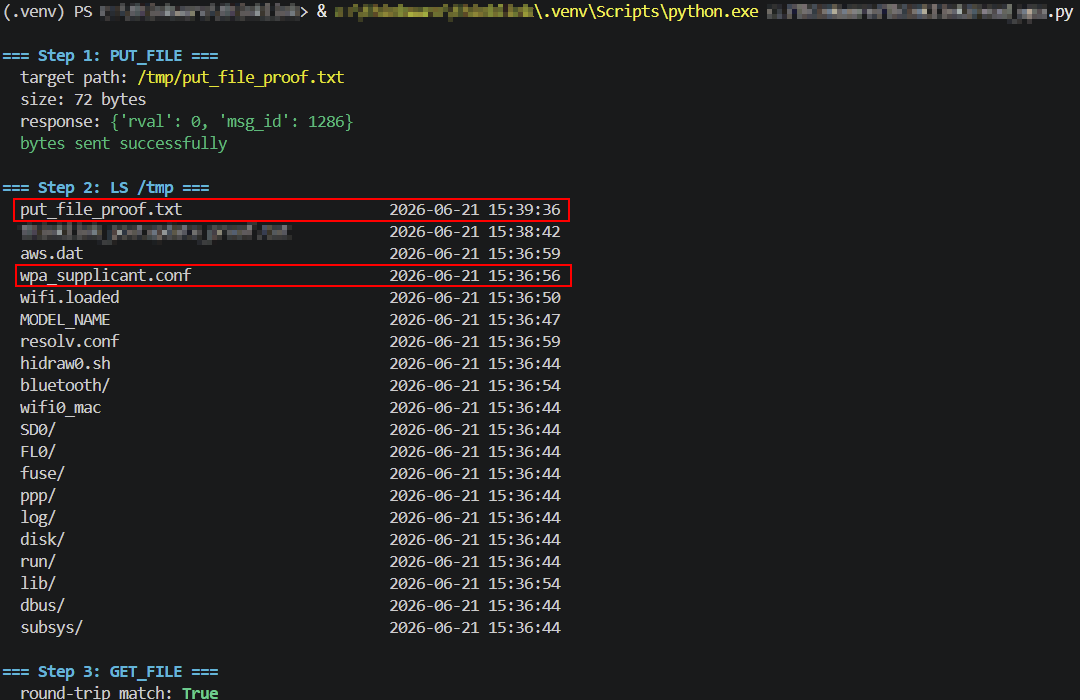
The device's control protocol exposes a PUT_FILE command that writes attacker-supplied bytes to an attacker-supplied absolute path, with no path validation or sandboxing whatsoever. Confirmed by writing a file directly into the device's /tmp directory, the same directory that holds its own WiFi configuration (wpa_supplicant.conf) and at least one shell script (hidraw0.sh), and reading it back byte-for-byte to confirm exact placement.
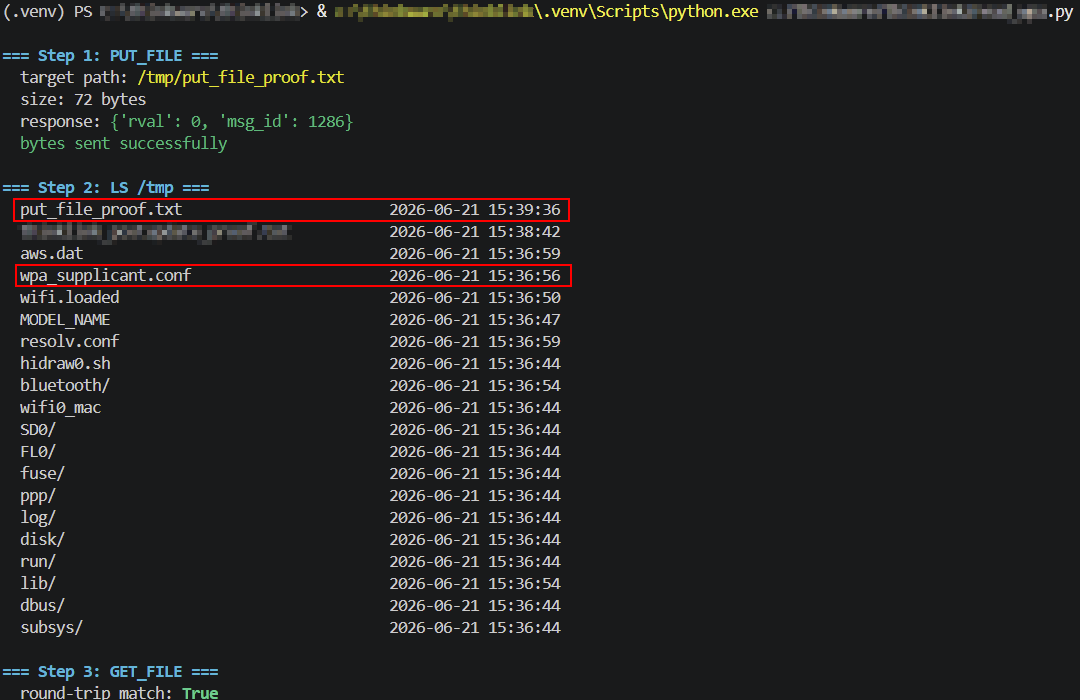
START_SESSION -> SET_CLNT_INFO -> APP_CONNECT.PUT_FILE with param set to a path outside anywhere the official app would legitimately write.{"rval": 0, "msg_id": 1286} immediately, then later pushes an asynchronous NOTIFICATION (msg_id 7) confirming completion.LS on the parent directory confirms the file is present under the exact requested name, alongside system files.GET_FILE on the same path reads the content back for a byte-for-byte comparison against what was sent.CVE: CVE-2026-101054 (VulDB #410916)
Full writeup:
findings/02-arbitrary-file-read.md
Product: Thinkware U3000 Dashcam
Affected component: TCP control protocol (port 7878 command / port 8787 data), no authentication
Attack vector: Any device on the same local network can list and read any absolute path on the device's filesystem, not just recorded video.
The same protocol's LS and GET_FILE commands enumerate and read any absolute path with no restriction. Confirmed by directly reading the device's live wpa_supplicant.conf, which contains its real WiFi SSID and plaintext password. This is the read-side mirror of Finding 1: same root cause, opposite direction, and a mechanically distinct route to the same credentials exposed in Finding 3.
START_SESSION -> SET_CLNT_INFO -> APP_CONNECT.LS on /tmp confirms wpa_supplicant.conf is present, alongside other system files (hidraw0.sh, aws.dat, resolv.conf, etc).GET_FILE with param: "/tmp/wpa_supplicant.conf" returns the file's size, then the full content streams over the data socket exactly as it would for a video file.ssid=/psk= lines matching the camera's actual configured network.CVE: CVE-2026-101055 (VulDB #410917)
Full writeup:
findings/03-wifi-credential-disclosure.md
Product: Thinkware U3000 Dashcam
Affected component: TCP control protocol (port 7878), no authentication
Attack vector: Any device on the same local network can retrieve the camera's WiFi password directly, with no authentication and no prior access required.
A dedicated status query, GET_STATUS "wifi_info", returns the device's WiFi SSID and plaintext password directly. This is a different mechanism than Finding 2, requiring no filesystem access at all, just a normal protocol status read.
START_SESSION -> SET_CLNT_INFO -> APP_CONNECT.GET_STATUS with param: "wifi_info".{"rval": 0, "msg_id": 2050, "type": "wifi_info", "param": [{"ssid": "<real SSID>"}, {"password": "<real plaintext password>"}, {"mac": "<real MAC>"}]}.| Date | Event |
|---|---|
| 2026-06-19 | Findings confirmed against firmware v1.02.00 |
| 2026-06-21 | Firmware upgraded to v1.02.04 (current production release); all three findings re-confirmed, no change in behavior |
| 2026-06-21 | Vendor notified via email to [email protected] |
| 2026-06-22 (approx.) | Thinkware customer support acknowledged receipt, confirmed the report was forwarded to their development team. No technical response, timeline, or fix confirmation was provided. |
| 2026-07-21 | 30-day disclosure window closed. No further vendor contact received. |
| 2026-08-13 | Public disclosure |
| 2026-9-27 | CVE IDs assigned, VulDB entries published |
Consistent with responsible disclosure practice, this repository documents the existence and impact of each primitive without providing a ready-to-use exploitation tool:
PUT_FILE proof-of-concept script is published. The reproduction steps above are sufficient to confirm the finding; a parameterized, ready-to-run write-anywhere tool would offer no additional value to legitimate verification while providing real value to misuse.PUT_FILE can be executed, or into further exploitation chains.