 thunlp/openattack
An Open-Source Package for Textual Adversarial Attack.





Documentation • Features & Uses • Usage Examples • Attack Models • Toolkit Design
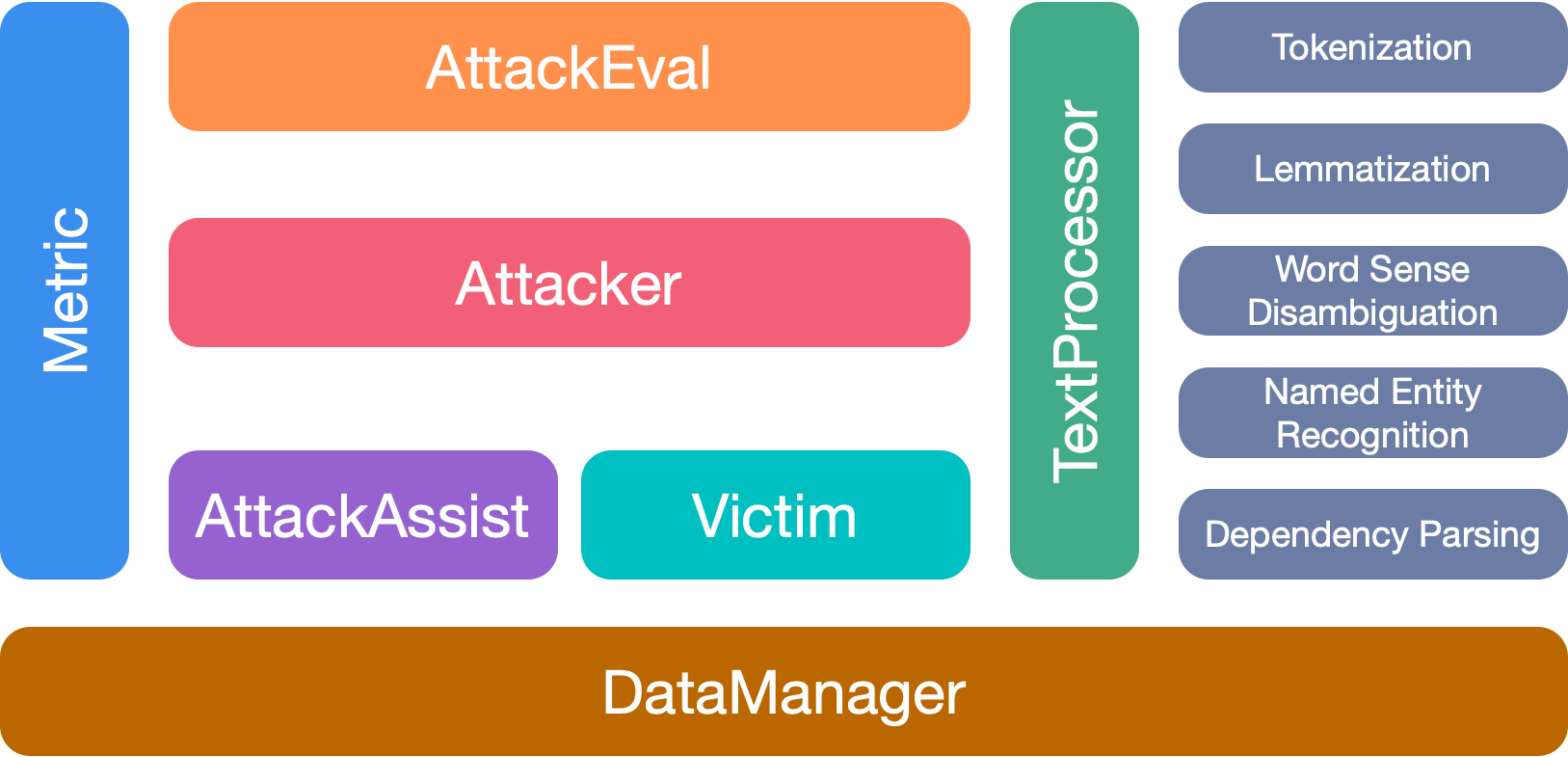
OpenAttack is an open-source Python-based textual adversarial attack toolkit, which handles the whole process of textual adversarial attacking, including preprocessing text, accessing the victim model, generating adversarial examples and evaluation.
⭐️ Support for all attack types. OpenAttack supports all types of attacks including sentence-/word-/character-level perturbations and gradient-/score-/decision-based/blind attack models;
⭐️ Multilinguality. OpenAttack supports English and Chinese now. Its extensible design enables quick support for more languages;
⭐️ Parallel processing. OpenAttack provides support for multi-process running of attack models to improve attack efficiency;
⭐️ Compatibility with 🤗 Hugging Face. OpenAttack is fully integrated with 🤗 Transformers and Datasets libraries;
⭐️ Great extensibility. You can easily attack a customized victim model on any customized dataset or develop and evaluate a customized attack model.
✅ Providing various handy baselines for attack models;
✅ Comprehensively evaluating attack models using its thorough evaluation metrics;
✅ Assisting in quick development of new attack models with the help of its common attack components;
✅ Evaluating the robustness of a machine learning model against various adversarial attacks;
✅ Conducting adversarial training to improve robustness of a machine learning model by enriching the training data with generated adversarial examples.
pip (recommended)pip install OpenAttack
git clone https://github.com/thunlp/OpenAttack.git
cd OpenAttack
python setup.py install
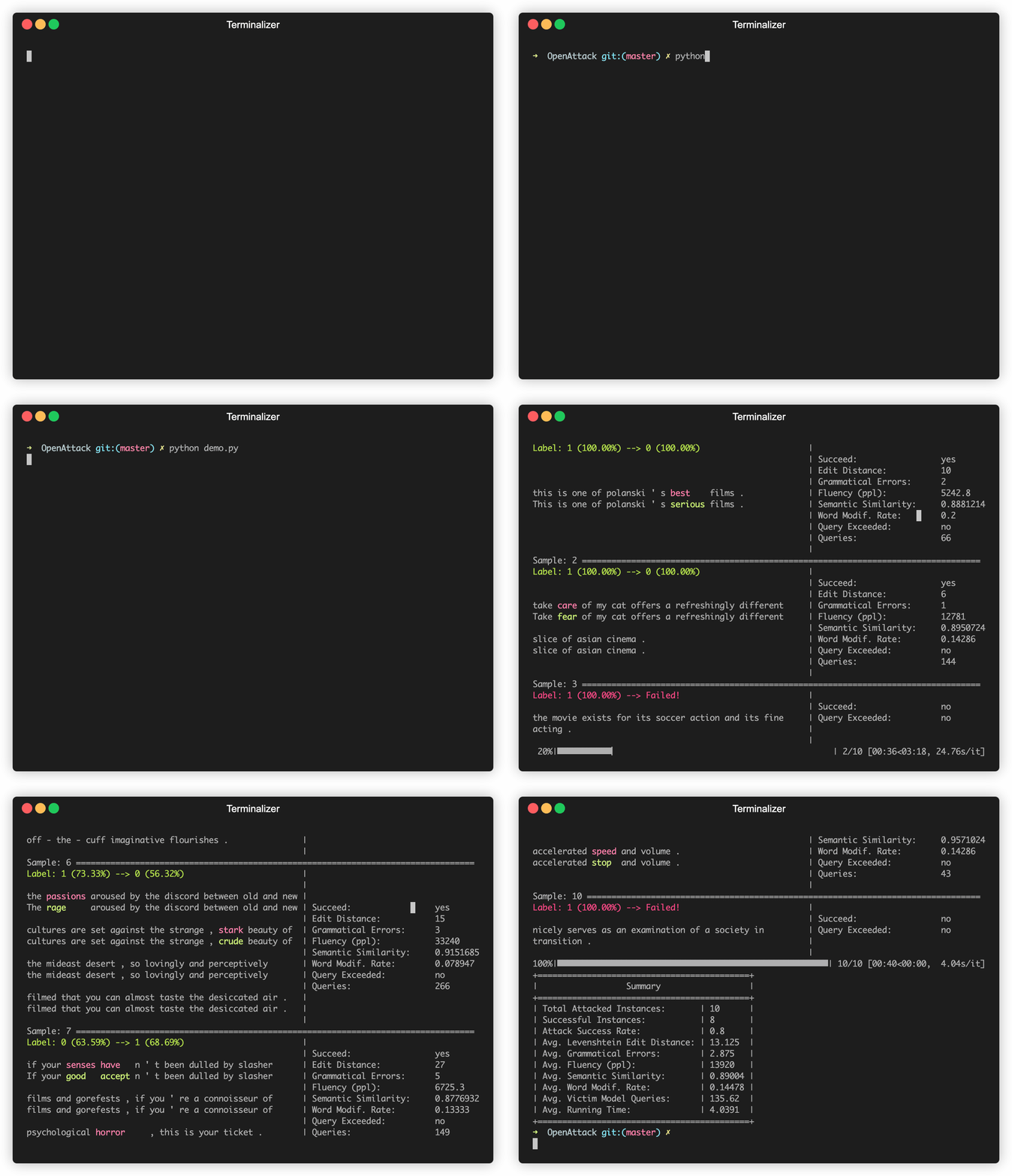
After installation, you can try running demo.py to check if OpenAttack works well:
python demo.py
OpenAttack builds in some commonly used NLP models like BERT (Devlin et al. 2018) and RoBERTa (Liu et al. 2019) that have been fine-tuned on some commonly used datasets (such as SST-2). You can effortlessly conduct adversarial attacks against these built-in victim models.
The following code snippet shows how to use PWWS, a greedy algorithm-based attack model (Ren et al., 2019), to attack BERT on the SST-2 dataset (the complete executable code is here).
import OpenAttack as oa
import datasets # use the Hugging Face's datasets library
# change the SST dataset into 2-class
def dataset_mapping(x):
    return {
        "x": x["sentence"],
        "y": 1 if x["label"] > 0.5 else 0,
    }
# choose a trained victim classification model
victim = oa.DataManager.loadVictim("BERT.SST")
# choose 20 examples from SST-2 as the evaluation data
dataset = datasets.load_dataset("sst", split="train[:20]").map(function=dataset_mapping)
# choose PWWS as the attacker and initialize it with default parameters
attacker = oa.attackers.PWWSAttacker()
# prepare for attacking
attack_eval = OpenAttack.AttackEval(attacker, victim)
# launch attacks and print attack results
attack_eval.eval(dataset, visualize=True)
The following code snippet shows how to use PWWS to attack a customized sentiment analysis model (a statistical model built in NLTK) on SST-2 (the complete executable code is here).
import OpenAttack as oa
import numpy as np
import datasets
import nltk
from nltk.sentiment.vader import SentimentIntensityAnalyzer


# configure access interface of the customized victim model by extending OpenAttack.Classifier.
class MyClassifier(oa.Classifier):
    def __init__(self):
        # nltk.sentiment.vader.SentimentIntensityAnalyzer is a traditional sentiment classification model.
        nltk.download('vader_lexicon')
        self.model = SentimentIntensityAnalyzer()

    def get_pred(self, input_):
        return self.get_prob(input_).argmax(axis=1)

    # access to the classification probability scores with respect input sentences
    def get_prob(self, input_):
        ret = []
        for sent in input_:
            # SentimentIntensityAnalyzer calculates scores of “neg” and “pos” for each instance
            res = self.model.polarity_scores(sent)

            # we use 𝑠𝑜𝑐𝑟𝑒_𝑝𝑜𝑠 / (𝑠𝑐𝑜𝑟𝑒_𝑛𝑒𝑔 + 𝑠𝑐𝑜𝑟𝑒_𝑝𝑜𝑠) to represent the probability of positive sentiment
            # Adding 10^−6 is a trick to avoid dividing by zero.
            prob = (res["pos"] + 1e-6) / (res["neg"] + res["pos"] + 2e-6)

            ret.append(np.array([1 - prob, prob]))

        # The get_prob method finally returns a np.ndarray of shape (len(input_), 2). See Classifier for detail.
        return np.array(ret)

def dataset_mapping(x):
    return {
        "x": x["sentence"],
        "y": 1 if x["label"] > 0.5 else 0,
    }

# load some examples of SST-2 for evaluation
dataset = datasets.load_dataset("sst", split="train[:20]").map(function=dataset_mapping)
# choose the costomized classifier as the victim model
victim = MyClassifier()
# choose PWWS as the attacker and initialize it with default parameters
attacker = oa.attackers.PWWSAttacker()
# prepare for attacking
attack_eval = oa.AttackEval(attacker, victim)
# launch attacks and print attack results
attack_eval.eval(dataset, visualize=True)
The following code snippet shows how to use PWWS to attack an existing fine-tuned sentiment analysis model on a customized dataset (the complete executable code is here).
import OpenAttack as oa
import transformers
import datasets
