

Catch what's lurking in your Kafka clusters.

Catch what's lurking in your Kafka clusters.
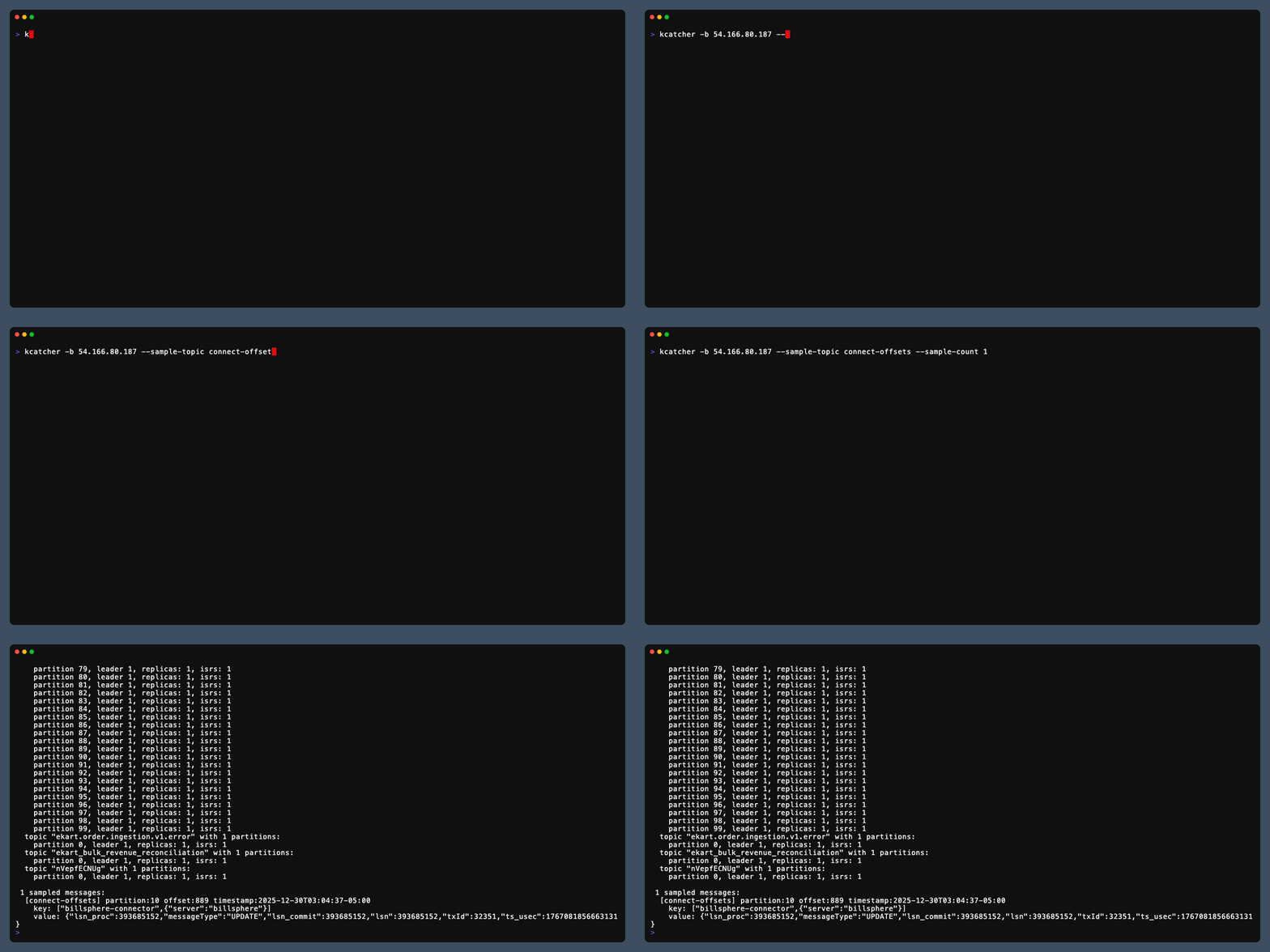
Kcatcher is a command-line utility for enumerating and evaluating Kafka cluster configurations. It connects to Apache Kafka clusters and retrieves detailed information about brokers, topics, ACLs, and even samples messages. Perfect for security audits, infrastructure assessments, or just understanding what's running in your Kafka environment.
If you have a functional Go environment, you can install with:
go install github.com/RoseSecurity/kcatcher@latest
To install packages, you can quickly setup the repository automatically:
curl -1sLf \
  'https://dl.cloudsmith.io/public/rosesecurity/kcatcher/setup.deb.sh' \
  | sudo -E bash
Once the repository is configured, you can install with:
apt install kcatcher
git clone [email protected]:RoseSecurity/kcatcher.git
cd kcatcher
make build
Connect to a Kafka cluster and retrieve broker and topic metadata:
kcatcher -b kafka-broker-1,kafka-broker-2
Specify a non-default Kafka port:
kcatcher -b kafka-broker-1 -p 9093
Retrieve Access Control Lists configured on the cluster:
kcatcher -b kafka-broker-1 --acls
Sample recent messages from a specific topic:
kcatcher -b kafka-broker-1 --sample-topic my-topic --sample-count 5
Output results in JSON format for further processing:
kcatcher -b kafka-broker-1 --acls -o json
Retrieve broker and topic configurations:
kcatcher -b kafka-broker-1 --configs
Run a comprehensive security analysis on your Kafka cluster:
kcatcher -b kafka-broker-1 --analyze
Combine with ACL and configuration enumeration for a complete assessment:
kcatcher -b kafka-broker-1 --acls --configs --analyze
The security analysis evaluates your cluster against 20 built-in security rules across five categories: Authentication, Authorization, Encryption, Access Control, and Configuration. Results include a security score (0-100), letter grade, and detailed findings with remediation guidance.
| Flag | Description | Default |
|---|---|---|
-b, --brokers | List of Kafka brokers to enumerate (required) | - |
-p, --port | Kafka broker port | 9092 |
-t, --timeout | Connection timeout duration | 10s |
-o, --output | Output format (text or json) | text |
--acls | Enable ACL enumeration | false |
--configs | Enable broker and topic configuration retrieval | false |
--analyze | Run security analysis on cluster configuration | false |
--metadata | Show cluster metadata (auto-enabled unless --analyze only) | true |
--sample-topic | Topic to sample messages from | - |
--sample-count | Number of messages to sample | 10 |
The security analysis engine evaluates your Kafka cluster against the following rules:
| Rule ID | Name | Severity | Description |
|---|---|---|---|
| AUTH001 | No Authentication Configured | CRITICAL | Detects when no authentication mechanism is configured |
| AUTH002 | Plaintext Listener Detected | CRITICAL | Identifies listeners using PLAINTEXT protocol |
| AUTH003 | Weak SASL Mechanism | HIGH | Flags weak SASL mechanisms like PLAIN without SSL |
| Rule ID | Name | Severity | Description |
|---|---|---|---|
| AUTHZ001 | No Authorizer Configured | CRITICAL | Detects missing authorizer configuration |
| AUTHZ002 | Allow Everyone Permission | CRITICAL | Identifies overly permissive allow-everyone settings |
| AUTHZ003 | Superusers Exposed | MEDIUM | Flags exposed superuser configurations |
| Rule ID | Name | Severity | Description |
|---|---|---|---|
| ENC001 | No Inter-Broker Encryption | CRITICAL | Detects unencrypted inter-broker communication |
| ENC002 | Weak SSL Protocol | HIGH | Identifies deprecated or weak SSL/TLS protocols |
| ENC003 | No SSL Client Authentication | MEDIUM | Flags missing SSL client authentication |
| ENC004 | No Endpoint Identification | MEDIUM | Detects disabled SSL endpoint identification |
| Rule ID | Name | Severity | Description |
|---|---|---|---|
| ACL001 | Wildcard Principal in ACL | CRITICAL | Identifies ACLs with wildcard (*) principals |
| ACL002 | Wildcard Host in ACL | MEDIUM | Flags ACLs allowing access from any host |
| ACL003 | Overly Permissive ACL | HIGH | Detects ACLs granting excessive permissions |
| ACL004 | Cluster-Wide ACL | MEDIUM | Identifies ACLs applied to entire cluster |
| ACL005 | Wildcard Resource in ACL | HIGH | Flags ACLs with wildcard resource patterns |
| Rule ID | Name | Severity | Description |
|---|---|---|---|
| TOPIC001 | Auto Topic Creation Enabled | HIGH | Detects automatic topic creation being enabled |
| TOPIC002 | Unclean Leader Election | HIGH | Identifies unclean leader election configuration |
| TOPIC003 | Low Min ISR | HIGH | Flags topics with insufficient minimum in-sync replicas |
| TOPIC004 | Short Retention Period | MEDIUM | Detects unusually short message retention periods |
| TOPIC005 | Delete Topic Enabled | MEDIUM | Identifies when topic deletion is enabled |
The analysis produces a security score from 0-100 and a letter grade:
| Grade | Score Range | Description |
|---|---|---|
| A | 90-100 | Excellent security posture |
| B | 80-89 | Good security with minor improvements needed |
| C | 70-79 | Moderate security, several improvements recommended |
| D | 60-69 | Poor security, significant changes required |
| F | 0-59 | Critical security issues requiring immediate attention |
For bug reports & feature requests, please use the issue tracker.
PRs are welcome! We follow the typical "fork-and-pull" Git workflow.
[!TIP] Be sure to merge the latest changes from "upstream" before making a pull request!

