
Skip to content
KitploitKITPLOIT
ToolsBlog
Submit
ToolsBlog
Submit

Hacking, PenTest, and Cybersecurity Tools for Your Security Arsenal!

Kitploit is a directory of hacking, cybersecurity, and pentesting tools. Discover the latest project updates to find vulnerabilities, analyze systems, automate testing, and strengthen your security.

··Feeds·Contact·Privacy·© 2026 Kitploit

Tool Directory

Categories

View all categories
Loading categories
ApiHunter — Async API security scanner in Rust for CORS, CSP, GraphQL, JWT, OpenAPI, and active API posture checks. | Kitploit
Tools/GitHubGitHub/teycir/apihunter
ReconnaissanceVulnerability ScannersDynamic Analysis (Sandboxing)Web Application ExploitationInformation GatheringWeb SecurityPenetration TestingDevSecOpsAPI Security
GitHubteycir/apihunter

ApiHunter

Async API security scanner in Rust for CORS, CSP, GraphQL, JWT, OpenAPI, and active API posture checks.

1921 month agoReviewed by Kitploit

Most Popular

View all →

Discover the most used tools by our community.

Explore all tools

Browse our collection of tools

View all tools →
Share
View RepositoryWebsite

Support Development

If this project helps your work, support ongoing maintenance and new features.

ETH Donation Wallet
0x11282eE5726B3370c8B480e321b3B2aA13686582

Ethereum donation QR code

Scan the QR code or copy the wallet address above.

🎯 ApiHunter

Typing SVG

Rust Security API Async CI License


📺 Video Demo

ApiHunter Demo Video
Click to watch the full demo on YouTube

🖥️ Desktop App Snapshots

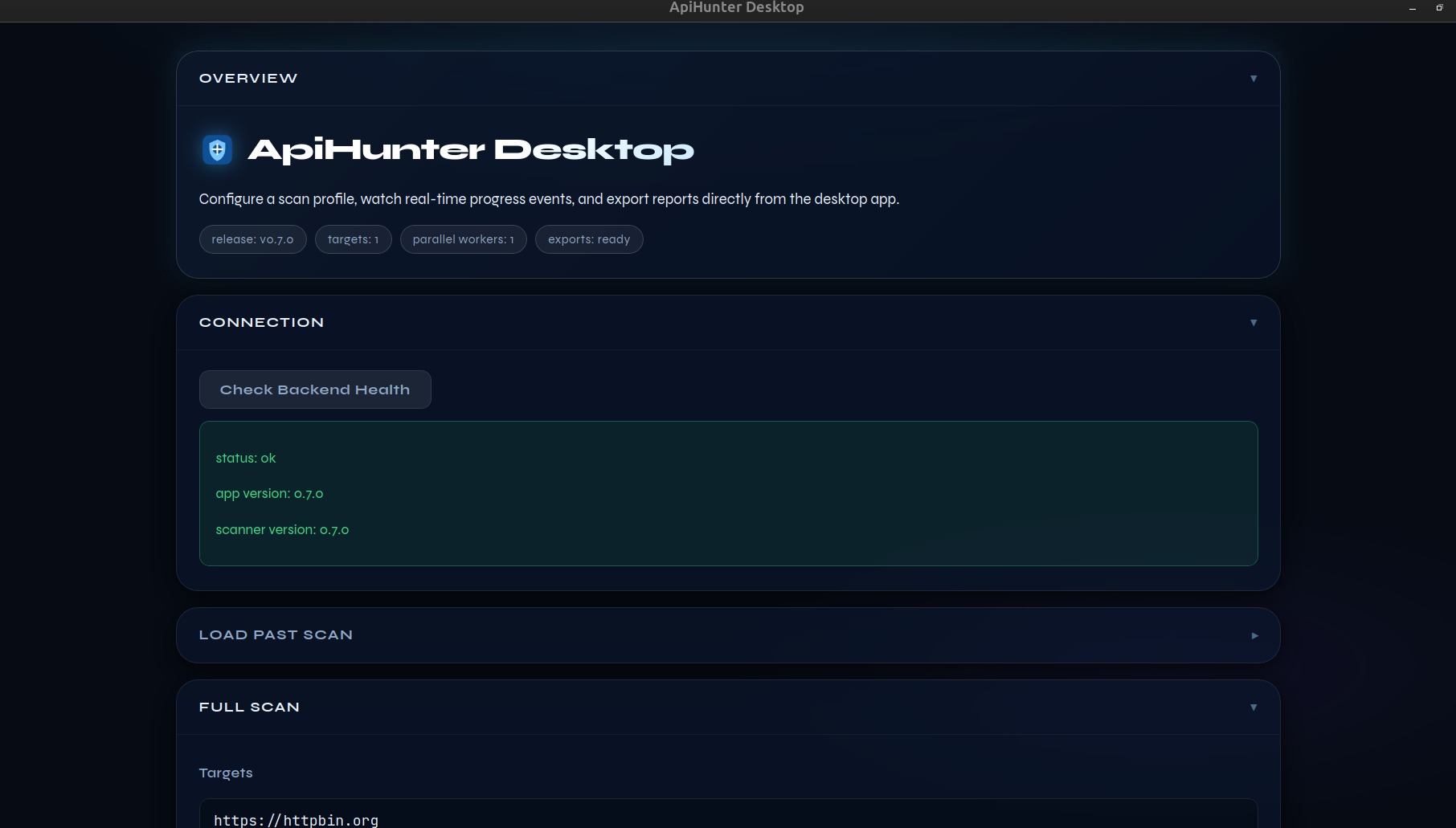
ApiHunter Desktop — Overview panel with version chip, health check, and Full Scan target input

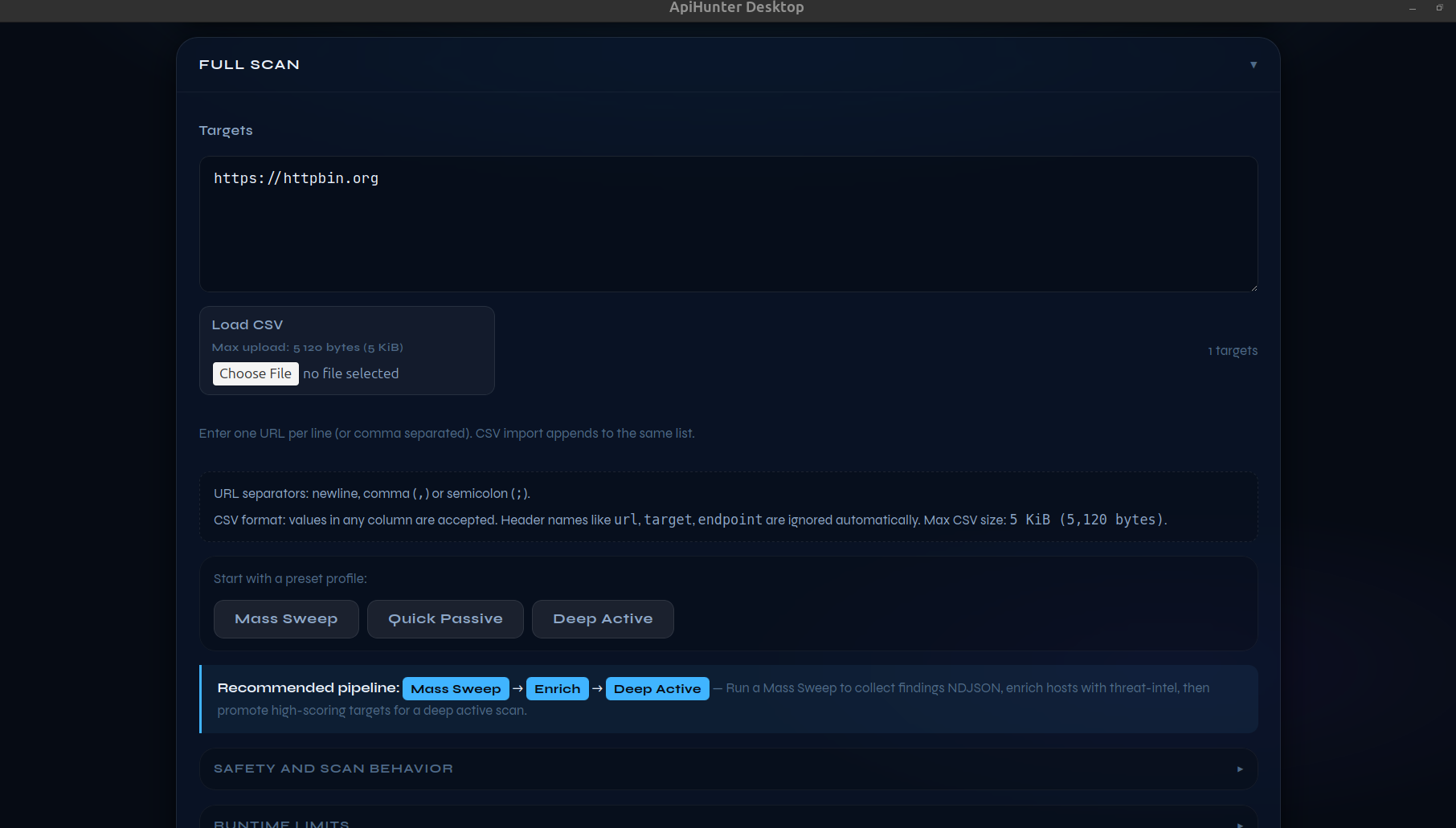
ApiHunter Desktop — Full Scan controls: Quick Passive / Deep Active presets, collapsible Safety, Runtime Limits, and Scanner Toggles sections

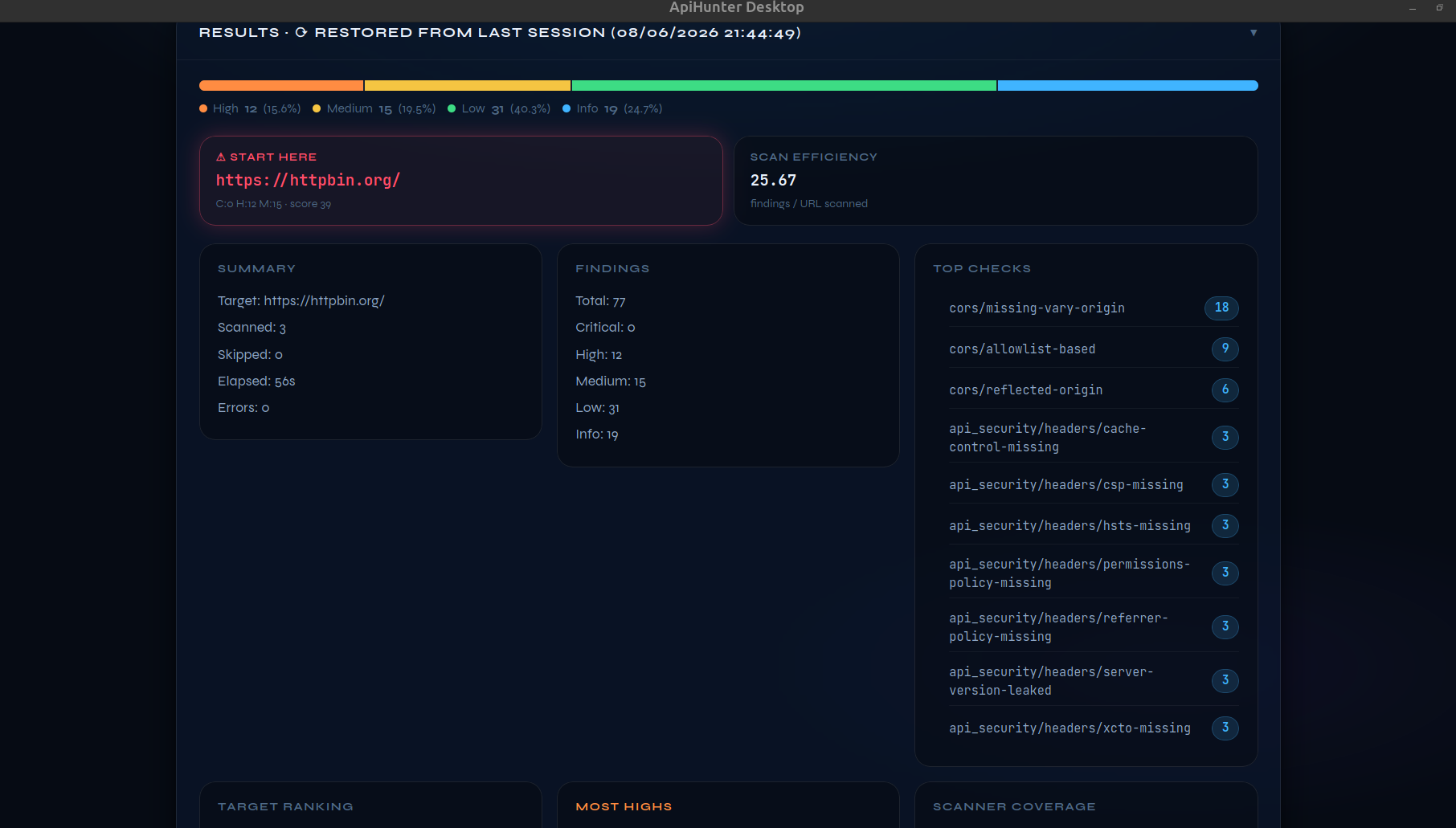
ApiHunter Desktop — Results analytics dashboard: severity heatmap, worst-target card, scan efficiency, summary, findings breakdown, and top checks

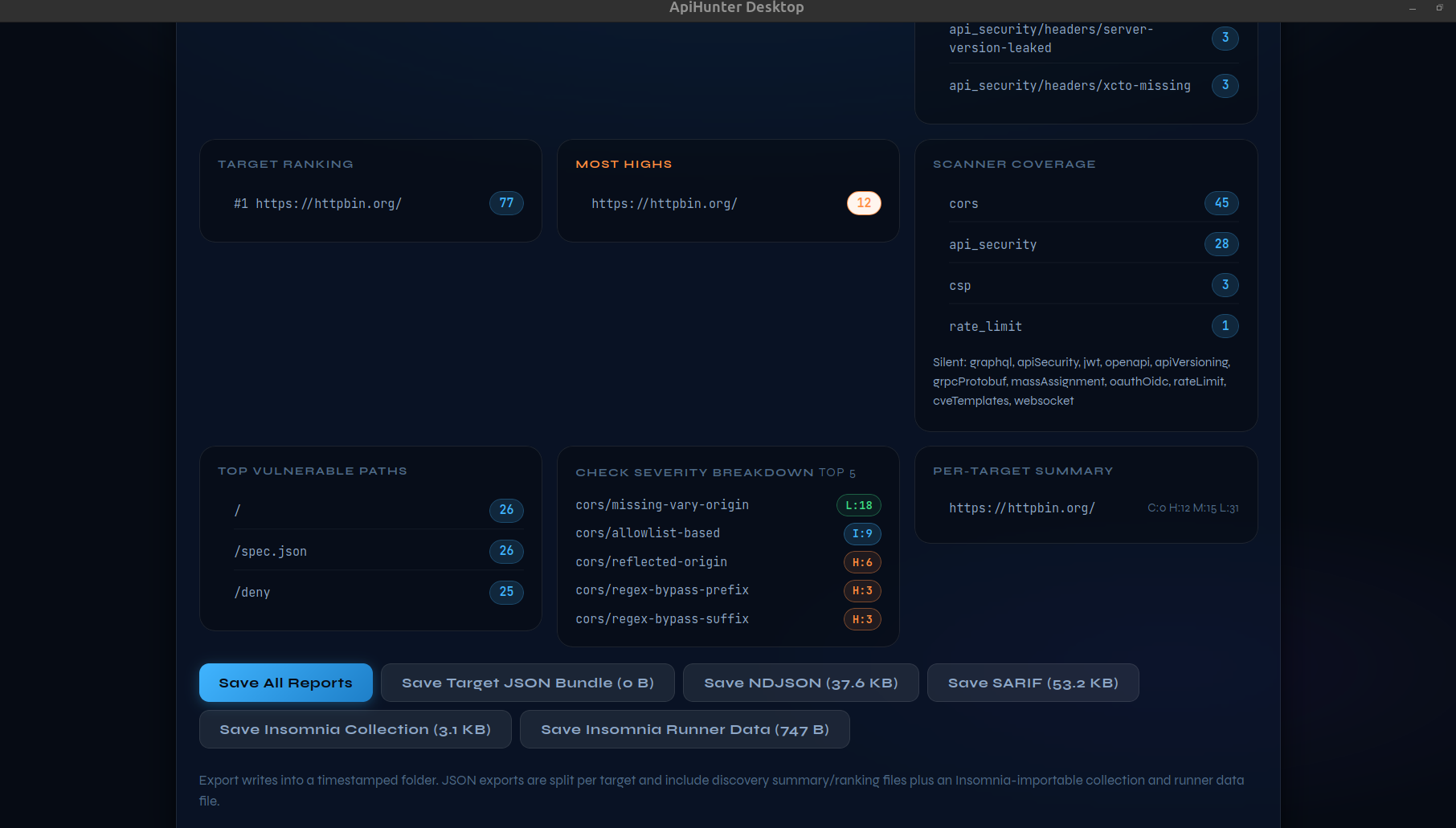
ApiHunter Desktop — Results lower panel: target ranking, scanner coverage, check severity breakdown, per-target summary, and one-click export buttons


📑 Table of Contents

  • Video Demo
  • Desktop App Snapshots
  • Why ApiHunter?
  • Scanner Modules
  • Features
  • Comparison with Other Tools
  • Quick Start
  • Architecture
  • Template Tooling
  • Scan Scripts
  • Testing Strategy
  • Documentation
  • Roadmap
  • Installation
  • CLI Reference
  • Exit Codes
  • Security & Legal Guardrails
  • Related Projects
  • About
  • FAQ
  • License

Async, modular API security scanner for API baseline testing and regression detection.
Combines discovery with targeted checks (CORS/CSP/GraphQL/OpenAPI/JWT/API Security) using adaptive concurrency and CI-ready outputs (NDJSON/SARIF).

Use cases: offense for red-team/API pentest discovery and exploit validation, and defense for CI/CD regression gating, continuous API hardening, and early misconfiguration detection.

Scanning at scale? See Triage Mode — scan 5000 targets in 20 minutes with core security checks, then use Enrich Mode to add threat intelligence context (ports, CVEs, ASN, domain age) to findings.

Naming

  • Project/repository: ApiHunter
  • Cargo package: apihunter
  • Library crate: api_scanner
  • CLI binary: apihunter (default for cargo run)

GitHub Metadata (Recommended)

Set these in the GitHub repository settings for discoverability:

  • Description: Async API security scanner for CORS/CSP/GraphQL/JWT/OpenAPI and active API posture checks.
  • Website: https://github.com/Teycir/ApiHunter
  • Topics: rust, security, api-security, scanner, graphql, cors, csp, jwt, openapi, sarif, ndjson

Repository Flow

root@kitploit:~
flowchart LR
    A[CLI apihunter] --> B[main.rs]
    D[Input Sources] --> E[Pre-filter + Discovery]
    B --> C[HttpClient + Config]
    E --> F[runner.rs]
    C --> F

    F --> G1[Passive scanners]
    F --> G2[Active scanners]

    I[template-tool] --> H[CVE templates]
    H --> G2

    G1 --> J[Findings]
    G2 --> J
    J --> K[Reporter]
    K --> L[Auto Reports]
    K --> M[CI/CD Controls]

Why ApiHunter?

Core Advantages

  • API-First Architecture: Purpose-built for REST/GraphQL APIs, not adapted from web app scanners
  • Intelligent False Positive Reduction:
    • SPA catch-all detection with canary probing
    • Context-aware secret validation (frontend vs backend)
    • Body content validation and referer checking
    • Response fingerprinting to skip duplicate findings
  • Production-Safe by Design:
    • Adaptive concurrency (AIMD) that backs off on errors
    • Per-host rate limiting with configurable delays
    • Politeness controls (retries, timeouts, WAF evasion)
    • Dry-run mode for active checks
  • Stealth & Evasion:
    • Runtime User-Agent rotation from curated pool (assets/user_agents.txt)
    • Randomized request delays with jitter
    • Per-host delay enforcement (avoids burst patterns)
    • Retry logic with exponential backoff
    • Custom header injection for blending with legitimate traffic
    • Adaptive timing based on server responses
    • No hardcoded scanner fingerprints in default mode

Stealth Techniques Deep Dive

ApiHunter uses several stealth techniques to avoid detection by WAF (Web Application Firewall) and bot protection systems:

1. User-Agent Rotation

What it does: Randomly cycles through 100+ real browser User-Agent strings from a file (assets/user_agents.txt)

Why it works: Bots typically use the same User-Agent (like curl/7.68.0). By pretending to be Chrome, Firefox, Safari, etc., you blend in with legitimate traffic

Simple analogy: Like wearing different disguises instead of always wearing the same uniform

2. Random Timing & Jitter

What it does: Adds random delays between requests (controlled by --delay-ms) with jitter (small random variations)

Why it works: Bots send requests at perfect intervals (exactly 100ms apart). Humans are unpredictable. Random timing makes traffic look organic

Simple analogy: Walking with irregular steps instead of marching like a robot

3. Per-Host Delay Enforcement

What it does: Tracks delay separately for each domain, not globally

Why it works: Prevents burst patterns where you hit one host 50 times instantly. Each host sees polite, spaced-out requests

Simple analogy: Taking turns in different conversations instead of shouting at one person repeatedly

4. Adaptive Concurrency (AIMD)

What it does: Automatically slows down when getting 429 (rate limit) or 503 (server busy) errors, speeds up when successful

Why it works: Backs off when caught, mimics how browsers retry. WAFs see "this client respects our limits"

Simple analogy: Slowing down when traffic is congested, speeding up on open roads

5. Retry with Exponential Backoff

What it does: When a request fails, waits 1s, then 2s, then 4s before retrying

Why it works: Legitimate clients retry gracefully. Bots often hammer immediately or give up

Simple analogy: Knocking on a door, waiting longer each time instead of banging continuously

6. No Scanner Fingerprints

What it does: Doesn't send headers like X-Scanner: ApiHunter or predictable patterns

Why it works: Many tools leave signatures (Nuclei templates, sqlmap patterns). ApiHunter avoids obvious markers

Simple analogy: Not wearing a name tag that says "Security Tester"

7. Connection Reuse & Pooling

What it does: Uses per-host HTTP client pools, keeps connections alive

Why it works: Browsers reuse connections. Opening/closing for every request looks suspicious

Simple analogy: Keeping the door open instead of slamming it shut and ringing the bell again

8. Custom Header Injection

What it does: Can add headers like Referer, X-Forwarded-For, custom cookies

Why it works: Makes requests look like they came from a legitimate application flow (clicked a link, have session cookies)

Simple analogy: Showing a ticket stub when entering a venue instead of jumping the fence

Detection Comparison

When to use --waf-evasion

  • Testing production APIs with Cloudflare/Akamai/AWS WAF

  • Avoiding IP bans during large scans

  • Penetration tests where you need to stay under the radar

  • CI/CD Native:

    • Baseline diffing (only report new findings)
    • Streaming NDJSON output for real-time monitoring
    • SARIF 2.1.0 for GitHub/GitLab Code Scanning
    • Exit code bitmask for pipeline control
    • Severity-based filtering and failure thresholds
  • Performance at Scale:

    • Rust async runtime (tokio) with zero-cost abstractions
    • Concurrent scanning with semaphore-bounded parallelism
    • Per-host HTTP client pools to avoid connection bottlenecks
    • Efficient memory usage (no GC pauses)
  • Comprehensive Auth Support:

    • JSON-based auth flows with cookie/header extraction
    • Dual-identity IDOR/BOLA testing
    • Session file import (Excalibur integration)
    • Bearer, Basic, and custom header auth
    • Automatic unauth client for privilege escalation checks

Scanner Modules

ApiHunter includes 13 built-in scanner modules. See docs/scanners.md for detailed detection logic.

Passive scanners run by default and analyze responses without sending crafted requests.
Active scanners/checks require --active-checks and send potentially invasive probes (IDOR/BOLA, mutation, bypass tests).
IDOR/BOLA lives under the API Security scanner (there is no dedicated --no-idor flag; use --no-api-security to disable it).

Module Output & Signal Notes

These notes summarize how findings are emitted and what typically causes noise:

For check-by-check detail and remediation guidance, see docs/scanners.md and docs/findings.md. The scanner docs now include a source-aligned Module Check Catalog and False-Positive Expectation Model.

Features

Passive Security Analysis

  • CORS Misconfiguration Detection:
    • Dynamic origin generation based on target domain
    • Regex bypass testing (suffix/prefix attacks)
    • Credential-aware severity scoring
    • Wildcard and null origin detection
  • CSP Policy Analysis:
    • Missing/weak Content Security Policy detection
    • Unsafe inline/eval directives
    • Wildcard source detection
    • Policy bypass patterns
  • GraphQL Security:
    • Introspection query detection
    • Sensitive type/field name analysis
    • Query batching support detection
    • Alias amplification (DoS) probing
    • Active mutation fuzzing (--active-checks, supports --dry-run)
    • GraphiQL/Playground exposure
  • JWT Token Analysis:
    • Algorithm confusion (alg=none, HS256→RS256)
    • Weak secret detection (curated wordlist)
    • Long-lived token detection (missing/excessive exp)
    • Sensitive claim exposure
    • Token extraction from headers and cookies
  • OpenAPI/Swagger Analysis:
    • Security scheme validation
    • File upload endpoint detection
    • Deprecated operation flagging
    • Missing security definitions
    • Spec caching for performance
  • gRPC/Protobuf Coverage:
    • gRPC response metadata/content-type detection
    • Protobuf surface hint detection from endpoint metadata/path shape
    • Optional reflection/health active probe signals on known gRPC paths
  • Secret Exposure Detection:
    • AWS keys (AKIA*, secret keys)
    • Google API keys (AIza*)
    • GitHub tokens (ghp_, github_pat_)
    • Slack tokens (xox*)
    • Stripe keys (sk_live_, pk_live_)
    • Database URLs, private keys, bearer tokens
    • Context-aware validation (reduces false positives)
  • API Security Checks:
    • HTTP method enumeration

Active Security Testing (--active-checks)

  • API Security IDOR/BOLA Checks (3-tier approach):
    • Unauthenticated access testing
    • Response comparison via body fingerprints plus stable header snapshots
    • ID enumeration (±2 range walk)
    • Cross-user authorization bypass (dual-identity)
    • Blind SSRF callback probing via callback-style query params (APIHUNTER_OAST_BASE, supports --dry-run)
    • Gateway fingerprint and bypass probing (api_security/gateway-*)
  • Mass Assignment Vulnerabilities:
    • Reflected sensitive field injection
    • Persisted state change detection
    • Baseline→Mutate→Confirm verification
    • Privilege escalation via field injection
  • OAuth/OIDC Security:
    • Redirect URI validation bypass
    • State parameter handling
    • PKCE support detection
    • Metadata configuration hardening
    • Implicit flow and password grant detection
  • Rate Limiting:
    • Burst request probing
    • Missing rate limit detection
    • Retry-After header validation
    • IP header spoofing bypass tests
  • WebSocket Security:
    • Upgrade acceptance on common paths
    • Origin validation testing
    • Missing authentication checks
  • CVE Template Engine:
    • TOML-based template catalog
    • Nuclei YAML import support
    • Baseline vs bypass differential matching
    • Host+template deduplication
    • Loader quality gates skip invalid/unsafe request templates (for example unresolved request placeholders)
    • Segment-aware context matching reduces broad path-substring over-triggering
    • Current local catalog: 168 templates (includes curated hardened checks such as CVE-2022-22947, CVE-2021-29442, CVE-2021-29441, CVE-2020-13945, CVE-2021-45232, CVE-2022-24288)

Discovery & Enumeration

  • Endpoint Discovery:
    • robots.txt parsing
    • sitemap.xml parsing
    • OpenAPI/Swagger spec import
    • HAR file import (Excalibur integration)
    • Postman/Insomnia collection import (--collection)
    • JavaScript endpoint extraction
    • Same-host filtering
  • URL Accessibility Pre-filtering:
    • Fast pre-check to skip dead endpoints
    • Configurable timeout
    • Optional bypass with --no-filter

Performance & Reliability

  • Adaptive Concurrency (AIMD):
    • Automatic rate adjustment based on errors
    • Additive increase (every 5s)
    • Multiplicative decrease on 429/503/timeouts
  • Stealth & WAF Evasion:
    • User-Agent rotation from runtime pool (assets/user_agents.txt with 100+ real UAs)
    • Embedded fallback UAs if file unavailable
    • Random delay jitter to avoid detection patterns
    • Per-host timing enforcement (not global)
    • Retry logic with exponential backoff
    • Custom header injection (X-Forwarded-For, Referer, etc.)
    • Adaptive timing based on 429/503 responses
    • Politeness mode for cooperative testing
    • No scanner fingerprints in User-Agent or headers by default
  • Resource Management:
    • Semaphore-bounded parallelism
    • Per-host HTTP client pools
    • Connection reuse and pooling
    • Configurable timeouts and retries
  • Error Handling:
    • Panic recovery via JoinSet
    • Captured errors reported separately
    • Graceful degradation on scanner failures

Output & Reporting

  • Multiple Output Formats:
    • Pretty JSON (human-readable)
    • NDJSON (streaming, parseable)
    • SARIF 2.1.0 (GitHub/GitLab Code Scanning)
  • Baseline Diffing:
    • Generate baseline snapshots
    • Compare scans to report only new findings
    • Perfect for regression testing
  • Auto-Save Reports (enabled by default, disable with --no-auto-report):
    • Saved to ~/Documents/ApiHunterReports//
    • findings.json (structured findings)
    • summary.md (markdown report)
    • scan.log (execution log)
  • Real-Time Streaming:
    • Stream findings as they're discovered
    • NDJSON format for live parsing
    • Progress tracking
  • Severity Filtering:
    • Filter by minimum severity (info/low/medium/high/critical)
    • Fail-on threshold for CI/CD
    • Exit code bitmask (0x01 findings, 0x02 errors)

Integration & Extensibility

  • Pluggable Scanner Architecture:
    • Implement Scanner trait to add modules
    • Async-first design
    • Independent scanner execution
    • Panic isolation per scanner
  • TOML-Based Extensibility:
    • CVE template catalog in assets/cve_templates/*.toml
    • No code changes needed to add new checks
    • Template-driven vulnerability detection
    • Community-shareable template format
  • Nuclei Template Import:
    • template-tool binary for YAML → TOML conversion
    • Automatic matcher translation (status, word, regex, dsl)
    • Safe preflight request-chain extraction
    • Preserves detection logic from upstream templates
  • Dual Extension Model:
    • Code-based: Write Rust scanners implementing Scanner trait for complex logic
    • Template-based: Write TOML templates for signature-based checks (CVEs, misconfigs)
    • Best of both worlds: performance + flexibility
  • Complementary Tools:
    • Excalibur browser extension (HAR capture)
    • BurpAPIsecuritysuite (manual testing)
    • Workflow: Capture → Automate → Deep test

Configuration & Control

  • Flexible Input:
    • File-based URL lists
    • stdin (pipe from other tools)
    • HAR file import
    • Postman/Insomnia collection import
    • OpenAPI spec import
  • Granular Scanner Control:
    • Enable/disable individual scanners
    • Active vs passive mode
    • Dry-run for active checks
    • Per-scanner configuration
  • Network Configuration:
    • HTTP/HTTPS proxy support
    • TLS certificate validation control
    • Custom headers and cookies
    • Configurable timeouts and retries
  • Scan Profiles:
    • quickscan.sh (fast, low-impact)
    • deepscan.sh (comprehensive, active checks)
    • inaccessiblescan.sh (re-check previously inaccessible targets with slower settings)
    • baselinescan.sh (generate baseline)
    • diffscan.sh (compare against baseline)
    • authscan.sh (authenticated scanning)
    • sarifscan.sh (CI/CD integration)
    • scan-and-report.sh (run scan + print latest report path)
    • split-by-host.sh (split targets by host and optionally fan out scans)

Comparison with Other Tools

Key Differentiators

ApiHunter: API-first design, SPA detection, baseline diffing, 3-tier IDOR/BOLA, context-aware secrets, AIMD concurrency, stealth/WAF evasion (UA rotation, jitter, adaptive timing), dual extensibility (TOML templates + Rust modules)
Nuclei: Broader CVE coverage, YAML templates only, basic evasion
ZAP/Burp: Manual testing, proxy workflows, GUI-based extensions, limited stealth
ffuf: Pure fuzzing, content discovery, limited extensibility, basic evasion

Quick Start

root@kitploit:~
cargo build --release

# Scan URLs from a file (newline-delimited)
./target/release/apihunter --urls ./targets/cve-regression-real-public.txt --format ndjson --output ./results.ndjson

# Or scan URLs from stdin
cat ./targets/cve-regression-real-public.txt | ./target/release/apihunter --stdin --min-severity medium

Desktop Quick Start (Tauri + React)

ApiHunter also ships a desktop app in apps/desktop.

root@kitploit:~
cd apps/desktop
npm install
npm run tauri dev

Desktop scan input supports:

  • Manual multi-target entry (one URL per line or comma-separated)
  • CSV import via Load CSV (max 307,200 bytes / 300 KiB)
  • Guided scan presets: Quick Passive and Deep Active
  • Hard limit: up to 3,000 targets per run (deduped + validated as absolute http/https URLs)
  • Scope controls: discovery on/off, accessibility filtering + timeout, max endpoints per site
  • API versioning controls: optional deep response-diff probing toggle
  • Advanced controls: proxy, headers, cookies, bearer/basic auth, TLS invalid-cert toggle
  • Blind SSRF callback correlation input (OAST callback base) for active checks
  • Performance controls: per-host clients, adaptive concurrency, WAF evasion with custom user-agent pool
  • Full scanner toggle coverage including API Versioning and gRPC/Protobuf
  • Collapsible scan sections with right-aligned carets; Safety and Scan Behavior, Runtime Limits, and Scanner toggles are collapsed by default
  • Parallel-run progress cards with per-target completion/findings snapshots

See HOWTO.md for detailed usage, docs/lab-setup.md for Vulhub-based CVE validation labs, and docs/ for internals.

If you want a release desktop binary:

root@kitploit:~
cd apps/desktop
npm run tauri build
./src-tauri/target/release/apihunter-desktop

Install a clickable Linux app icon/launcher:

root@kitploit:~
cd apps/desktop
npm run desktop:install-icon

Note: desktop dev startup now uses built frontend assets directly and does not require a separate localhost:1420 server.

See HOWTO.md for detailed usage, docs/lab-setup.md for Vulhub-based CVE validation labs, and docs/ for internals.

Example NDJSON Finding

root@kitploit:~
{
  "url": "https://api.example.com/graphql",
  "check": "graphql/introspection-enabled",
  "title": "GraphQL introspection is enabled",
  "severity": "MEDIUM",
  "detail": "Introspection query returned schema metadata from a public endpoint.",
  "evidence": "POST /graphql -> HTTP 200 with __schema fields in response body",
  "scanner": "graphql",
  "timestamp": "2026-03-19T14:02:11.824Z"
}

Architecture

root@kitploit:~
main.rs  ──► cli.rs (args) ──► config.rs (Config)
                                     │
                               runner.rs (orchestration)
                              ┌──────┴────────────────────────────┐
                    discovery/               scanner/
                    ├─ robots.rs             ├─ cors.rs
                    ├─ sitemap.rs            ├─ csp.rs
                    ├─ swagger.rs            ├─ jwt.rs
                    ├─ js.rs                 ├─ graphql.rs
                    ├─ headers.rs            ├─ openapi.rs
                    └─ common_paths.rs       ├─ api_security.rs
                                             ├─ api_versioning.rs
                                             ├─ grpc_protobuf.rs
                                             ├─ mass_assignment.rs
                                             ├─ oauth_oidc.rs
                              http_client.rs ├─ rate_limit.rs
                              auth.rs        ├─ cve_templates.rs
                              waf.rs         └─ websocket.rs
                              reports.rs
                              error.rs

Flow: CLI args → Config → Runner orchestrates Discovery + Scanners → HTTP Client (with Auth/WAF) → Reports

Template Tooling

ApiHunter supports dual extensibility: add checks via TOML templates (no code) or Rust modules (full control).

TOML Template Format

Create custom checks in assets/cve_templates/*.toml:

root@kitploit:~
id = "custom-api-check"
name = "Custom API Vulnerability"
severity = "high"

[[requests]]
method = "GET"
path = "/api/vulnerable"

[[requests.matchers]]
type = "status"
values = [200]

[[requests.matchers]]
type = "word"
part = "body"
words = ["sensitive_data", "exposed"]

Import Nuclei Templates

Convert existing Nuclei YAML templates:

root@kitploit:~
cargo run --bin template-tool -- import-nuclei \
  --input tests/fixtures/upstream_nuclei/CVE-2022-24288.yaml \
  --output assets/cve_templates/cve-2022-24288.toml

Add Custom Rust Scanners

Implement the Scanner trait for complex logic:

root@kitploit:~
#[async_trait]
impl Scanner for MyCustomScanner {
    async fn scan(
        &self,
        url: &str,
        client: &HttpClient,
        config: &Config,
    ) -> (Vec<Finding>, Vec<CapturedError>) {
        // Your custom scanning logic
    }
}

See HOWTO.md and docs/scanners.md for details.

Scan Scripts

ScanScripts/ contains convenience wrappers for common scan profiles:

  • quickscan.sh - Fast, low-impact scan (concurrency: 10, max-endpoints: 20, timeout: 5s, retries: 0, delay: 50ms)
  • deepscan.sh - Comprehensive scan with active checks (adaptive concurrency, per-host clients, unlimited endpoints, retries: 3, timeout: 20s, delay: 200ms)
  • defaultscan.sh - Run with CLI defaults (no preset flags)
  • baselinescan.sh - Generate baseline NDJSON for diffing
  • diffscan.sh - Compare against baseline and report only new findings
  • authscan.sh - Authenticated scan with auth flows (requires --auth-flow, enables active checks, WAF evasion, retries: 2, timeout: 15s, delay: 150ms)
  • sarifscan.sh - Output SARIF format for CI/CD integration
  • inaccessiblescan.sh - Re-scan previously inaccessible URLs with conservative retry/timeouts
  • scan-and-report.sh - Run scan and print latest auto-saved report location
  • split-by-host.sh - Split URL list into per-host files and optionally scan them in parallel

Usage Examples

root@kitploit:~
# Quick scan from file
./ScanScripts/quickscan.sh targets/cve-regression-real-public.txt

# Deep scan from stdin
cat targets/cve-regression-real-public.txt | ./ScanScripts/deepscan.sh --stdin

# Generate baseline
./ScanScripts/baselinescan.sh targets/cve-regression-real-public.txt

# Compare against baseline
./ScanScripts/diffscan.sh targets/cve-regression-real-public.txt baseline.ndjson

# Authenticated scan
./ScanScripts/authscan.sh targets/cve-regression-real-public.txt --auth-flow auth.json

# SARIF output for GitHub Code Scanning
./ScanScripts/sarifscan.sh targets/cve-regression-real-public.txt

# Split by host and scan in parallel
./ScanScripts/split-by-host.sh targets/cve-regression-real-public.txt --scan-cmd ./ScanScripts/quickscan.sh --jobs 4

All wrapper scripts except split-by-host.sh support --stdin and trailing ApiHunter flags.

Testing Strategy

ApiHunter testing is split by intent:

  • Unit tests (tests/*_scanner.rs, parser/config tests): scanner logic and edge cases.
  • Integration tests (tests/integration_runner.rs, startup/CLI behavior): orchestration and runtime wiring.
  • Fixture regression tests (tests/cve_templates_real_data.rs, tests/cve_templates_upstream_parity.rs): replay real payloads and compare against pinned upstream templates.
  • Mock-server tests (multiple scanner suites): deterministic behavior checks without relying on internet targets.
  • Live-target checks: optional/manual only (not part of default cargo test).

See the dedicated Testing Guide for the full test matrix and coverage map.

Run focused suites:

root@kitploit:~
cargo test --test cors_scanner
cargo test --test graphql_scanner
cargo test --test cve_templates_runtime_ext
cargo test --test integration_runner

Run full validation:

root@kitploit:~
cargo test

Run real-data integration gate (fixtures + live ignored suites):

root@kitploit:~
# Fixture-backed real payload regression suites
cargo test --test cve_templates_real_data --test cve_templates_upstream_parity --test cve_templates_runtime_ext

# Manual live internet integration suites (ignored by default)
cargo test --test live_vulnerable_apis --test live_real_world_targets -- --ignored

Live suites use default target inventories:

  • targets/vuln-api-regression-real-public.txt
  • targets/real-world-integration-public.txt

You can override with:

  • APIHUNTER_LIVE_VULN_TARGET_FILE or APIHUNTER_LIVE_VULN_TARGETS
  • APIHUNTER_LIVE_REAL_TARGET_FILE or APIHUNTER_LIVE_REAL_TARGETS

Documentation

Complete documentation is available in docs/. Start with:

  • Documentation Index
  • Desktop App Guide
  • Architecture
  • Configuration
  • Auth Flow
  • Testing Guide
  • Operations Runbook
  • Scanners
  • Findings & Remediation
  • Security Policy
  • HOWTO
  • Triage Mode
  • Enrich Mode

Roadmap

Completed (v0.7.0): Glass UI redesign, scan persistence (last-scan store), results analytics dashboard (severity heatmap, worst-target card, scan efficiency, scanner coverage, check severity breakdown), Enrich → Deep-Scan promote flow, Triage/threat-intel mode, Discovery configuration, WebSocket/Mass-Assignment/OAuth/Rate-Limit/CVE scanners, expanded Nuclei importer, Docker image
Next: App.tsx component split, scan history ring-buffer, finding detail drawer, HTML/PDF report export, GitHub Actions native action, per-target timing in live progress

Installation

CLI Installation

Requires Rust stable (tested on 1.76+).

root@kitploit:~
git clone https://github.com/Teycir/ApiHunter
cd ApiHunter
cargo build --release

Prebuilt Release Artifacts

Tagged releases (v*) publish prebuilt apihunter binaries for:

  • Linux (x86_64-unknown-linux-gnu, aarch64-unknown-linux-gnu)
  • macOS (x86_64-apple-darwin)
  • Windows (x86_64-pc-windows-msvc)

Each release also publishes supply-chain artifacts:

  • SHA256 checksum files (*.sha256)
  • Sigstore keyless signature materials (*.sig, *.pem, *.sigstore.json)
  • SPDX JSON SBOM (apihunter-release-assets-sbom.spdx.json)
  • GitHub artifact attestations (provenance and SBOM attestation metadata)

Download from GitHub Releases.

Desktop Installation (Tauri + React)

Desktop app source lives in apps/desktop.

Build and run a production desktop binary:

root@kitploit:~
cd apps/desktop
npm install
npm run tauri build
./src-tauri/target/release/apihunter-desktop

For development mode:

root@kitploit:~
cd apps/desktop
npm run tauri dev

Install a clickable Linux launcher icon:

root@kitploit:~
cd apps/desktop
npm run desktop:install-icon

Desktop features (brief):

  • Multi-target scans (up to 3,000 targets) with manual input + CSV import (300 KiB limit)
  • Guided setup presets: Quick Passive and Deep Active
  • Live progress UI with per-target status cards
  • Full scan profile controls (discovery/filtering, retries/timeouts, scanner toggles)
  • Collapsible scan sections with right-aligned carets; heavy subsections collapsed by default
  • API versioning deep response-diff toggle and OAST callback base control
  • Advanced runtime controls (proxy/auth headers/cookies, TLS toggle, WAF/adaptive/per-host options)
  • Results analytics dashboard: severity heatmap, worst-target, scan efficiency, scanner coverage, check severity breakdown, top vulnerable paths, per-target summary
  • Session persistence: last scan auto-restores on next launch with timestamp badge
  • Enrich Mode panel: threat-intel enrichment with per-host promote-to-deep-scan flow
  • One-click export for per-target JSON bundles, NDJSON, SARIF, Insomnia collection, and Insomnia Runner data

Docker

root@kitploit:~
docker build -t apihunter:local .
docker run --rm apihunter:local --help

Run a scan from files in your current directory:

root@kitploit:~
docker run --rm -v "$PWD:/work" apihunter:local \
  --urls /work/targets/cve-regression-real-public.txt \
  --format ndjson \
  --output /work/results.ndjson

CLI Reference

*You must provide exactly one of --urls, --stdin, --har, or --collection.

Exit Codes

Security & Legal Guardrails

  • --proxy does not disable TLS verification on its own. Certificate checks remain enabled unless --danger-accept-invalid-certs is explicitly set.
  • --danger-accept-invalid-certs is intended for controlled lab/debug use only. ApiHunter emits an explicit runtime warning when this flag is enabled.
  • --waf-evasion and active probes may trigger IDS/WAF alerts. Run only with explicit written authorization and within agreed test windows.
  • For CI or production-adjacent checks, prefer passive mode first, then scope active checks to approved targets.

Related Projects

ApiHunter is part of a complementary security testing toolkit:

  • Excalibur - Browser extension for capturing API traffic and exporting HAR files with session cookies. Use with ApiHunter via --har and --session-file flags.
  • BurpAPIsecuritysuite - Burp Suite extension for interactive API security testing. Complements ApiHunter's automated scanning with manual testing workflows.

Workflow: Capture traffic with Excalibur → Automated baseline with ApiHunter → Deep manual testing with BurpAPIsecuritysuite

About

Author: Teycir Ben Soltane
Email: [email protected]
Website: teycirbensoltane.tn

FAQ

Q: Why ApiHunter vs Nuclei/ZAP/Burp?
A: API-first design, SPA detection, baseline diffing, 3-tier IDOR, context-aware secrets. Complementary to Nuclei (CVE coverage) and ZAP/Burp (manual testing).

Q: Production-safe?
A: Yes. Use --delay-ms and lower --concurrency. Try quickscan.sh.

Q: Authenticated scans?
A: --auth-bearer, --auth-basic, or --auth-flow. For IDOR: --auth-flow-b.

Q: Speed comparison (1000 endpoints)?
Depends on endpoint latency, retries, target behavior, and enabled checks. Use --concurrency, --delay-ms, and --active-checks to tune throughput vs impact.

Q: Slow scan?
Increase --concurrency (default: 20), reduce --delay-ms (default: 150ms), enable --adaptive-concurrency.

Q: Output formats?
pretty (default), ndjson (streaming), sarif (CI integration).

Q: CI/CD integration?

root@kitploit:~
./target/release/apihunter --urls targets/cve-regression-real-public.txt --fail-on medium --format sarif --output results.sarif

Q: Baseline diffing?

root@kitploit:~
./target/release/apihunter --urls targets/cve-regression-real-public.txt --format ndjson --output baseline.ndjson
./target/release/apihunter --urls targets/cve-regression-real-public.txt --baseline baseline.ndjson --format ndjson

Q: Passive vs active checks?
Passive (default): analyze responses. Active (--active-checks): send crafted requests (IDOR, mass-assignment, OAuth, rate-limit, CVE probes).

Q: CORS testing?
Dynamic origin generation: null, https://evil.com, https://<target>.evil.com, https://evil<target>. Tests regex bypasses when reflected.

Q: IDOR detection?
3-tier: (1) unauthenticated fetch, (2) ID enumeration (±2), (3) cross-user (--auth-flow-b).

Q: Secret detection?
AWS/Google/GitHub/Slack/Stripe keys, bearer tokens, DB URLs, private keys. Context-aware validation.

Q: Cookies?
--cookies "session=abc", --session-file excalibur.json, or --auth-flow login.json.

Q: Proxy?
--proxy http://proxy.corp.com:8080

Q: Debug logging?
RUST_LOG=debug ./target/release/apihunter --urls targets/cve-regression-real-public.txt

Q: Adaptive concurrency?
AIMD: increases by 1 every 5s, halves on errors (429/503/timeouts). Enable with --adaptive-concurrency.

Q: Disable scanners?
--no-cors, --no-csp, --no-graphql, --no-api-security, --no-jwt, --no-openapi, --no-api-versioning, --no-mass-assignment, --no-oauth-oidc, --no-rate-limit, --no-cve-templates, --no-websocket.

Q: Is ApiHunter stealthy?
A: Yes. Features: UA rotation from 100+ real browsers (assets/user_agents.txt), randomized delays with jitter, per-host rate limiting, adaptive backoff on 429/503, no scanner fingerprints in headers, exponential retry logic, custom header injection. Enable with --waf-evasion.

Q: How does WAF evasion work?
A: Automatically rotates User-Agents from curated pool, adds random jitter to delays, enforces per-host timing (not global bursts), backs off exponentially on rate limits, and allows custom header injection to blend with legitimate traffic. No "scanner" strings in default headers.

See CONTRIBUTING.md for development guidelines.

License

MIT

Download Tool
TechniqueWithout EvasionWith Evasion
User-Agentpython-requests/2.28.0 (obvious bot)Mozilla/5.0 (Windows NT 10.0; Win64; x64)... (looks like Chrome)
TimingPerfect 100ms intervals → WAF blocks120ms, 95ms, 180ms → looks human
RetriesInstant retry → banWait 1s→2s→4s → "patient client"
Concurrency100 parallel hits → alarmAdaptive 5→10→3 based on response → "polite browser"
ScannerTypeWhat It Detects
CORSPassiveWildcard origins, reflected origins with credentials, null origin acceptance, regex bypass vulnerabilities (suffix/prefix attacks), missing Vary: Origin, unsafe preflight methods
CSPPassiveMissing Content-Security-Policy, unsafe-inline/unsafe-eval directives, wildcard sources, bypassable CDN hosts (JSONP gadgets), missing frame-ancestors
GraphQLPassiveIntrospection enabled, sensitive schema fields (user/password/token types), field suggestions (schema leakage), query batching, alias amplification (DoS), GraphiQL/Playground exposure
JWTPassivealg=none tokens, weak HS256 secrets (wordlist-based), missing/excessive expiry, sensitive claims in payload, algorithm confusion vulnerabilities
OpenAPIPassiveMissing security schemes, operations without auth requirements, file upload endpoints, deprecated operations still present, unsecured sensitive endpoints
API VersioningPassiveVersion header disclosure, concurrent legacy/new API versions, deprecation headers, and response drift across benign query/version variants (plus deep mode via --response-diff-deep)
gRPC/ProtobufPassive + ActivegRPC transport/content-type signals, protobuf surface hints, and optional reflection/health probe signals
API SecurityPassive + ActiveMissing security headers (X-Content-Type-Options, X-Frame-Options), server version disclosure, unauthenticated access to sensitive paths, HTTP method enumeration, debug endpoints, secret exposure patterns, active IDOR/BOLA checks (body + selected header comparison), blind SSRF callback probes, and gateway/bypass probe signals
Mass AssignmentActiveReflected sensitive fields (is_admin, role, permissions), persisted state changes, privilege escalation via field injection
OAuth/OIDCActiveRedirect URI validation bypass, missing state parameter, PKCE support issues (missing S256, plain allowed), implicit flow enabled, password grant enabled
Rate LimitActiveMissing rate limiting (burst probes), missing Retry-After headers, IP header spoofing bypass (X-Forwarded-For)
WebSocketActiveWebSocket upgrade acceptance on common paths, missing origin validation, unauthenticated WebSocket connections
CVE TemplatesActiveTemplate-driven CVE detection from assets/cve_templates/*.toml (168 templates currently), baseline vs bypass differential matching
ModuleFinding Prefix / ShapeCommon False PositivesCommon False Negatives
CORScors/* with origin/evidence fieldsReflection on non-sensitive routesOrigin checks applied only on authenticated routes
CSPcsp/* with directive evidenceLegacy CSP applied intentionally during migrationCSP delivered only on production CDN edge path
GraphQLgraphql/* with endpoint + capability signalPublic playground intended for internal/testing tenantsSchema controls enabled only after auth
JWTjwt/* with token claim/header evidenceTest/demo tokens in synthetic responsesToken never appears in scanned responses
OpenAPIopenapi/* with operation/security contextSpec intentionally includes deprecated but blocked endpointsSpec unavailable or split across private docs
API Versioningapi_versioning/* + response_diff/*Multiple supported versions during controlled migrationsVersioned paths not discoverable from current seed set
gRPC/Protobufgrpc_protobuf/* with transport/reflection evidencegRPC-like metadata on edge proxies without exposed RPC surfacegRPC endpoints behind separate host/path not reached from seed set
API Securityapi_security/* with header/path/method evidenceDebug/test endpoints intentionally exposed in non-prodControls enforced behind auth/session context
Mass Assignmentmass_assignment/* with reflected/persisted deltasEcho behavior that does not persist backend stateMutations rejected by hidden validation rules
OAuth/OIDCoauth/* with redirect/metadata evidenceNon-production IdP config with relaxed policiesDynamic policy enforcement not visible in metadata
Rate Limitrate_limit/* with burst/429 behaviorGlobal traffic shaping masks app-level limiter behaviorLong-window limiters not triggered by short probe window
WebSocketwebsocket/* with upgrade/origin checksPublic WS endpoints intentionally anonymousAuth required via handshake headers not provided in probe
CVE Templatescve/<id>/<check> with template evidenceFingerprint collision on generic endpointsVulnerable path/context not reached from seed URLs
  • Debug endpoint detection
  • Directory listing exposure
  • Security.txt presence
  • Response header analysis (HSTS, X-Frame-Options, etc.)
  • Error message disclosure
  • FeatureApiHunterNucleiZAPBurp Suiteffuf
    LanguageRustGoJavaJavaGo
    Performance⚡⚡⚡ Async, adaptive concurrency⚡⚡ Fast parallel⚡ Moderate⚡ Moderate⚡⚡⚡ Very fast
    API-First Design✅ Built for APIs❌ General web⚠️ Hybrid⚠️ Hybrid❌ Fuzzing focus
    False Positive Filtering✅ SPA detection, body validation, referer checks⚠️ Template-dependent⚠️ Many FPs✅ GoodN/A
    CORS/CSP Analysis✅ Deep policy parsing⚠️ Basic templates✅ Good✅ Good❌
    GraphQL Introspection✅ Schema exposure + sensitive field checks⚠️ Basic detection⚠️ Limited✅ Via extensions❌
    OpenAPI/Swagger✅ Security scheme analysis❌✅ Import only✅ Import + scan❌
    JWT Analysis✅ alg=none, weak secrets, expiry⚠️ Via templates⚠️ Limited✅ Via extensions❌
    IDOR/BOLA Detection✅ 3-tier (unauth/range/cross-user)⚠️ Manual templates⚠️ Limited✅ Manual testing❌
    Secret Detection✅ Context-aware (frontend vs backend)⚠️ Regex-based⚠️ Basic⚠️ Basic❌
    Active Checks✅ Opt-in (IDOR, mass-assignment, OAuth/OIDC, websocket, rate-limit, CVE templates)✅ Template-based✅ Active scan✅ Active scan✅ Fuzzing
    WAF Evasion✅ UA rotation, delays, retries, adaptive timing⚠️ Basic⚠️ Limited✅ Good⚠️ Basic
    CI/CD Integration✅ NDJSON, SARIF, exit codes✅ JSON, SARIF⚠️ XML reports⚠️ XML/JSON✅ JSON
    Baseline Diffing✅ Built-in❌ External tools❌❌❌
    Auth Flows✅ JSON-based pre-scan login⚠️ Header injection✅ Session mgmt✅ Session mgmt⚠️ Header injection
    Streaming Output✅ Real-time NDJSON❌ Batch only❌❌✅
    Resource Usage🟢 Low (Rust)🟢 Low (Go)🟡 High (Java)🟡 High (Java)🟢 Low (Go)
    Learning Curve🟢 Simple CLI🟢 Template syntax🟡 GUI complexity🔴 Steep🟢 Simple
    Extensibility✅ Rust trait system✅ YAML templates✅ Add-ons✅ Extensions⚠️ Limited
    LicenseMIT (Free)MIT (Free)Apache 2.0 (Free)CommercialMIT (Free)
    Best ForAPI security in CI/CD, regression testing, CORS/GraphQL/JWT analysisGeneral vuln scanning, CVE detectionFull web app pentestingManual pentesting, complex workflowsDirectory/parameter fuzzing
  • Results analytics dashboard: severity heatmap, worst-target card, scan efficiency, scanner coverage, top vulnerable paths, check severity breakdown
  • Session persistence: last scan results auto-restore on next launch
  • Enrich Mode panel: load findings NDJSON, run threat-intel enrichment, promote high-scoring hosts directly to Full Scan with Deep Active preset
  • Export UX: size labels + Save All Reports + per-run timestamped filenames; exports include per-target JSON bundles, NDJSON, SARIF, Insomnia collection, and Insomnia Runner data
  • FlagDefaultDescription
    --urlsrequired*Path to newline-delimited URL file
    --stdinoffRead newline-delimited URLs from stdin
    --haroffImport likely API request URLs from HAR (log.entries[].request.url)
    --collectionoffImport likely API request URLs from Postman/Insomnia collection export JSON
    --outputstdoutWrite results to a file instead of stdout
    --formatprettyOutput format: pretty, ndjson, or sarif
    --streamoffStream NDJSON findings as they arrive
    --baselinenoneBaseline NDJSON for diff-only findings
    --quietoffSuppress non-error stdout output
    --summaryoffPrint summary even in quiet mode
    --no-auto-reportoffSkip writing local auto reports under ~/Documents/ApiHunterReports
    --min-severityinfoFilter findings below this level
    --fail-onmediumExit non-zero at or above this severity
    --concurrency20Max in-flight requests
    --max-endpoints50Limit scanned endpoints per site (0 = unlimited)
    --delay-ms150Minimum delay between requests per host
    --retries1Retry attempts on transient failure
    --timeout-secs8Per-request timeout in seconds
    --no-filteroffSkip pre-filtering of inaccessible URLs
    --filter-timeout3Timeout for accessibility pre-check (seconds)
    --no-discoveryoffSkip endpoint discovery and scan only provided seed URLs
    --waf-evasionoffEnable WAF evasion heuristics
    --user-agentsnoneComma-separated UA list (implies WAF evasion)
    --headersnoneExtra request headers (e.g. Authorization: Bearer ...)
    --cookiesnoneComma-separated cookies (e.g. session=abc,theme=dark)
    --auth-bearernoneAdd Authorization: Bearer <token>
    --auth-basicnoneAdd HTTP Basic auth (user:pass)
    --auth-flownoneJSON auth flow file (pre-scan login)
    --auth-flow-bnoneSecond auth flow for cross-user IDOR checks
    --unauth-strip-headersnoneExtra header names to strip for unauth probes
    --session-filenoneLoad/save cookies from Excalibur session JSON ({"hosts": {...}})
    --proxynoneHTTP/HTTPS proxy URL
    --danger-accept-invalid-certsoffSkip TLS certificate validation
    --active-checksoffEnable active (potentially invasive) probes
    --dry-runoffDry-run active checks (report intended probes without sending mutation requests)
    --response-diff-deepoffEnable deeper response-diff variant probes in API versioning checks
    --per-host-clientsoffUse per-host HTTP client pools
    --adaptive-concurrencyoffAdaptive concurrency (AIMD)
    --no-corsoffDisable the CORS scanner
    --no-cspoffDisable the CSP scanner
    --no-graphqloffDisable the GraphQL scanner
    --no-api-securityoffDisable the API security scanner
    --no-jwtoffDisable the JWT scanner
    --no-openapioffDisable the OpenAPI scanner
    --no-api-versioningoffDisable the API versioning scanner
    --no-grpc-protobufoffDisable the gRPC/Protobuf scanner
    --no-mass-assignmentoffDisable the Mass Assignment scanner (active checks)
    --no-oauth-oidcoffDisable the OAuth/OIDC scanner (active checks)
    --no-rate-limitoffDisable the Rate Limit scanner (active checks)
    --no-cve-templatesoffDisable the CVE template scanner (active checks)
    --no-websocketoffDisable the WebSocket scanner (active checks)
    CodeMeaning
    0No findings at/above --fail-on threshold and no errors
    1One or more findings at/above --fail-on threshold
    2One or more scanners captured errors
    3Both findings and errors