
Skip to content
KitploitKITPLOIT
ToolsBlog
Submit
ToolsBlog
Submit

Hacking, PenTest, and Cybersecurity Tools for Your Security Arsenal!

Kitploit is a directory of hacking, cybersecurity, and pentesting tools. Discover the latest project updates to find vulnerabilities, analyze systems, automate testing, and strengthen your security.

··Feeds·Contact·Privacy·© 2026 Kitploit

Tool Directory

Categories

View all categories
Loading categories
moonwalk — find dll base addresses without PEB WALK | Kitploit
Tools/GitHubGitHub/teach2breach/moonwalk
Post-ExploitationBinary AnalysisLearning & EducationRed TeamingPayload Development
GitHubteach2breach/moonwalk

moonwalk

find dll base addresses without PEB WALK

View Repository
1702121 year agoReviewed by Kitploit

Most Popular

View all →

Discover the most used tools by our community.

Explore all tools

Browse our collection of tools

View all tools →
Share

moonwalk: DLL Base Address Finder

This Rust library and CLI tool demonstrates an alternative method to find the base address of loaded DLLs without using a Process Environment Block (PEB) walk. This technique is particularly useful in scenarios where PEB walking might be detected or blocked.

Branch Differences

This repository contains two branches with different approaches:

Main Branch

  • Uses winapi crate and VirtualQuery for memory validation
  • Library functions (lib.rs) have no print statements for clean integration
  • CLI tool (main.rs) includes debug output for proof of concept
  • Good for learning and understanding the technique

OPSEC Branch

  • No external dependencies - completely self-contained
  • No Windows API calls - uses direct memory access with exception handling instead of VirtualQuery
  • No print statements in library functions
  • Enhanced stealth - makes no API calls
Download Tool
  • Better for implants/tools - leaves fewer traces and is harder to detect
  • Both branches are safe to use, but the OPSEC branch provides additional operational security benefits for scenarios where API calls might be monitored or blocked.

    How It Works

    The program uses a stack walking approach to locate DLLs by:

    1. Accessing the Thread Environment Block (TEB):

      • Uses inline assembly to read the TEB pointer from the GS segment register (GS:[0x30])
      • Retrieves the stack base (GS:[0x08]) and stack limit (GS:[0x10]) from the TEB
    2. Stack Walking:

      • Starts from the current stack pointer (RSP)
      • Walks up the stack looking for return addresses
      • Checks each address for executable memory
      • Main branch: Uses VirtualQuery to validate memory regions
      • OPSEC branch: Uses direct memory access with exception handling
    3. Module Identification:

      • For each potential return address, checks if it points to executable memory
      • When executable memory is found, walks backwards to find the PE header
      • Validates the module by checking:
        • MZ signature (DOS header)
        • PE signature
        • DLL characteristics
        • 64-bit architecture
        • Module name from export directory
    4. Validation:

      • Verifies the module is the target DLL by checking its name in the export directory
      • Confirms all PE header structures are valid

    Why This Approach?

    Traditional methods of finding DLLs often involve walking the PEB's module list. While effective, this approach can be:

    • Detected by security software
    • Blocked in certain environments

    This stack walking method provides an alternative that:

    • Doesn't rely on the PEB
    • Can work in environments where PEB walking is blocked
    • OPSEC branch: Makes no API calls

    Requirements

    • Rust (nightly toolchain)
    • Windows x64
    • Main branch: winapi crate
    • OPSEC branch: No external dependencies

    Usage

    As a Library

    Add to your Cargo.toml:

    Main branch:

    root@kitploit:~
    [dependencies]
    moonwalk = { git = "https://github.com/Teach2Breach/moonwalk.git" }
    

    OPSEC branch:

    root@kitploit:~
    [dependencies]
    moonwalk = { git = "https://github.com/Teach2Breach/moonwalk.git", branch = "opsec" }
    

    Example usage in your code:

    root@kitploit:~
    use moonwalk::find_dll_base;
    
    fn main() {
        // Find ntdll.dll
        if let Some(ntdll_base) = find_dll_base("ntdll.dll") {
            println!("ntdll.dll base: 0x{:X}", ntdll_base);
        }
    
        // Case-insensitive, .dll extension optional
        if let Some(kernel32_base) = find_dll_base("KeRNEl32") {
            println!("kernel32.dll base: 0x{:X}", kernel32_base);
        }
    }
    

    As a CLI Tool

    Build:

    root@kitploit:~
    cargo build --release
    

    Run:

    root@kitploit:~
    # Find ntdll.dll (default)
    cargo run --release
    
    # Find specific DLL (case insensitive, .dll extension optional)
    cargo run --release kernel32.dll
    cargo run --release KeRNEl32
    cargo run --release USER32
    

    Example

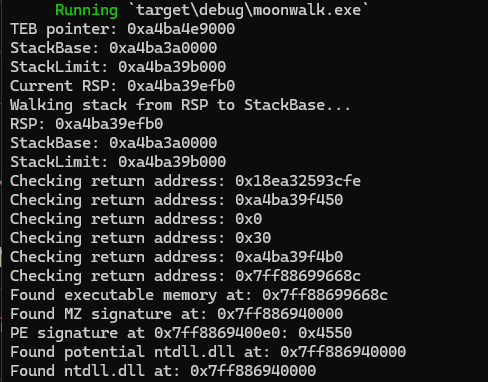
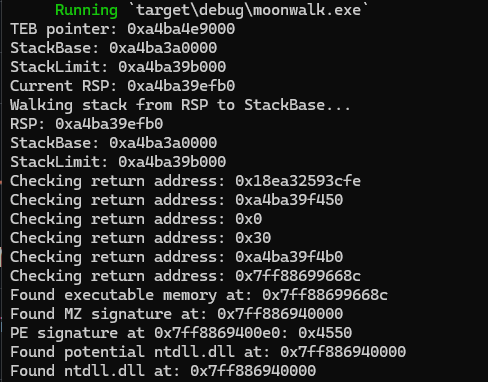
    Print statements are no longer included. This image is included for educational purposes.
    Moonwalk DLL Base Address Finder Demo

    Notes

    • DLL names are case-insensitive and the .dll extension is optional
    • Only works with DLLs that are in the call stack
    • Main branch: Uses VirtualQuery for safe memory access validation
    • OPSEC branch: Uses direct memory access with exception handling for maximum stealth
    • Both branches have clean library interfaces with no debug output