 stratosphereips/aip
Generates efficient IPv4 blocklists from Zeek network flows using multiple prioritization models (new, consistent, random forest) to identify emerging and persistent attackers, optimized for IoT environments.


The Attacker IP Prioritization (AIP) is a tool to generate efficient and economic IP blocklists based on network traffic captured from honeypot networks.
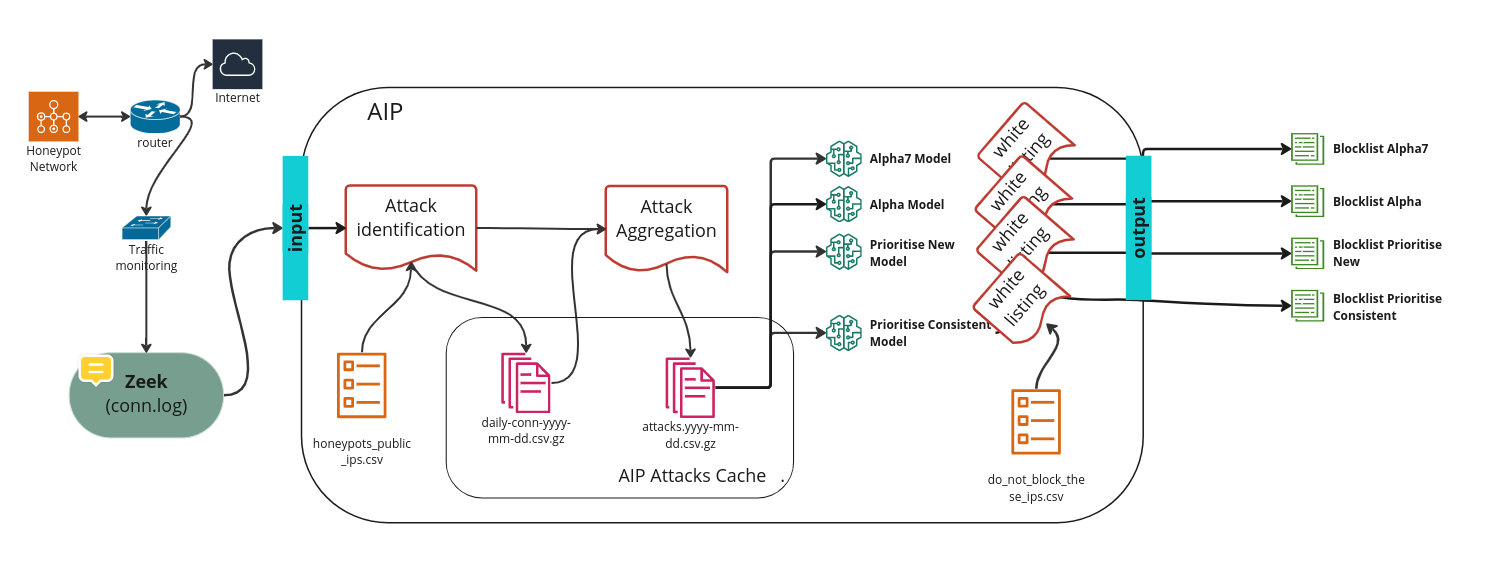
With the advent of 5G, IoT devices are directly connected often without firewall protection. Therefore we need blocklists that are small, efficient and economic. The AIP structure is shown below.
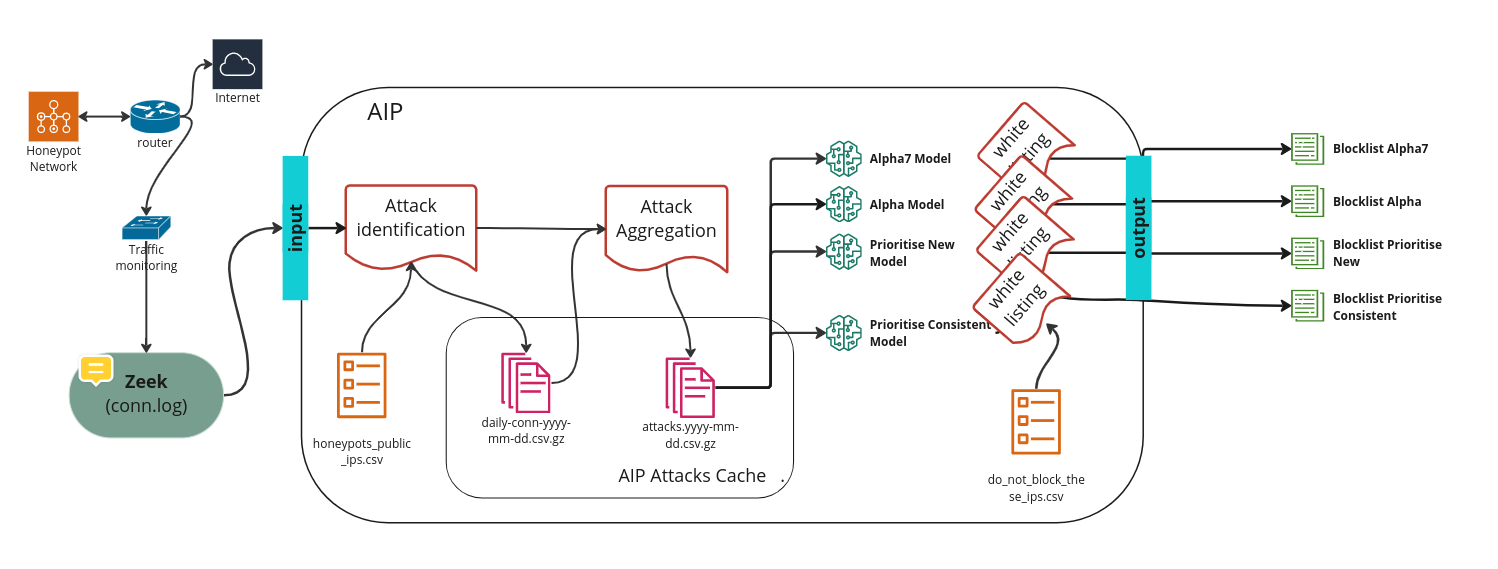
Each AIP model generates its own blocklist based on a specific criteria. The main models are:
AIP can run with Docker (recommended) or directly with Python. Either way, it needs two things:
Zeek logs in data/raw/, one folder per day (for example data/raw/2024-10-22/conn.*). With Docker you can point AIP to your Zeek logs folder instead of copying them.
Your honeypot IPs in data/external/. Copy the example files and edit them:
cp data/external/honeypots_public_ips_example.csv data/external/honeypots_public_ips.csv
cp data/external/do_not_block_these_ips_example.csv data/external/do_not_block_these_ips.csv
honeypots_public_ips.csv (required): the public IPs of your honeypots. AIP only looks at traffic sent to these IPs.do_not_block_these_ips.csv (optional): IPs that must never appear in a blocklist.From the AIP folder, assuming your Zeek logs are in /opt/zeek/logs/:
docker run --rm \
  -v /opt/zeek/logs/:/home/aip/AIP/data/raw:ro \
  -v ${PWD}/data/:/home/aip/AIP/data/:rw \
  --name aip stratosphereips/aip:latest bin/aip
This runs all models for today. To use any of the commands below, write them after bin/aip. For example, to run all models for one day:
docker run --rm \
  -v /opt/zeek/logs/:/home/aip/AIP/data/raw:ro \
  -v ${PWD}/data/:/home/aip/AIP/data/:rw \
  --name aip stratosphereips/aip:latest bin/aip run-models --start-date 2026-10-12 --end-date 2026-10-12
To build the image yourself, see the Docker guide.
git clone https://github.com/stratosphereips/AIP.git ~/AIP
cd ~/AIP
python3 -m venv aip-venv
source aip-venv/bin/activate
pip install -r requirements.txt
export PYTHONPATH=$(pwd)/lib
bin/aip --help
Run source aip-venv/bin/activate and the export PYTHONPATH line again each time you open a new terminal.
| What you want | Command |
|---|---|
| Run all models for today | bin/aip |
| Run all models for one day | bin/aip run-models --start-date 2026-10-02 --end-date 2026-10-02 |
| Run all models for several days | bin/aip run-models --start-date 2026-10-01 --end-date 2026-10-12 |
| Run only one model | Add --model with Alpha, Alpha7, Prioritize_New, Prioritize_Consistent or Random_Forest |
| Rebuild the attacker history from a date until yesterday | bin/aip rebuild-kb --start-date 2026-10-01 |
Things to know:
--end-date, it is today. So --start-date alone runs every day from that date until today.data/output/<model name>/.-v (progress) or -d (full detail) right after bin/aip, for example bin/aip -v run-models.bin/aip --help.The Stratosphere AIP tool is licensed under GNU General Public License v3.0.
This tool was developed at the Stratosphere Laboratory at the Czech Technical University in Prague. This is part of the Stratosphere blocklist generation project.
This tool was originally born from the bachelor thesis of Thomas O'Hara, The Attacker IP Prioritizer: An IoT Optimized Blacklisting Algorithm (2021).

