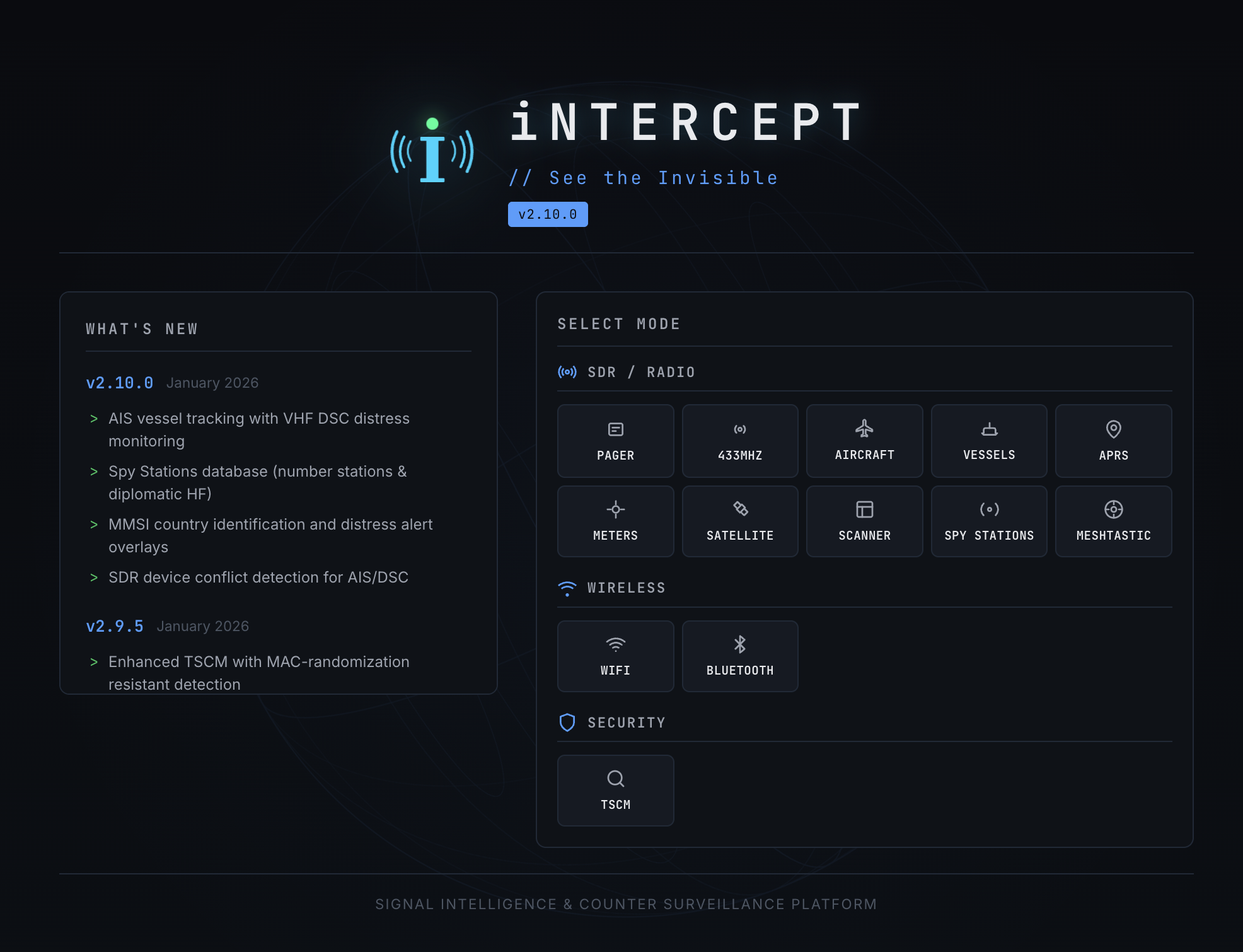

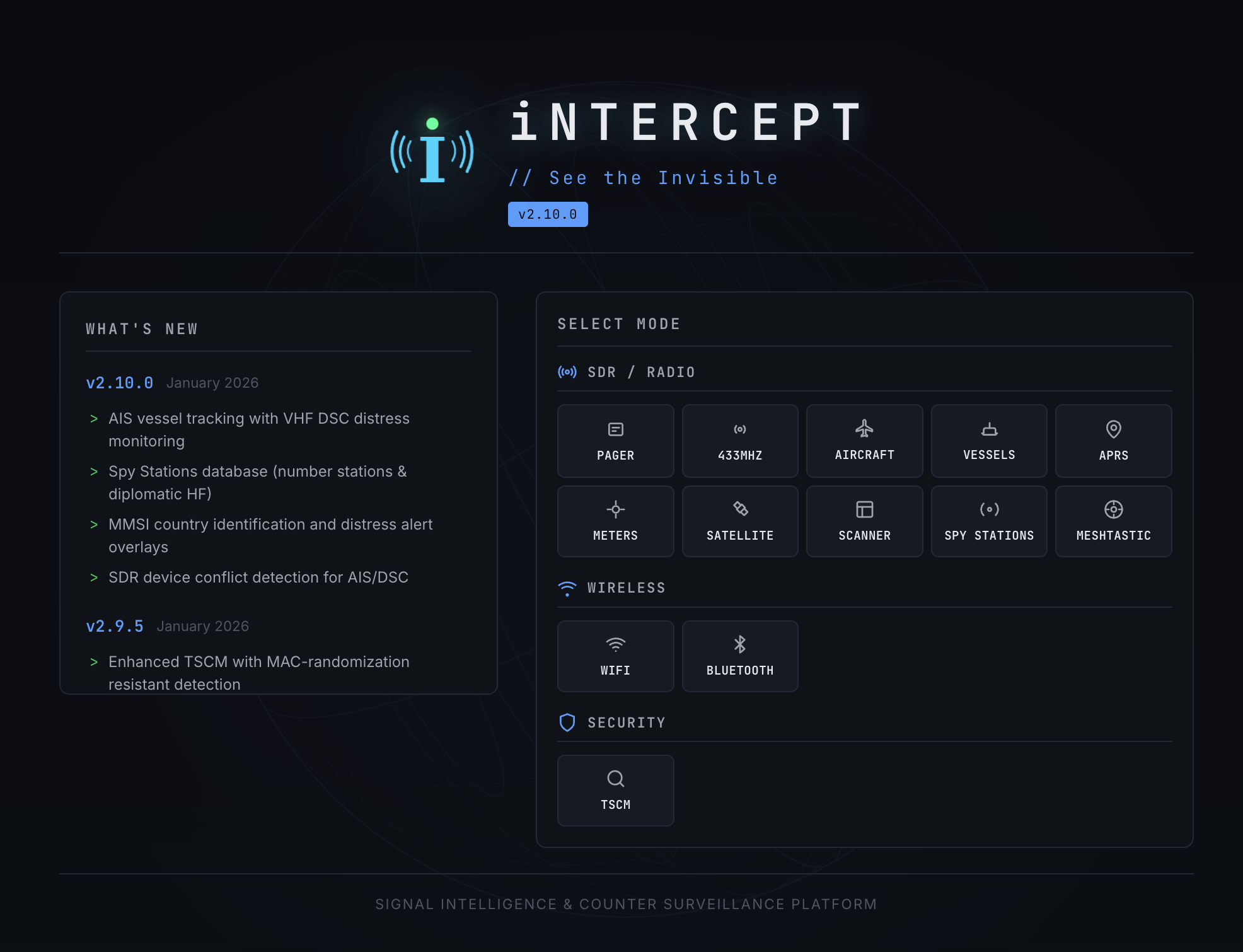
iNTERCEPT, a free and open-source platform that unites the best signal intelligence tools into a single, accessible interface.




Support the developer of this open-source project

Signal Intelligence Platform
A web-based interface for software-defined radio tools.
git clone https://github.com/smittix/intercept.git
cd intercept
./setup.sh          # Interactive menu (first run launches setup wizard)
sudo ./start.sh
On first run, setup.sh launches a guided wizard that detects your OS, lets you choose install profiles, sets up the Python environment, and optionally configures environment variables and PostgreSQL.
On subsequent runs, it opens an interactive menu:
INTERCEPT Setup Menu
════════════════════════════════════════
  1) Install / Add Modules
  2) System Health Check
  3) Database Setup (ADS-B History)
  4) Update Tools
  5) Environment Configurator
  6) Uninstall / Cleanup
  7) View Status
  0) Exit
Production vs Dev server:
start.shauto-detects gunicorn + gevent and runs a production server with cooperative greenlets — handles multiple SSE/WebSocket clients without blocking. Falls back to Flask dev server if gunicorn is not installed. For quick local development, you can still usesudo -E venv/bin/python intercept.pydirectly.
Choose what to install during the wizard or via menu option 1:
| # | Profile | Tools |
|---|---|---|
| 1 | Core SIGINT | rtl_sdr, multimon-ng, rtl_433, dump1090, acarsdec, dumpvdl2, ffmpeg, gpsd |
| 2 | Maritime & Radio | AIS-catcher, direwolf |
| 3 | Weather & Space | SatDump, radiosonde_auto_rx |
| 4 | RF Security | aircrack-ng, HackRF, BlueZ, hcxtools, Ubertooth, SoapySDR |
| 5 | Full SIGINT | All of the above |
| 6 | Custom | Per-tool checklist |
Multiple profiles can be combined (e.g. enter 1 3 for Core + Weather).
./setup.sh --non-interactive          # Headless full install (same as legacy behavior)
./setup.sh --profile=core,weather     # Install specific profiles
./setup.sh --health-check             # Check system health and exit
./setup.sh --postgres-setup           # Run PostgreSQL setup and exit
./setup.sh --menu                     # Force interactive menu
git clone https://github.com/smittix/intercept.git
cd intercept
docker compose --profile basic up -d --build
Note: Docker requires privileged mode for USB SDR access. SDR devices are passed through via
/dev/bus/usb.
For multi-architecture builds (amd64 + arm64 for Raspberry Pi), see build-multiarch.sh — it handles cross-compilation and registry push in one step.
Use the Environment Configurator (menu option 5) to interactively set any INTERCEPT_* variable. Settings are saved to a .env file that start.sh sources automatically on startup.
You can also create or edit .env manually:
# .env (auto-loaded by start.sh)
INTERCEPT_PORT=5050
INTERCEPT_ADSB_AUTO_START=true
INTERCEPT_DEFAULT_LAT=51.5074
INTERCEPT_DEFAULT_LON=-0.1278
The ADS-B history feature persists aircraft messages to PostgreSQL for long-term analysis.
Automated setup (local install):
./setup.sh --postgres-setup
# Or use menu option 3: Database Setup
This will install PostgreSQL if needed, create the database/user/tables, and write the connection settings to .env.
Docker:
docker compose --profile history up -d
Set the following environment variables (in .env):
INTERCEPT_ADSB_HISTORY_ENABLED=true
INTERCEPT_ADSB_DB_HOST=adsb_db
INTERCEPT_ADSB_DB_PORT=5432
INTERCEPT_ADSB_DB_NAME=intercept_adsb
INTERCEPT_ADSB_DB_USER=intercept
INTERCEPT_ADSB_DB_PASSWORD=intercept
To store Postgres data on external storage, set PGDATA_PATH (defaults to ./pgdata):
PGDATA_PATH=/mnt/usbpi1/intercept/pgdata
Then open /adsb/history for the reporting dashboard.
Verify your installation is complete and working:
./setup.sh --health-check
# Or use menu option 2
Checks installed tools, SDR devices, port availability, permissions, Python venv, .env configuration, and PostgreSQL connectivity.

