
Skip to content
KitploitKITPLOIT
ToolsBlog
Submit
ToolsBlog
Submit

Hacking, PenTest, and Cybersecurity Tools for Your Security Arsenal!

Kitploit is a directory of hacking, cybersecurity, and pentesting tools. Discover the latest project updates to find vulnerabilities, analyze systems, automate testing, and strengthen your security.

··Feeds·Contact·Privacy·© 2026 Kitploit

Tool Directory

Categories

View all categories
Loading categories
CVE-2026-54998-exp — CVE-2026-54998 RCE Exploit | Kitploit
Tools/GitHubGitHub/sentinel-aidefense/cve-2026-54998-exp
Privilege EscalationVulnerability AnalysisExploitationWeb Application ExploitationPenetration TestingLearning & Education
GitHubsentinel-aidefense/cve-2026-54998-exp

CVE-2026-54998-exp

CVE-2026-54998 RCE Exploit

View Repository
31 month agoNot yet reviewed

Most Popular

View all →

Discover the most used tools by our community.

Explore all tools

Browse our collection of tools

View all tools →
Share

DISCLAIMER

This repository is for educational and research purposes only.

The author is not responsible for any misuse, damage, or illegal activities caused by the use of this material.

Use at your own risk. Respect applicable laws and ethical guidelines.

Overview

CVE-2026-54998 is an Incorrect Authorization vulnerability (CWE-863) in Microsoft Exchange Online. It allows an authenticated attacker with low-level user privileges to elevate their access rights beyond the intended authorization scope over the network.

The vulnerability was published on July 3, 2026. CVSS v3.1 score: 8.8 (High).

Affected Versions

  • Microsoft Exchange Online (all versions prior to the patch released on July 3, 2026)
  • Microsoft 365 environments using Exchange Online

Patch Available: Yes (released July 3, 2026 via GitHub Advisory GHSA-phr2-vr74-whpx).

Technical Breakdown (Root Cause)

The root cause is improper authorization checks in Exchange Online. An authenticated user with standard/low privileges can manipulate requests to gain higher-level permissions, allowing actions beyond their assigned scope (e.g., accessing other users' mailboxes, administrative functions, etc.).
Attack Chain

  1. Attacker logs in with a standard user account.
  2. Sends specially crafted requests to Exchange Online APIs.
  3. Bypasses authorization controls to elevate privileges.
  4. Performs unauthorized actions (data access, configuration changes, etc.).

PoC

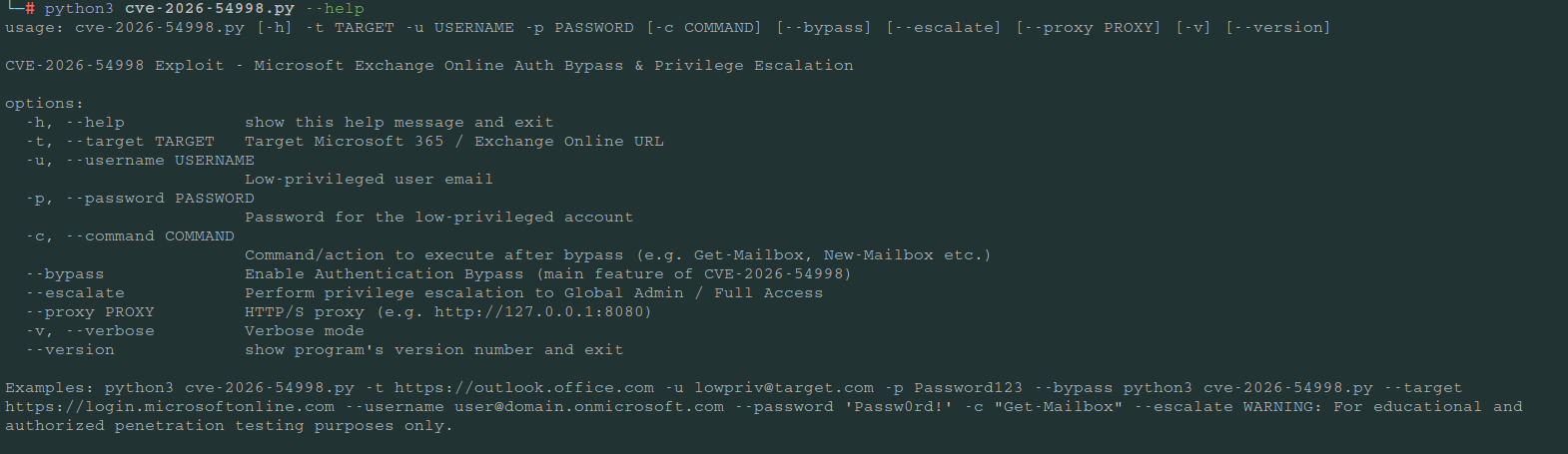
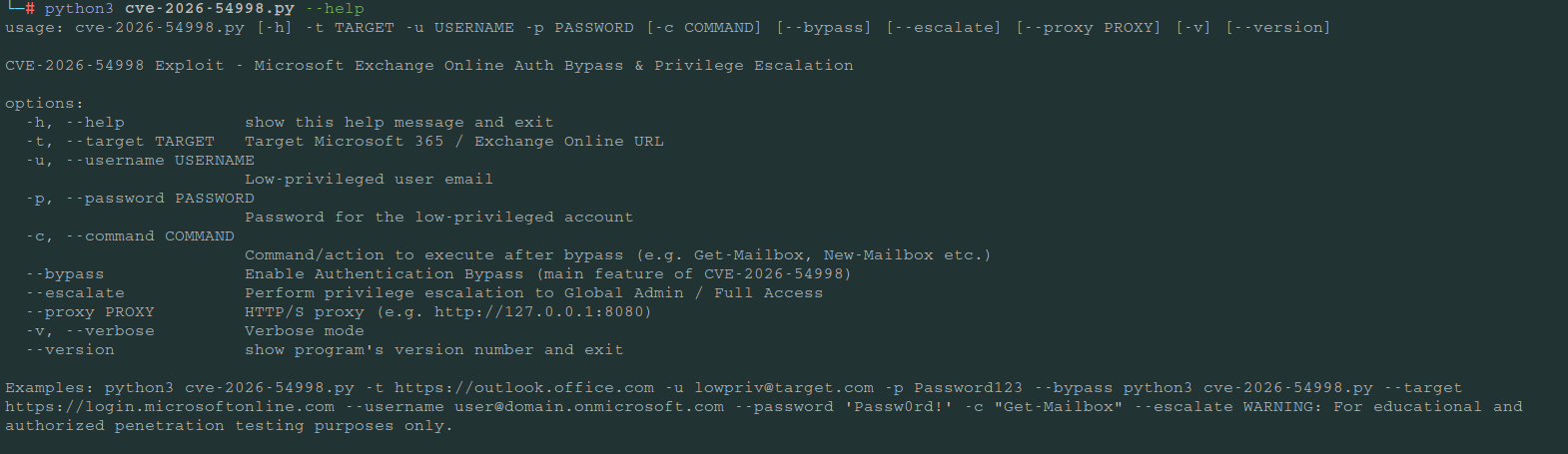
{D22B1F63-0E0C-49C9-9F49-3DCD1598D49A}

Exploit - href

Detection Guidance

  • Monitor Exchange Online audit logs for suspicious privilege escalation attempts.
  • Look for abnormal permission usage by low-privileged accounts.
  • Enable Microsoft 365 Defender alerts for anomalous access patterns.

Mitigation

  • Apply the official patch immediately (July 3, 2026 update).
  • Enforce the principle of least privilege for all Exchange Online accounts.
  • Implement network-level access controls and conditional access policies.
  • Regularly review and monitor user permissions and audit logs.
Download Tool