 samyk/slipstream
NAT Slipstreaming allows an attacker to remotely access any TCP/UDP services bound to a victim machine, bypassing the victim’s NAT/firewall, just by anyone on the victim's network visiting a website

NAT Slipstreaming allows an attacker to remotely access any TCP/UDP service bound to any system behind a victim's NAT, bypassing the victim's NAT/firewall (remote arbitrary firewall pinhole control), just by the victim visiting a website.
v1 developed by: @SamyKamkar // https://samy.pl
v2 developed by: Samy Kamkar && (Ben Seri && Gregory Vishnipolsky of Armis).
Read Ben & Gregory's excellent technical writeup on v2 here which goes deep into their updates of v2 with plenty of additional details.
v1 released: October 31 👻, 2020
v2 released: January 26, 2021
Source code: https://github.com/samyk/slipstream
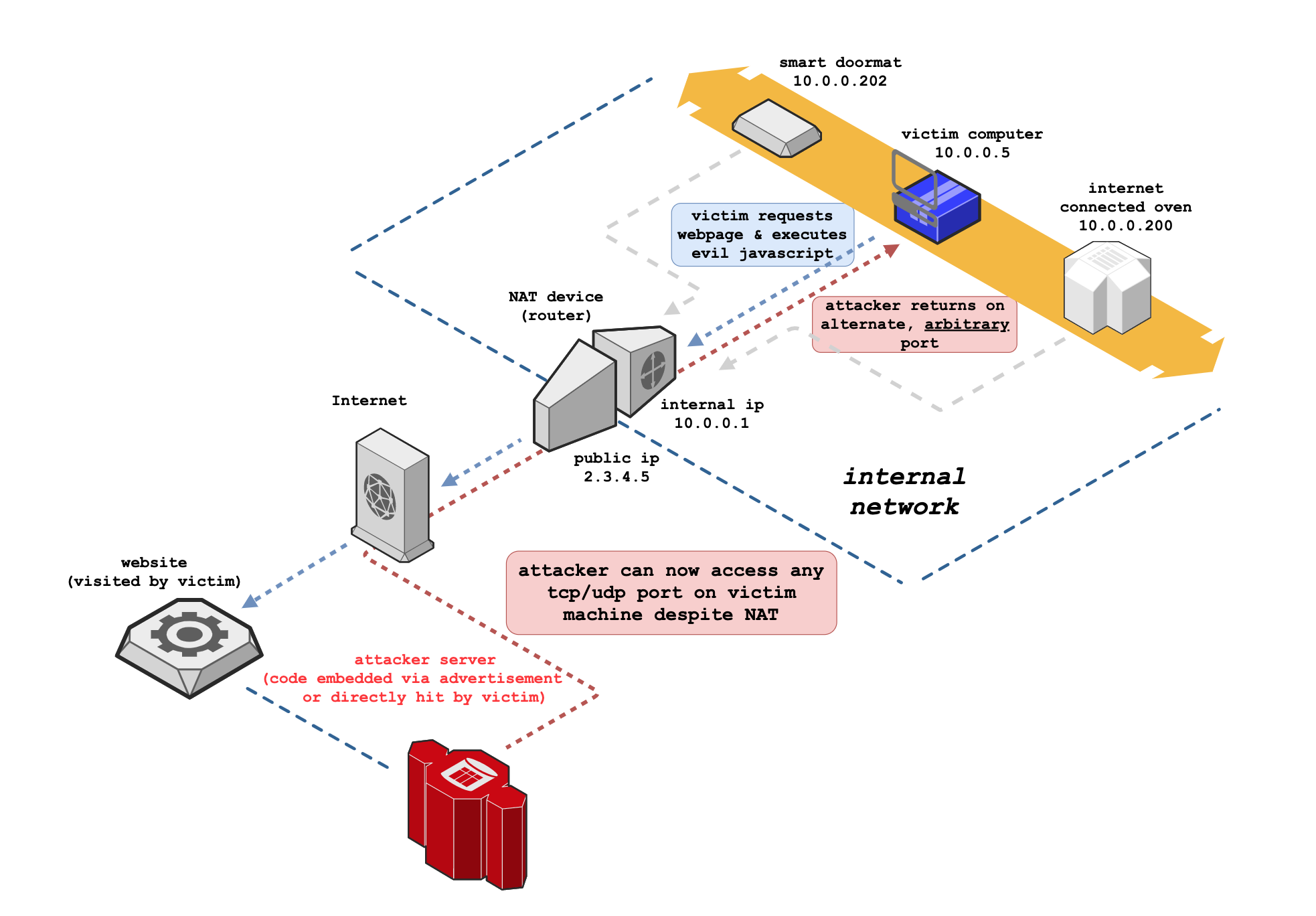 animated version here generated with my fork of draw.io, allowing exportable edge context flow & control in animations
NAT Slipstreaming exploits the user's browser in conjunction with the Application Level Gateway (ALG) connection tracking mechanism built into NATs, routers, and firewalls by chaining internal IP extraction via timing attack or WebRTC, automated remote MTU and IP fragmentation discovery, TCP packet size massaging, TURN authentication misuse, precise packet boundary control, and protocol confusion through browser abuse. As it's the NAT or firewall that opens the destination port, this bypasses any browser-based port restrictions.
This attack takes advantage of arbitrary control of the data portion of some TCP and UDP packets without including HTTP or other headers; the attack performs this new packet injection technique across all major modern (and older) browsers, and is a modernized version to my original NAT Pinning technique from 2010 (presented at DEFCON 18 + Black Hat 2010). Additionally, new techniques for local IP address discovery are included.
This attack requires the NAT/firewall to support ALG (Application Level Gateways), which are mandatory for protocols that can use multiple ports (control channel + data channel) such as SIP and H323 (VoIP protocols), FTP, IRC DCC, etc.
At a high level, NAT Slipstreaming works like so:
