PoisonTap - siphons cookies, exposes internal router & installs web backdoor on locked computers
Created by @SamyKamkar || https://samy.pl
When PoisonTap (Raspberry Pi Zero & Node.js) is plugged into a locked/password protected computer, it:
- emulates an Ethernet device over USB (or Thunderbolt)
- hijacks all Internet traffic from the machine (despite being a low priority/unknown network interface)
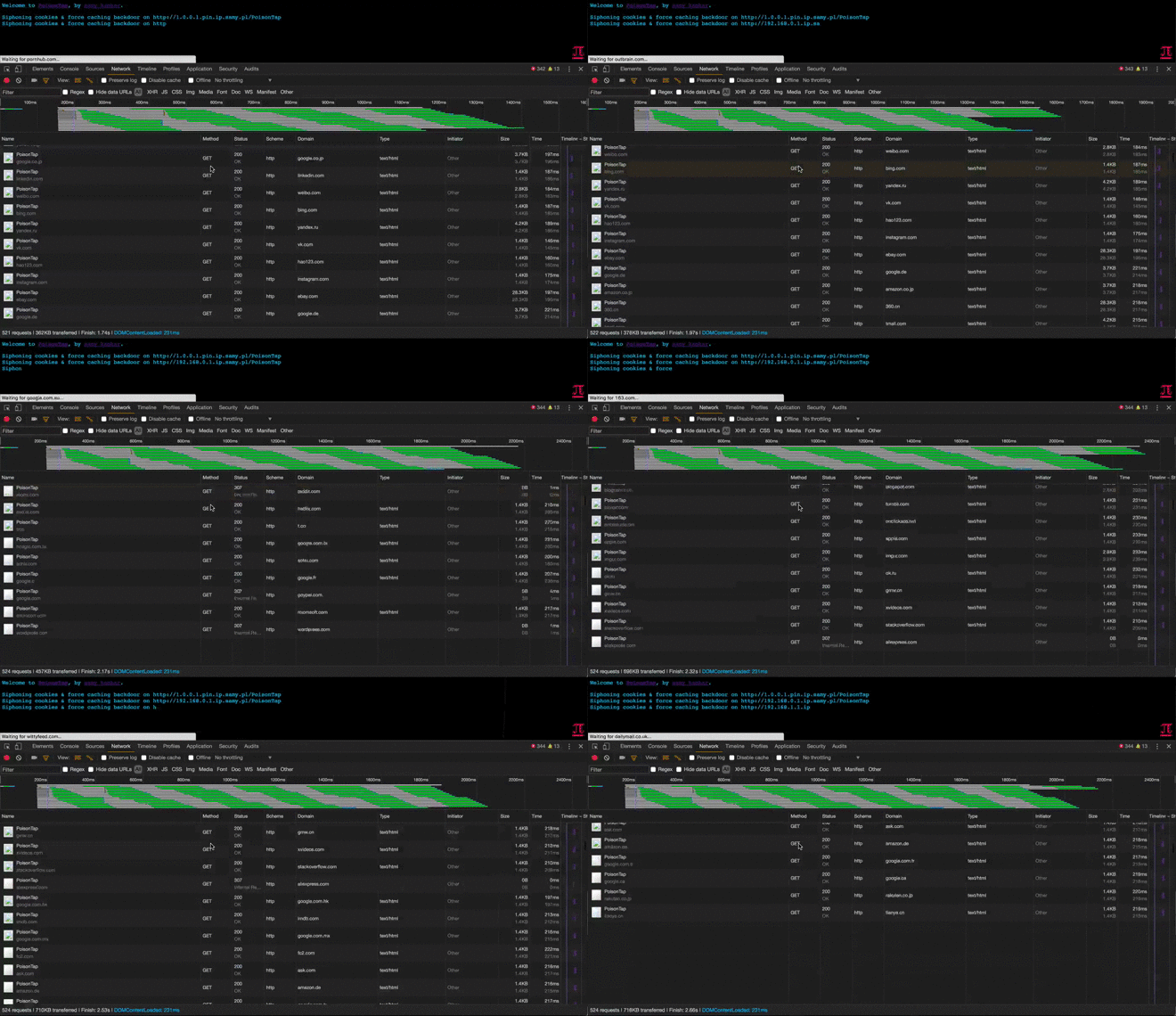
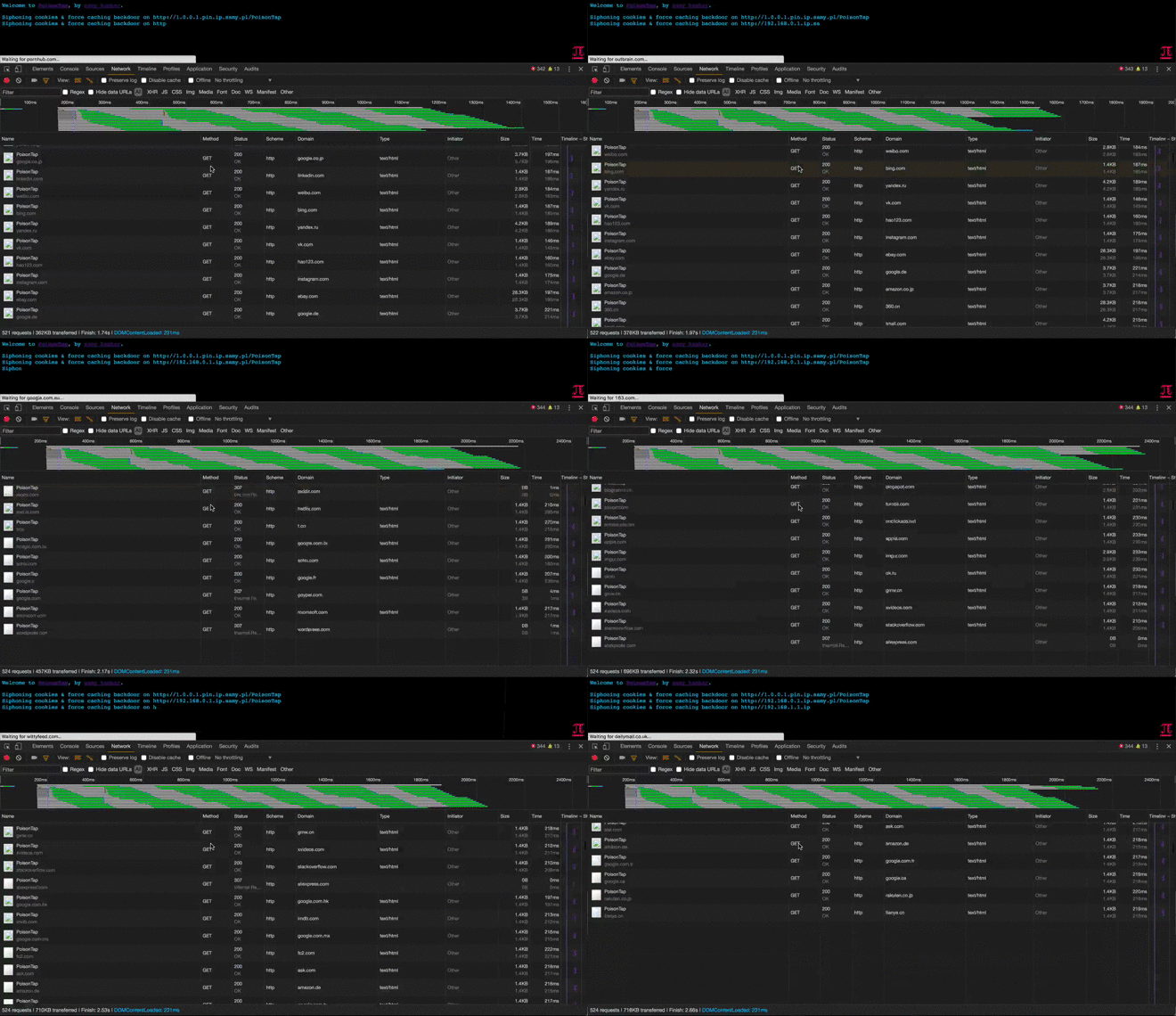
- siphons and stores HTTP cookies and sessions from the web browser for the Alexa top 1,000,000 websites
- exposes the internal router to the attacker, making it accessible remotely via outbound WebSocket and DNS rebinding (thanks Matt Austin for rebinding idea!)
- installs a persistent web-based backdoor in HTTP cache for hundreds of thousands of domains and common Javascript CDN URLs, all with access to the user's cookies via cache poisoning
- allows attacker to remotely force the user to make HTTP requests and proxy back responses (GET & POSTs) with the user's cookies on any backdoored domain
- does not require the machine to be unlocked
- backdoors and remote access persist even after device is removed and attacker sashays away

(incredible HTML5 canvas animation by Ara)
PoisonTap evades the following security mechanisms:
Demo
PoisonTap is built for the $5 Raspberry Pi Zero without any additional components other than a micro-USB cable & microSD card, or can work on any Raspberry Pi (1/2/3) with an Ethernet-to-USB/Thunderbolt dongle, or can work on other devices that can emulate USB gadgets such as USB Armory and LAN Turtle.
Live demonstration and more details available in the video:

Point of Contact: @SamyKamkar // https://samy.pl
Released: November 16, 2016
Source code and download: https://github.com/samyk/poisontap
How PoisonTap Works
PoisonTap produces a cascading effect by exploiting the existing trust in various mechanisms of a machine and network, including USB/Thunderbolt, DHCP, DNS, and HTTP, to produce a snowball effect of information exfiltration, network access and installation of semi-permanent backdoors.
In a nutshell, PoisonTap performs the following:
Network Hijacking
- Attacker plugs PoisonTap (such as weaponized Raspberry Pi Zero) into a locked computer (even if computer is password protected)
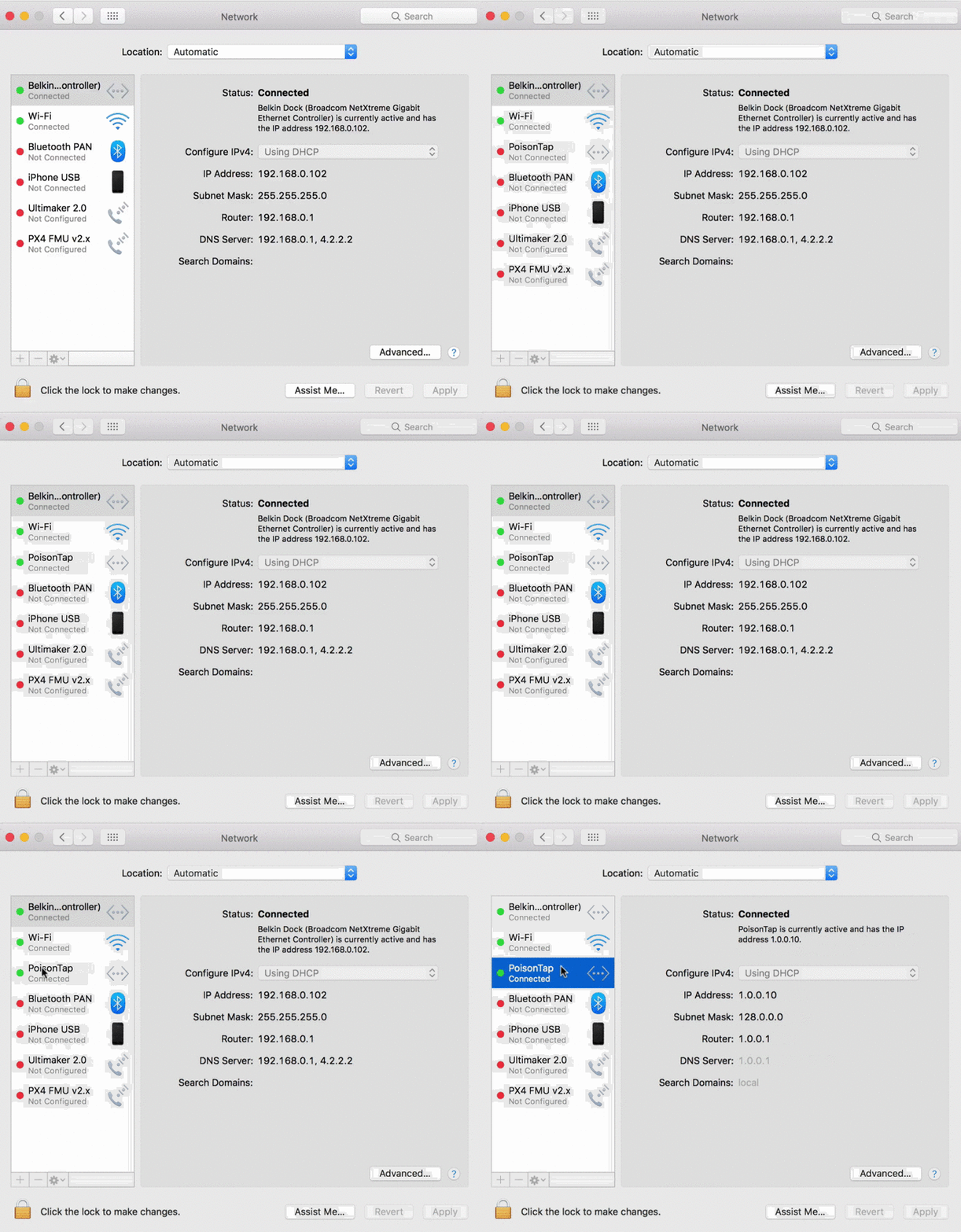
- PoisonTap emulates an Ethernet device (eg, Ethernet over USB/Thunderbolt) -- by default, Windows, OS X and Linux recognize an ethernet device, automatically loading it as a low-priority network device and performing a DHCP request across it, even when the machine is locked or password protected
- PoisonTap responds to the DHCP request and provides the machine with an IP address, however the DHCP response is crafted to tell the machine that the entire IPv4 space (0.0.0.0 - 255.255.255.255) is part of the PoisonTap's local network, rather than a small subnet (eg 192.168.0.0 - 192.168.0.255)
- Normally it would be irrelevant if a secondary network device connects to a machine as it will be given lower priority than the existing (trusted) network device and won't supersede the gateway for Internet traffic, but...
- Any routing table / gateway priority / network interface service order security is bypassed due to the priority of "LAN traffic" over "Internet traffic"
- PoisonTap exploits this network access, even as a low priority network device, because the subnet of a low priority network device is given higher priority than the gateway (default route) of the highest priority network device
- This means if traffic is destined to 1.2.3.4, while normally this traffic would hit the default route/gateway of the primary (non-PoisonTap) network device, PoisonTap actually gets the traffic because the PoisonTap "local" network/subnet supposedly contains 1.2.3.4, and every other IP address in existence ;)
- Because of this, all Internet traffic goes over PoisonTap, even though the machine is connected to another network device with higher priority and proper gateway (the true wifi, ethernet, etc.)