 sahiloj/cve-2023-37191
A Stored Cross-Site Scripting (XSS) vulnerability exists in Issabel PBX version 4.0.0-6. This allows an authenticated attacker to inject arbitrary JavaScript or HTML code via the Group and Description input fields found under System → Users → Groups.

| Field | Details |
|---|---|
| CVE ID | CVE-2023-37191 |
| Product | Issabel PBX (issabel-pbx) |
| Affected Version | 4.0.0-6 |
| Vulnerability Type | Stored Cross-Site Scripting (XSS) |
| Severity | Medium |
| Discovery Date | 7 July 2023 |
| Discovered By | Sahil Ojha |
| Vendor Homepage | https://www.issabel.org/ |
| Source Code | https://github.com/IssabelFoundation/issabelPBX |
| Tested On | Windows |
A Stored Cross-Site Scripting (XSS) vulnerability exists in Issabel PBX version 4.0.0-6. The application fails to properly sanitize or encode user-supplied input before storing it in the database and later rendering it in the browser. This allows an authenticated attacker to inject arbitrary JavaScript or HTML code via the Group and Description input fields found under System → Users → Groups.
Once the malicious payload is saved, it is persistently stored on the server. Every time any user (including administrators) visits the affected page, the injected script is automatically executed within their browser session — without any further action required from the attacker. This is what distinguishes a Stored (Persistent) XSS from a Reflected XSS; the impact is broader and more dangerous because the payload affects all visitors of the page.
System → Users → Groups module of the Issabel PBX web interfaceGroup (name field) and Description (text field)A successful exploitation of this vulnerability can allow an attacker to:
Because the payload is stored on the server, every user who visits the compromised page is affected — amplifying the damage compared to a reflected XSS attack.
Step 1: Log in to the Issabel PBX web interface using administrator credentials.
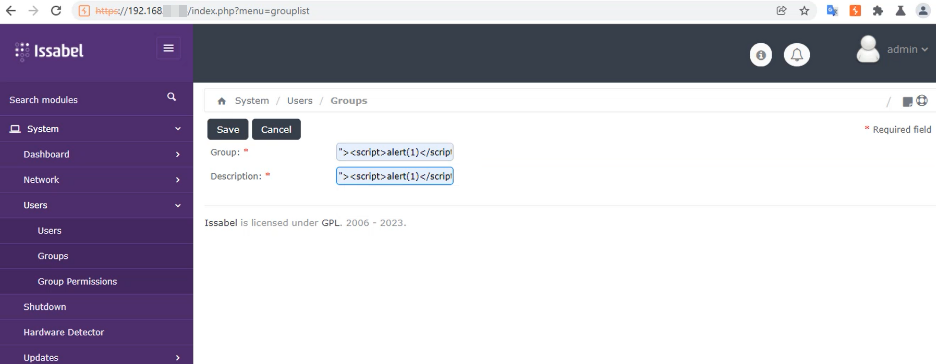
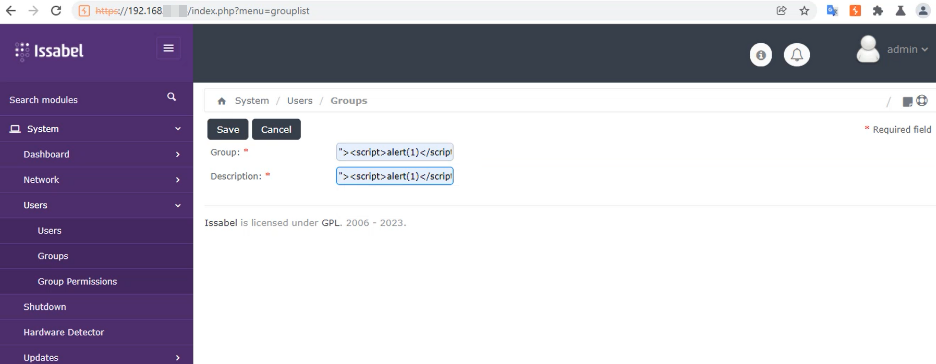
Step 2: Navigate to System → Users → Groups. In the Group and/or Description input fields, enter the following XSS payload:
"><script>alert(1)</script>
The fields should look similar to the screenshot below:
Step 3: Click Save. The payload is now persistently stored in the application's database.
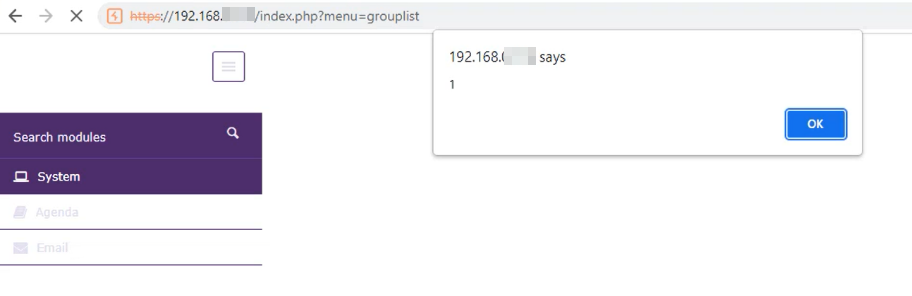
Step 4: Navigate back to the System → Users → Groups page (or have any other user visit it). The injected script executes automatically in the browser, as shown below:
To mitigate this vulnerability, the Issabel PBX development team should apply the following fixes:
Input Validation: Strictly validate all user-supplied input server-side. Reject or sanitize values that contain HTML special characters (<, >, ", ', &) in fields that do not require HTML formatting.
Output Encoding: When rendering stored data back to the browser, apply context-aware output encoding (e.g., HTML entity encoding) to neutralize any injected markup. Since Issabel PBX is PHP-based, use PHP's built-in htmlspecialchars() or htmlentities() functions rather than custom filtering.
Content Security Policy (CSP): Implement a strict Content Security Policy HTTP header to limit the sources from which scripts can be executed. A properly configured CSP can prevent injected scripts from running even if input sanitization is bypassed.
Regular Security Audits: Conduct periodic code reviews and penetration tests to identify and remediate injection vulnerabilities across the entire application.
This information is provided for educational and research purposes only. The author is not responsible for any misuse of this information. Always obtain proper written authorization before testing vulnerabilities on any system you do not own.
