 sahiloj/cve-2023-34835
A Reflected Cross-Site Scripting (XSS) vulnerability was discovered in the Microworld Technologies eScan Management Console, version 14.0.1400.2281.




A Reflected Cross-Site Scripting (XSS) vulnerability was discovered in the Microworld Technologies eScan Management Console, version 14.0.1400.2281. An authenticated remote attacker can inject and execute arbitrary JavaScript code in the victim's browser by manipulating the delete_file POST parameter within the Report Template deletion functionality.
This vulnerability was discovered and responsibly disclosed by Sahil Ojha on 23 June 2023, and has been assigned the identifier CVE-2023-34835.
| Field | Details |
|---|---|
| CVE ID | CVE-2023-34835 |
| Vulnerability Type | Reflected Cross-Site Scripting (XSS) |
| CVSS Score | 5.4 (Medium) — CVSS:3.1/AV:N/AC:L/PR:L/UI:R/S:C/C:L/I:L/A:N |
| CWE | CWE-79: Improper Neutralization of Input During Web Page Generation |
| Affected Version | 14.0.1400.2281 |
| Vendor | Microworld Technologies |
| Vendor Homepage | https://www.escanav.com |
| Software Link | https://cl.escanav.com/ewconsole.dll |
| Tested On | Windows |
| Discovered By | Sahil Ojha |
| Disclosure Date | 23 June 2023 |
eScan Management Console is an enterprise security management platform developed by Microworld Technologies. It is used by organizations to centrally manage endpoint security policies, antivirus deployments, reports, and alerts across their internal network. Because the console typically resides on an internal (corporate) network and requires authentication to access, this vulnerability is exploitable by authenticated insiders or attackers who have gained a foothold on the network.
Vulnerable component: The Report Template deletion endpoint does not sanitize or encode the delete_file parameter before reflecting it back in the HTTP response, allowing JavaScript payloads to be executed in the context of the victim's browser session.
The eScan Management Console's Report Template feature exposes a POST endpoint for deleting report template files. The server-side handler reflects the value of the delete_file parameter directly into the HTML response without proper output encoding or input validation. When a crafted request containing a JavaScript payload is sent, the browser interprets and executes the injected script.
Attack vector summary:
delete_file parameter is replaced with an XSS payload such as ">.Because session cookies are accessible via document.cookie (and are not protected by the HttpOnly flag in the affected version), this XSS can be chained with a session-hijacking attack to perform full account takeover.
Prerequisites: Valid credentials for an eScan Management Console instance (internal network access required).
Tools needed: A web browser and an HTTP interception proxy (e.g., Burp Suite).
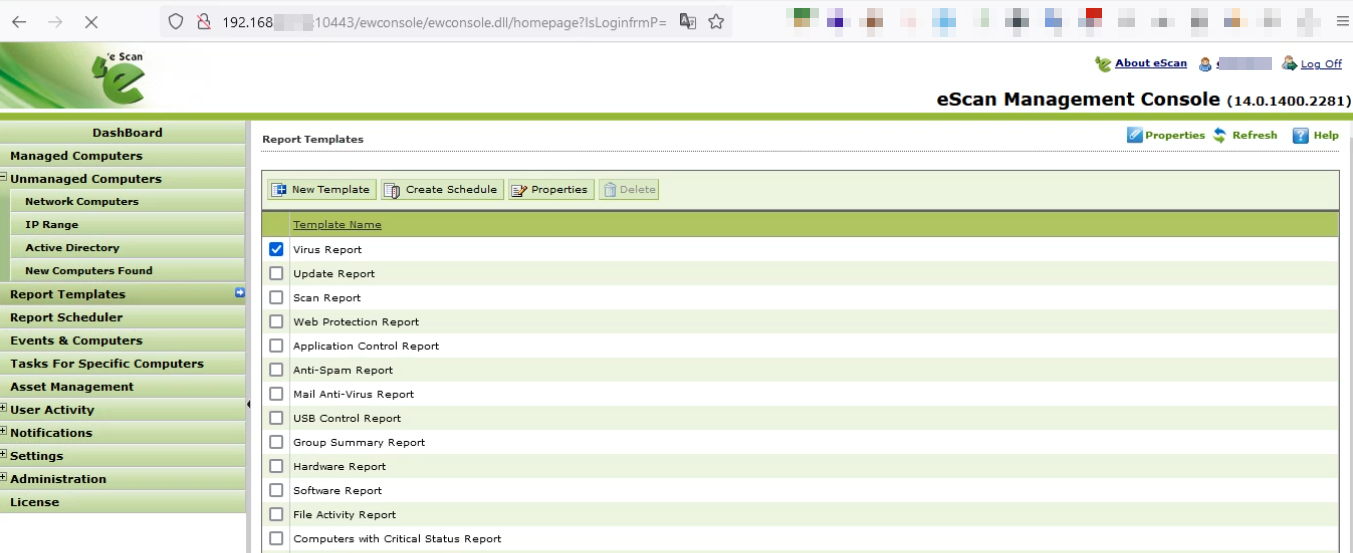
Authenticate to the eScan Management Console using valid user credentials. The console is typically accessible only from within the organization's internal network.
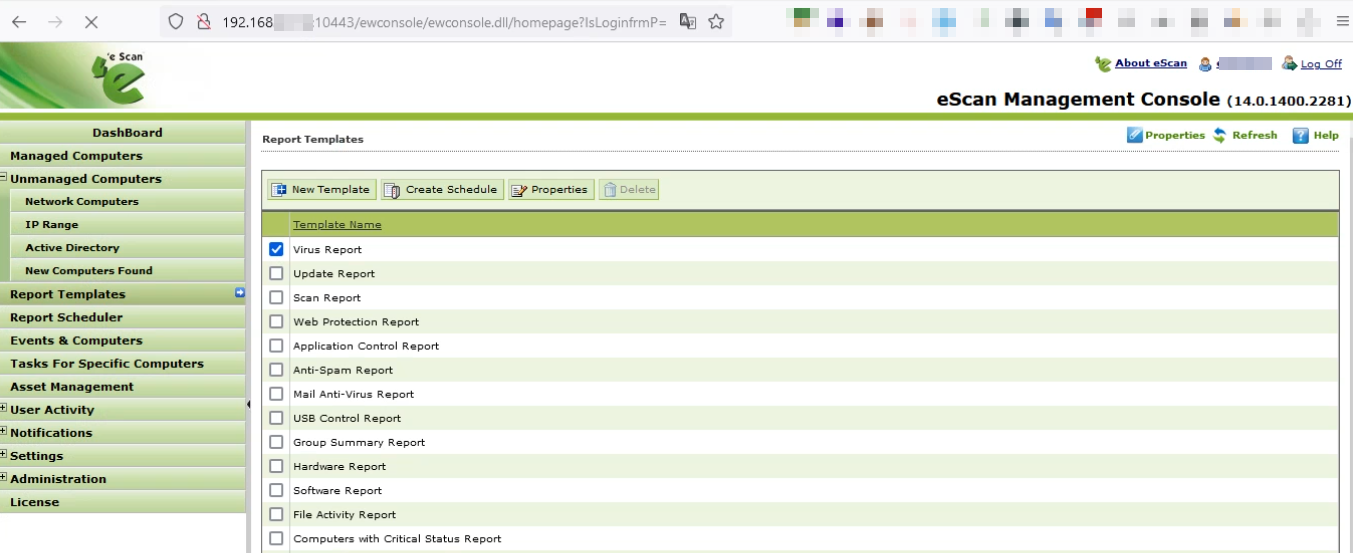
Using Burp Suite (or another HTTP proxy), intercept the outgoing POST request that is generated when the delete button is clicked. The request will contain a delete_file parameter whose value is the name of the report template file.
Replace the value of delete_file with an XSS payload, for example:
delete_file=">
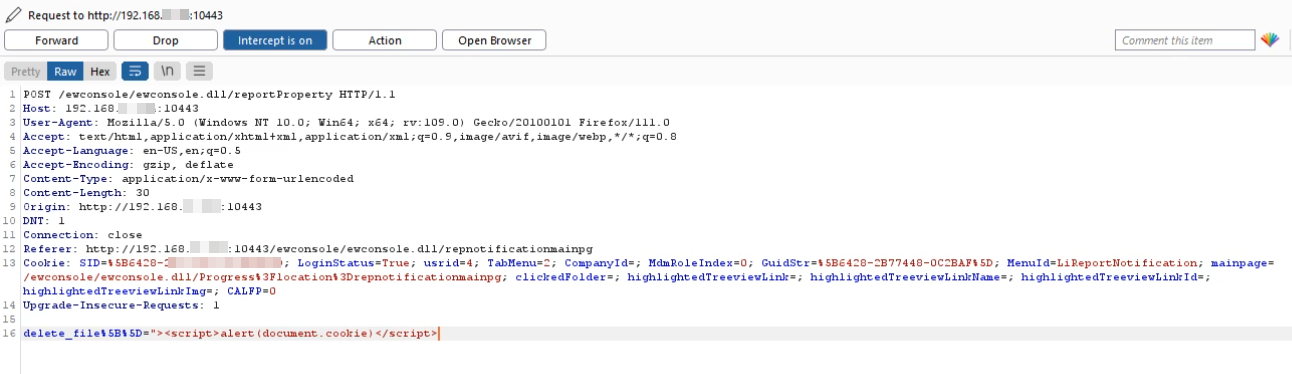
Forward the modified request. The server reflects the injected payload in the response without sanitization. The browser executes the JavaScript, and an alert dialog displays the victim's session cookie.
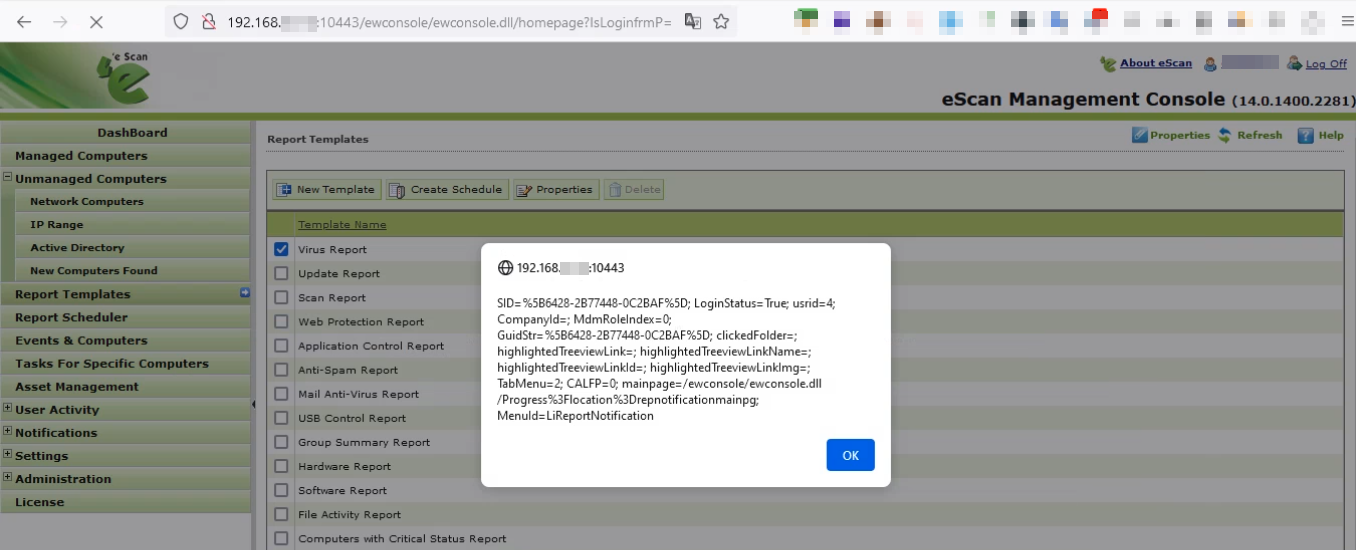
The session cookie exposed here can be exfiltrated to an attacker-controlled server and used to hijack the authenticated session (account takeover).
| Impact Category | Details |
|---|---|
| Session Hijacking | Exposed session cookies (lacking HttpOnly flag) can be stolen and used to impersonate the victim. |
| Account Takeover | A stolen session token grants full access to the eScan Management Console under the victim's role. |
| Phishing / Defacement | Injected scripts can redirect users to phishing pages or alter the console's UI. |
| Credential Harvesting | Attackers can inject fake login forms to capture user credentials. |
| Privilege Escalation | If a high-privileged administrator is the victim, the attacker gains administrative-level access. |
While exploitation requires an authenticated session on an internal network, the impact is significant given that eScan Management Console administrators typically have broad access to endpoint security configurations.
The following actions are recommended to address this vulnerability:

