
Skip to content
KitploitKITPLOIT
ToolsBlog
Submit
ToolsBlog
Submit

Hacking, PenTest, and Cybersecurity Tools for Your Security Arsenal!

Kitploit is a directory of hacking, cybersecurity, and pentesting tools. Discover the latest project updates to find vulnerabilities, analyze systems, automate testing, and strengthen your security.

··Feeds·Contact·Privacy·© 2026 Kitploit

Tool Directory

Categories

View all categories
Loading categories
CVE-2023-33731 — A Reflected Cross-Site Scripting (XSS) vulnerability was discovered in the eScan Management Console (version 14.0.1400.2281) developed by Microworld Technologies. | Kitploit
Tools/GitHubGitHub/sahiloj/cve-2023-33731
Vulnerability AnalysisWeb Application ExploitationWeb SecurityPenetration TestingPapers & ResearchLearning & Education
GitHubsahiloj/cve-2023-33731

CVE-2023-33731

A Reflected Cross-Site Scripting (XSS) vulnerability was discovered in the eScan Management Console (version 14.0.1400.2281) developed by Microworld Technologies.


View Repository
1116 months agoNot yet reviewed

Most Popular

View all →

Discover the most used tools by our community.

Explore all tools

Browse our collection of tools

View all tools →
Share

CVE-2023-33731 — eScan Management Console: Reflected Cross-Site Scripting (XSS)

CVE Severity Type Affected Version Vendor Status


Table of Contents

  • Overview
  • Vulnerability Details
  • Severity & CVSS Score
  • Affected Product
  • Technical Analysis
  • Proof of Concept
  • Impact
  • Mitigation & Remediation
  • Disclosure Timeline
  • References
  • Author

  • Overview

    A Reflected Cross-Site Scripting (XSS) vulnerability was discovered in the eScan Management Console (version 14.0.1400.2281) developed by Microworld Technologies. The vulnerability exists in the Dashboard Details (DashBoardDetails) endpoint, where multiple query-string parameters are reflected into the HTML response without proper sanitization or output encoding. An unauthenticated remote attacker can craft a malicious URL and trick an authenticated administrator into clicking it, causing arbitrary JavaScript to execute in the victim's browser session.


    Vulnerability Details

    FieldValue
    CVE IDCVE-2023-33731
    Vulnerability TypeReflected Cross-Site Scripting (XSS)
    CWECWE-79 — Improper Neutralization of Input During Web Page Generation
    Affected ProductMicroworld Technologies eScan Management Console
    Affected Version14.0.1400.2281
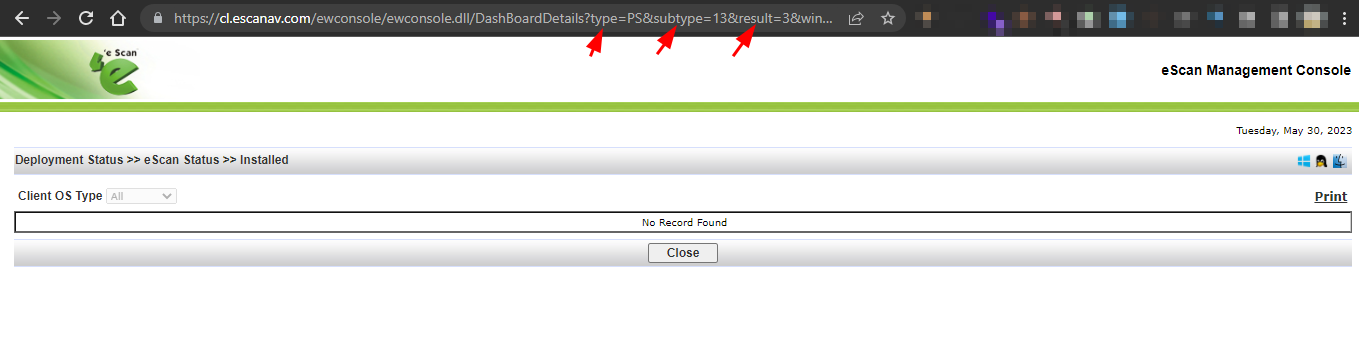
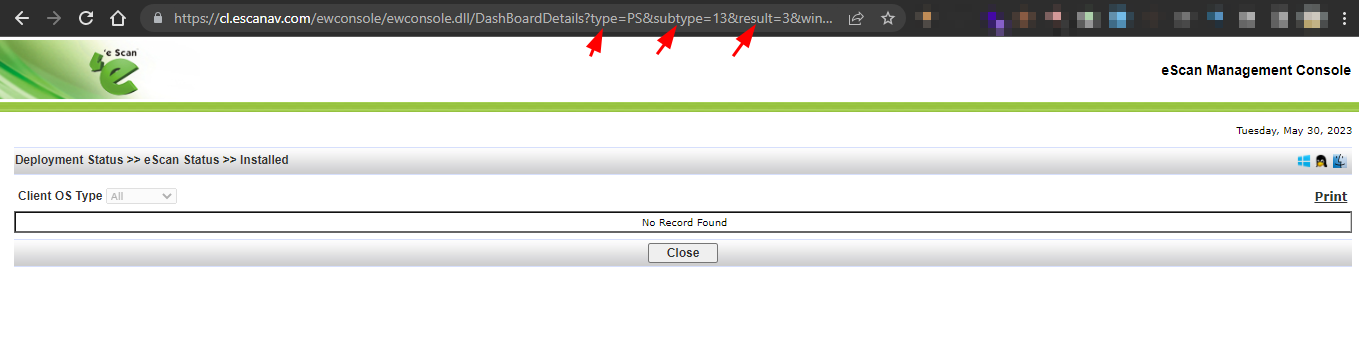
    Vulnerable Endpoint/ewconsole/ewconsole.dll/DashBoardDetails
    Vulnerable Parameterstype, subtype, result
    Attack VectorNetwork (crafted URL delivered via phishing / social engineering)
    Authentication RequiredVictim must be authenticated; attacker does not need credentials
    Tested OnWindows
    Disclosed30 May 2023
    Vendor Homepagehttps://www.escanav.com

    Severity & CVSS Score

    MetricValue
    Base Score6.1 (Medium)
    Attack VectorNetwork
    Attack ComplexityLow
    Privileges RequiredNone
    User InteractionRequired
    ScopeChanged
    ConfidentialityLow
    IntegrityLow
    AvailabilityNone

    CVSS 3.1 Vector: AV:N/AC:L/PR:N/UI:R/S:C/C:L/I:L/A:N


    Affected Product

    • Product: eScan Management Console (Web-based endpoint security management platform)
    • Vendor: Microworld Technologies
    • Version: 14.0.1400.2281
    • Software Link: https://cl.escanav.com/ewconsole.dll
    • Platform: Windows

    Technical Analysis

    The eScan Management Console exposes a web interface (ewconsole.dll) that handles various management operations, including dashboard views. The DashBoardDetails endpoint accepts several query-string parameters (type, subtype, result, windowname, DisplayOSSelection) and uses their values to dynamically construct HTML content in the server response.

    Root Cause

    The server-side code fails to sanitize or HTML-encode user-supplied input before embedding it into the response body. Specifically, the type parameter value is reflected directly into an HTML attribute context without escaping special characters such as ", <, and >. This allows an attacker to break out of the attribute context and inject arbitrary HTML/JavaScript tags.

    The same flaw is present in the subtype and result parameters.

    Vulnerable Request

    root@kitploit:~
    GET /ewconsole/ewconsole.dll/DashBoardDetails?type=<PAYLOAD>&subtype=<PAYLOAD>&result=<PAYLOAD>&windowname=usrmgmt&DisplayOSSelection=true
    Host: cl.escanav.com
    

    Payload Breakdown

    The URL-encoded payload PS%22%3E%3Cscript%3Ealert(document.cookie)%3C/script%3E decodes to:

    root@kitploit:~
    PS"><script>alert(document.cookie)</script>
    
    FragmentPurpose
    PS"Closes the existing HTML attribute value (" terminates the attribute)
    >Closes the surrounding HTML tag
    <script>alert(document.cookie)</script>Injects a script block that executes JavaScript, here exfiltrating the session cookie

    Proof of Concept

    ⚠️ For educational and authorized security research purposes only.

    Prerequisites

    1. The victim must be logged into the eScan Management Console as an authenticated user (e.g., an administrator).
    2. The attacker delivers the following crafted URL to the victim (e.g., via email phishing, chat message, or embedded link).

    Steps to Reproduce

    Step 1: Log in to the eScan Management Console with valid credentials.

    Step 2: Navigate to (or deliver to an authenticated victim) the following crafted URL:

    root@kitploit:~
    https://cl.escanav.com/ewconsole/ewconsole.dll/DashBoardDetails?type=PS%22%3E%3Cscript%3Ealert(document.cookie)%3C/script%3E&subtype=13&result=3&windowname=usrmgmt&DisplayOSSelection=true
    

    Decoded payload in the type parameter:

    root@kitploit:~
    PS"><script>alert(document.cookie)</script>
    

    Step 3: Upon loading the page, the injected script executes in the browser. An alert dialog appears displaying the victim's active session cookie.
    XSS Alert with session cookie

    Step 4: The attacker captures the session cookie value and uses it to hijack the administrator's session, gaining full control of the management console.
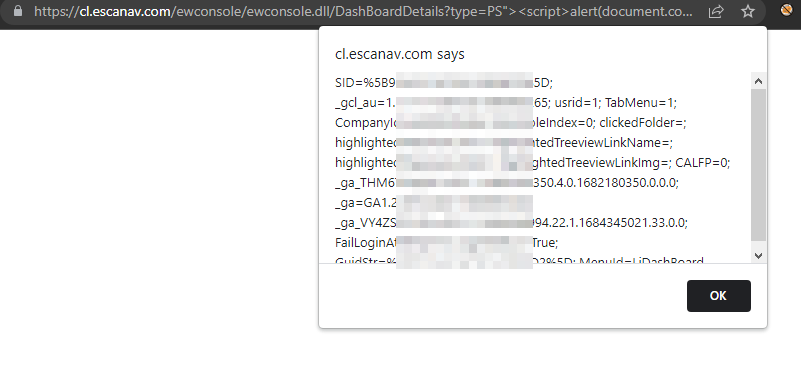
    Session Cookie Captured


    Impact

    Successful exploitation of this vulnerability allows an attacker to:

    • Session Hijacking / Account Takeover: Steal the authenticated administrator's session cookie and impersonate them without needing their credentials.
    • Credential Theft: Inject a fake login form or keylogger to capture usernames and passwords.
    • Malware Distribution: Redirect the victim to a malicious site or silently download malware.
    • UI Manipulation / Defacement: Alter the content of the management console page to mislead the administrator.
    • Privilege Escalation: Since the target is typically an administrator, a successful attack results in full control of the endpoint security management platform, potentially compromising all managed endpoints in the organization.

    Mitigation & Remediation

    For Vendor / Developers

    1. Output Encoding: HTML-encode all user-supplied input before reflecting it in responses (e.g., < → &lt;, > → &gt;, " → &quot;, ' → &#x27;).
    2. Input Validation: Enforce strict allowlists; for example, subtype and result should only accept numeric values and reject anything else.
    3. Content Security Policy (CSP): Deploy a strict Content-Security-Policy HTTP response header to prevent inline script execution.
    4. HttpOnly Cookie Flag: Set the HttpOnly attribute on session cookies so JavaScript cannot access them, significantly limiting the impact of any XSS vulnerability.
    5. Upgrade / Patch: Apply the latest security patches or upgrade to a version of eScan Management Console that addresses this vulnerability.

    For System Administrators / Users

    • Avoid clicking on unsolicited or unexpected links that reference your eScan Management Console.
    • Restrict management console access to trusted networks; do not expose it directly to the public internet — use a VPN or IP allowlist.
    • Monitor session activity and audit all administrative actions.
    • Apply vendor-supplied security updates promptly.

    Disclosure Timeline

    DateEvent
    2023-05-30Vulnerability discovered and documented by Sahil Ojha
    2023-05-30Public disclosure / CVE assigned: CVE-2023-33731

    References

    • NVD — CVE-2023-33731
    • Microworld Technologies — eScan Management Console
    • CWE-79: Improper Neutralization of Input During Web Page Generation
    • OWASP: Cross-Site Scripting (XSS)
    • OWASP XSS Prevention Cheat Sheet

    Author

    Sahil Ojha

    This vulnerability was responsibly researched and disclosed to raise awareness about security weaknesses in widely deployed security management software. All information provided here is intended solely for educational and defensive security research purposes.

    Download Tool



