 sahiloj/cve-2023-31703
A reflected Cross-Site Scripting (XSS) vulnerability exists in the Edit User functionality of the Microworld Technologies eScan Management Console (version 14.0.1400.2281).

CVE ID: CVE-2023-31703
Vulnerability Type: Reflected Cross-Site Scripting (XSS)
Affected Product: Microworld Technologies eScan Management Console
Affected Version: 14.0.1400.2281
Severity: Medium
Discovered By: Sahil Ojha
Disclosure Date: 16 May 2023
A reflected Cross-Site Scripting (XSS) vulnerability exists in the Edit User functionality of the Microworld Technologies eScan Management Console (version 14.0.1400.2281). The application fails to properly sanitize or encode user-supplied input passed via the from parameter in the URL before reflecting it back in the HTTP response.
An unauthenticated or authenticated remote attacker who can trick a logged-in administrator into clicking a crafted link can inject and execute arbitrary JavaScript in the context of the victim's browser session. This can lead to session cookie theft, account takeover, credential harvesting, or further client-side attacks.
| Field | Details |
|---|---|
| Vendor | Microworld Technologies |
| Product | eScan Management Console |
| Version | 14.0.1400.2281 |
| Component | editUserName endpoint — from URL parameter |
| Vendor Site | https://www.escanav.com |
| Software Link | https://cl.escanav.com/ewconsole.dll |
| Platform | Windows |
The from parameter accepted by the /ewconsole/ewconsole.dll/editUserName endpoint is reflected directly into the HTML response body without any HTML encoding or output sanitization. This allows an attacker to break out of the HTML attribute context and inject a <script> tag or other event-handler payload that is executed immediately by the browser.
GET /ewconsole/ewconsole.dll/editUserName?usrid=<ID>&from=<PAYLOAD>&P=
Log in to the eScan Management Console with valid credentials.
Navigate to the following baseline URL to confirm the from parameter is reflected:
https://cl.escanav.com/ewconsole/ewconsole.dll/editUserName?usrid=4&from=banner&P=
Replace the from value with the XSS payload below and open the crafted URL in the victim's authenticated browser:
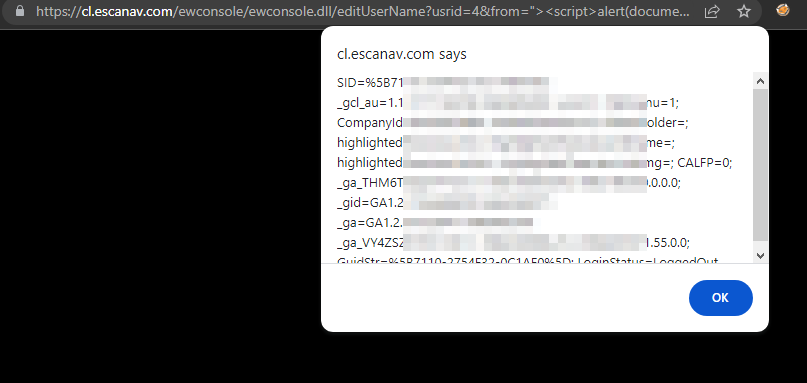
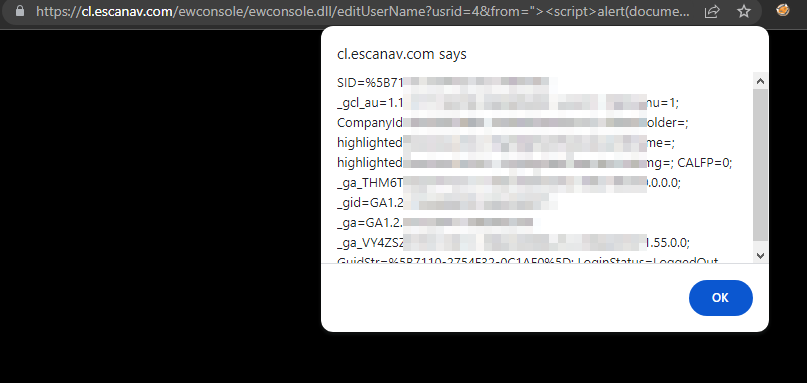
https://cl.escanav.com/ewconsole/ewconsole.dll/editUserName?usrid=4&from="><script>alert(document.cookie)</script>banner&P=
The browser will execute the injected script and display an alert box containing the session cookie, confirming the vulnerability.
| Impact Category | Description |
|---|---|
| Session Hijacking | An attacker can steal the authenticated user's session cookie and take over their account. |
| Account Takeover | With admin-level session cookies, full administrative control of the console can be gained. |
| Phishing | Injected scripts can redirect the user to a phishing page hosted by the attacker. |
| Defacement | The attacker can manipulate the visible content of the page for the targeted user. |
| Malware Delivery | Malicious scripts can be used to silently download or execute further payloads in the browser. |
Microworld Technologies should apply the following mitigations:
<, >, ", ', and &. This alone prevents the injected markup from being interpreted by the browser.from parameter) rather than attempting to denylist specific characters, which is easily bypassed.Content-Security-Policy: default-src 'self') to limit the impact of any remaining XSS vectors.HttpOnly flag to prevent JavaScript from accessing them even if an XSS payload is executed.This information is provided for educational and responsible disclosure purposes only. The author is not responsible for any misuse of this information. Always obtain proper authorization before testing any system you do not own.
