 rxb06/credactor
Scan. Redact. Commit clean.


Find the secret. Fix it. Commit clean.
Secret scanners are good at sounding the alarm and not much help putting it out. They hand you a list of leaked credentials and leave the cleanup to you. Credactor closes the loop: it finds a hardcoded secret and rewrites it in place, so a leak goes from detection to fix in a single command.
 Keeping credentials out of source code is a baseline security practice, not an optional one. Credactor makes that baseline cheap to hold, on your machine before a commit or in CI before a merge. Run it on its own, or alongside the scanners you already trust.
# Credactor finds this:
db_password = "h8Tq2vKp9mRz4Wd"

# By default it rewrites the secret as a sentinel that fails loudly at runtime:
db_password = "REDACTED_BY_CREDACTOR"

# With --replace-with env, it writes a reference that reads from the environment:
db_password = os.environ["DB_PASSWORD"]
Redaction rewrites files in your working tree. If a secret has already been committed, rotate the key and scrub history as well (for example, with
git filter-repo). Rewriting a file is not a substitute for revoking a leaked credential.
REDACTED_BY_CREDACTOR sentinel that fails at runtime by default, or a language-aware environment-variable reference (Python, JavaScript/TypeScript, Go, Java/Kotlin, Ruby, PHP, and shell) such as os.environ["KEY"]. The replacement is valid code. If the file does not already include the matching import (for example import os), add it..bak backups, symlink-boundary and file-permission guards, and full-secret masking in every output. If a safe backup cannot be written, Credactor skips the file rather than rewrite it blind, and a crash mid-write leaves the original intact.--ci gate with precise exit codes, a pre-commit hook, and ingestion of Gitleaks, TruffleHog or Betterleaks reports. Detect with the scanner you already run, remediate with Credactor.pip install credactor
Requires Python 3.11+. No other dependencies. Runs on Linux, macOS, and Windows (CI-tested on Linux and Windows).
On macOS and Linux you can install it with Homebrew instead:
brew install rxb06/tap/credactor
The formula installs into its own virtualenv and includes the optional
[encoding] extra, so a Homebrew install also detects secrets in non-UTF-8
files. A plain pip install credactor leaves that extra out; add it with
pip install 'credactor[encoding]' if you want the same coverage.
From source:
git clone https://github.com/rxb06/credactor.git
cd credactor
pip install -e .
credactor then works from any directory.
Run
--dry-runfirst and review the findings before redacting. False positives are possible, and under--fix-alla false positive gets rewritten. Suppress known-safe values with# credactor:ignoreor a.credactorignoreentry.
credactor --dry-run .                 # scan, change nothing
credactor .                           # scan, then redact interactively (y/n per finding)
credactor --fix-all .                 # redact everything after one confirmation
credactor --fix-all --yes .           # redact non-interactively (CI / scripts)
credactor --ci .                      # read-only gate: exit 1 on findings
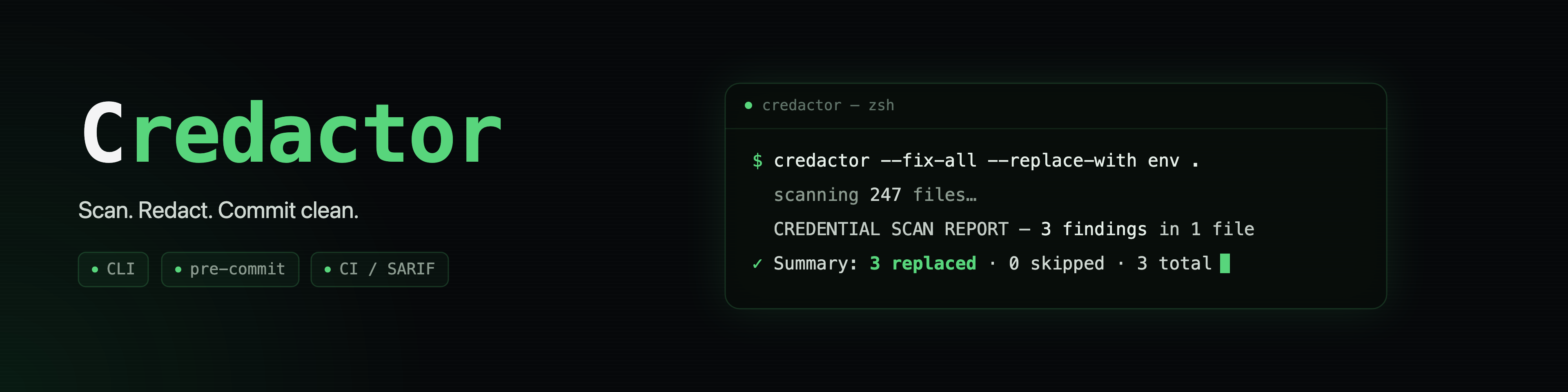
credactor --replace-with env .        # redact to env-var references instead of the sentinel
The hook gates staged content only, so a secret that is already committed is not re-flagged. Use
credactor --scan-history .to check what is already in the repo.
# .pre-commit-config.yaml
repos:
  - repo: https://github.com/rxb06/credactor
    rev: v2.7.4   # pin to the latest release tag
    hooks:
      - id: credactor
- uses: rxb06/[email protected]
The action always passes --ci, so it reports and gates but never rewrites the
checkout. Findings fail the step; set fail-on-findings: false to report
without gating. An error fails the step either way.
Upload to Code Scanning instead of failing on findings:
- uses: rxb06/[email protected]
  with:
    format: sarif
    upload-sarif: true
    fail-on-findings: false
The job needs permissions: security-events: write for the upload. See the
CI integration guide for every input,
including ingestion of Gitleaks, TruffleHog and Betterleaks reports.
Credactor detects the credential types that leak most often, and assigns each a severity so you can triage at a glance.
| Category | Examples | Severity |
|---|---|---|
| Cloud provider keys | AWS (AKIA…), GCP (AIza…), Stripe (sk_live_…), Slack (xoxb-…) | Critical |
| Platform tokens | GitHub (ghp_, github_pat_), GitLab (glpat-), npm (npm_), PyPI (pypi-) | Critical |
| Private keys | PEM blocks (-----BEGIN … PRIVATE KEY-----) | Critical |
| JWTs | eyJ… three-segment tokens | High |
| Connection strings | URLs with inline credentials (scheme://user:pass@host) | High |
| Credential variables | password = "…", api_key = "…", secret_key = "…" | High/Medium/Low |
| XML attributes | <add key="Password" value="…" /> | High/Medium/Low |
| High-entropy strings | quoted hex (32–64 chars) / Base64 (60+ chars) | Medium/Low |
Deterministic provider tokens (the prefixes above) are flagged regardless of entropy. Heuristic detectors (JWTs, connection strings, hex, Base64) must clear an entropy floor. Standalone hex or Base64 is flagged only when quoted. An unquoted high-entropy value is caught only on a credential-named variable, which spares git SHAs and checksums. For the full detection and severity rules, see the Manual.
Credactor's native rule set is narrower than a dedicated scanner's, and some provider formats (for example SendGrid, Twilio, and Slack webhooks) are not detected. Its edge is remediation: pair it with Gitleaks, TruffleHog or Betterleaks for the broadest detection, or run it on its own.
Credactor stands on its own, and it gets stronger in company. Already run Gitleaks, TruffleHog or Betterleaks? Pass their report to Credactor and it redacts the combined set, deduplicated against its own findings (on overlap, the higher severity wins). One remediation pass covers your scan and theirs:
gitleaks dir . -f json -r gitleaks.json
credactor --from-gitleaks gitleaks.json --fix-all --yes .

betterleaks dir . -f json -r betterleaks.json
credactor --from-betterleaks betterleaks.json --fix-all --yes .

